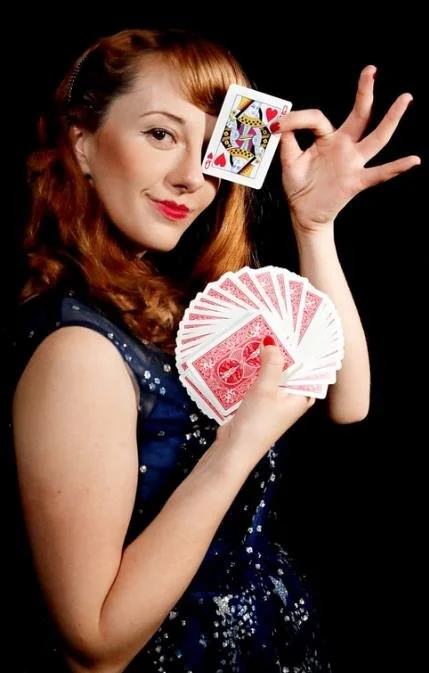


Female Magician Los Angeles for Women's Networks in Entertainment
Female Magician Los Angeles for Women's Networks in Entertainment
A women's network at a studio, an agency, a production company, or a streamer is programming for the hardest audience available: people who produce events professionally, have seen every speaker format, and can tell within two minutes whether something was put together properly.

That rules out most of what gets booked elsewhere. I'm Magical Katrina, an award winning magician and mentalist based right here in Los Angeles, and I want to set out what a female magician Los Angeles brings to a network event in this industry, starting with the part that isn't about gender.
Skill Decides It
Worth establishing first. Skill in magic and mentalism has nothing to do with gender, and you should book a female magician Los Angeles because she's genuinely excellent, assessed on the criteria you'd apply to anyone.
What follows is context. For a network in an industry with its own history on this subject, a woman doing something technically demanding at a high level in a field that has been overwhelmingly male carries the theme without framing. That's an addition on top of excellence rather than a reason by itself.
Production Won't Impress Them
Start with the thing that fails here and nowhere else as reliably. Your audience makes convincing things for a living, has attended events with budgets no internal network can approach, and is professionally immune to scale.
Spending more on production is therefore money spent on the element least likely to register. What large production structurally cannot deliver is intimacy: something impossible happening six inches from somebody's face, with no crew, no camera, and nothing between them and it. People who construct effects professionally frequently react hardest, because their usual explanations aren't available at that distance.
They've Seen Every Format
Worth accepting rather than working around. A panel, a fireside chat, a keynote, a workshop, and a networking hour are all familiar, and an audience that has attended hundreds of events evaluates yours against all of them.
That doesn't mean those formats can't work, and it means the content has to be genuinely good rather than structurally adequate. If you're choosing between a competent panel and something nobody in the room has seen before, the second is a better bet with this particular audience, since novelty is scarce for them and quality alone is not.
Attendance Competes With Production Schedules
The practical constraint specific to this industry. People are on set, in post, on location, or working to a release date, and their hours are neither predictable nor theirs.
That means an evening event loses a proportion of your intended audience to things they can't control. A lunchtime, an early evening that releases people rather than extending their day, or something scheduled in a quieter part of the production calendar performs considerably better. Ask the people you most want there when they could actually come, rather than picking a date and inviting them to it.
The Shared Ground Is Real
Worth using, since it's genuinely there. Magic has been overwhelmingly male throughout its modern history, and women working in it professionally have a version of an experience plenty of people in this room recognize from their own careers.
That's not a lecture and it doesn't need delivering as one. It's simply true, and it arrives with the performer rather than in a slide. For a network event, something demonstrating rather than describing that experience is a different proposition from a session about it, and it suits an audience skeptical of being told things.
Your Venue Is an Office or a Lot
Practically, these happen in a company's own space: a screening room, a commissary, an office floor, a lot, or a reserved restaurant section. None has entertainment facilities, and whatever production equipment exists is for work rather than events.
Close up magic needs no stage, power, sound, or setup, works in any of those exactly as it is, and requires nothing from a facilities team already managing a working building. For a network with a modest budget inside a company where booking a space is its own process, that simplicity matters.
Be Honest About What It Does
Worth saying, since this audience will notice overclaiming immediately. An event doesn't change how work is allocated, who gets promoted, or who gets hired, and presenting it as though it might invites exactly the skepticism this industry runs on.
What it does is produce a well attended hour that senior and junior women both enjoyed, contact between people who don't normally speak, and goodwill towards a network that has to keep earning attendance. Those are modest and real, and they're what makes the next event easier to fill.
Being Local Helps With a Moving Date
Worth mentioning, since dates shift here more than most places. Unlike a performer travelling in, I'm based right here in the LA area and serve all of Southern California, so there are no travel costs and no logistics to coordinate.
It also means flexibility when your date moves around a production schedule, which with this audience it frequently does, sometimes more than once.
Why Book Magical Katrina
If you run a network program, here's my case. I'm based in the LA area, I'm a member of the Magic Circle in London and the Academy of Magical Arts in Hollywood, I've earned multiple magic awards, and I've performed for clients including Formula 1, the Olympics, Porsche, and Prada, with appearances on Penn & Teller: Fool Us and Masters of Illusion, alongside work on Blippi as a performer and magic consultant. I understand production environments, I need no stage or setup, nobody is put on the spot, and there are no travel costs on your budget.
Frequently Asked Questions
Why won't production impress this audience?
Because they make convincing things for a living and have attended events with budgets no internal network can approach, which makes scale the element least likely to register. Intimacy is what large production can't deliver, and people who construct effects professionally frequently react hardest when their usual explanations aren't available.
They've seen every format. Does that matter?
It raises the bar rather than ruling formats out, since an audience that has attended hundreds of events evaluates yours against all of them. If you're choosing between a competent panel and something nobody has seen before, the second is a better bet here, since novelty is scarce for this audience and competence alone isn't.
When should we hold it?
When the people you most want there can actually come, which means asking them rather than picking a date and inviting them to it. Production schedules make hours unpredictable, so a lunchtime or an early evening that releases people rather than extending their day performs considerably better than a standard evening event.
Is there a natural connection to the theme?
A genuine one, since magic has been overwhelmingly male throughout its modern history and women working in it professionally have a version of an experience plenty of people in this room recognize. It arrives with the performer rather than in a slide, which suits an audience skeptical of being told things.
Will it work in our space?
Yes, since close up magic needs no stage, power, sound, or setup and works in a screening room, commissary, office floor, or reserved restaurant section exactly as it is. That matters when whatever production equipment exists is for work rather than events and booking a space is its own process.
What should we claim it achieves?
Something modest and true, since this audience notices overclaiming immediately. It won't change how work is allocated or who gets hired, and suggesting otherwise invites exactly the skepticism this industry runs on. A well attended hour people genuinely enjoyed is a real outcome.
Our date might move. Is that a problem?
Not with a local performer, since there are no flights to rearrange and no travel logistics, which matters in an industry where dates shift around production schedules, sometimes more than once. Tell me as soon as you know and we'll find another evening.
How do I book you, and what do you need to get started?
Reach out with your date, the venue or floor, expected numbers, and what the network is aiming at. That's enough for me to check availability, suggest a length, and send a quote, and being local means no travel costs and straightforward rescheduling if your date moves.

Give Them Something They Haven't Produced Themselves
A women's network in this industry is programming for people who make events professionally, which makes the usual options harder rather than impossible. A female magician Los Angeles offers the one thing a production budget can't buy: something impossible happening at conversational distance, to an audience whose expertise makes the experience stronger rather than weaker.
Ask the people you want there when they can come, keep the claims modest, and let the theme arrive with the performer rather than in the invitation.
Reach out with your date and what your network is aiming at, and let's talk about the format.