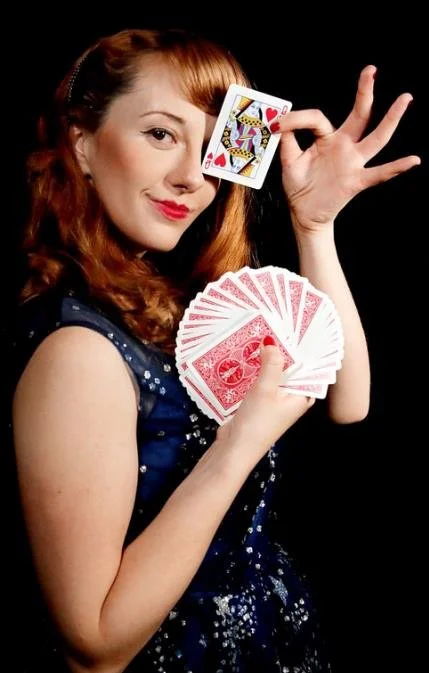


Female Mentalist for Board Dinners and Small Senior Gatherings
Female Mentalist for Board Dinners and Small Senior Gatherings
A dinner for twelve senior people is a harder room than a party of two hundred. Everybody knows everybody, the hierarchy in the room is entirely intact regardless of the hour, and anything that makes somebody look foolish is witnessed by the people who decide their future.

It's also where mentalism works better than almost anywhere. I'm Magical Katrina, an award winning magician and mentalist, and I want to set out what a female mentalist brings to a board dinner or a small senior gathering, and what governs the evening.
Skill Decides It
Worth establishing first. Skill in mentalism has nothing to do with gender, and you should book a female mentalist because she's genuinely excellent, assessed on the criteria you'd apply to anyone: sustained footage, experience with senior audiences, and professional communication.
What follows is distinctiveness, which at a dinner for people who've seen a great deal is a real consideration rather than a flourish. That's a bonus on top of genuine excellence rather than a reason on its own.
The Room Is Analytically Sharp
Start with why the format fits. A senior table contains people whose professional lives consist of evaluating claims, spotting weaknesses, and working out what's actually going on.
Traditional magic invites them to look for the method, which some will enjoy and others will treat as a puzzle to solve rather than an experience to have. Mentalism engages the same faculties differently: it doesn't present an object behaving impossibly, it presents something apparently known that couldn't be. For a room trained in skepticism, that's the version that lands, and the most skeptical person present usually reacts hardest.
Nobody Can Look Foolish
The constraint that governs everything. At a dinner where a chief executive, their direct reports, and a board member are present, a participant who's embarrassed has been embarrassed in front of people whose opinion materially affects them.
That rules out anything comedic at somebody's expense, anything requiring participants to perform, and anything that could expose a person who isn't quick or comfortable. A performer at this kind of dinner should be reading the room continuously and choosing accordingly. Ask directly how they handle senior participants and expect an answer reflecting experience rather than reassurance.
Some People Can't Be Chosen
Worth briefing specifically, since it isn't visible in the room. A guest of honor, a client, an incoming chair, or somebody having a difficult time professionally may all be people who should be left alone, for reasons a performer can't guess.
Tell them in advance and it's handled invisibly. Equally, mention anybody who'd genuinely enjoy being the center of a moment, since at a senior table that's frequently the person nobody expects. Two minutes of briefing is the difference between an evening worked intelligently and one worked by reading faces.
Discretion Is a Condition
Worth establishing at booking. A board dinner or partner dinner involves people discussing things that aren't public, and a supplier present for part of the evening is in the room for some of it.
No photographs, no social media, no mention of who attended, and no lingering. Any performer who works at this level treats that as standard, and it's still worth confirming explicitly alongside insurance and terms. If your organization requires a confidentiality agreement, say so early rather than producing one on the night.
Private Dining Rooms Have Nothing
The practical reality. These dinners happen in restaurant private rooms, club rooms, boardrooms, and occasionally somebody's home, none of which has a stage, a sound system, or space to spare.
Close up mentalism needs none of it, works around a table exactly as it is, and requires no slot in an evening that's built around conversation. For a dinner where the point is people talking to each other, entertainment that arrives between courses and leaves them talking is the only kind that fits.

Small Is the Advantage
Worth stating, since organizers assume otherwise. Mentalism improves as the group shrinks, since everybody sees everything from a few feet away and the whole table shares each moment rather than hearing about it afterwards.
Twelve people around a table is closer to ideal than to too small. If you've assumed a senior dinner doesn't justify a performer because of the numbers, the reverse is nearer the truth: you're getting the version of this that works best.
It Gives a Dinner a Middle
The practical function. A dinner for twelve has a predictable arc: arrival, seating, a first course of general conversation, and then either a genuinely good evening or a polite one that ends early.
Something between courses changes the second half, since a table that has reacted to something together talks differently afterwards. That's particularly useful at a dinner where the objective is relationships rather than business, which describes most board and partner dinners. It also gives people something to discuss that isn't work, which at that table is a scarcer commodity than you'd think.
A Note on "Local vs. Traveling In"
Worth knowing: there are relatively few women working professionally in mentalism, so restricting your search geographically shrinks an already small pool. Many travel in, with travel discussed openly and factored into the quote. I'm based in the Los Angeles area and travel for corporate and private dinners.
Why Book Magical Katrina
If you're planning a senior dinner, here's my case. I'm a member of the Magic Circle in London and the Academy of Magical Arts in Hollywood, I've earned multiple magic awards, and I've performed for clients including Formula 1, the Olympics, Porsche, Prada, and the Ritz Carlton, with appearances on Penn & Teller: Fool Us and Masters of Illusion. I work small senior rooms regularly, nobody is put on the spot or made the joke, I treat discretion as a condition rather than a courtesy, and I need no stage, sound, or program time.
Frequently Asked Questions
Why does mentalism suit a senior room?
Because it engages skepticism differently. A senior table contains people whose professional lives consist of evaluating claims and spotting weaknesses, and traditional magic invites them to look for the method, whereas mentalism presents something apparently known that couldn't be. The most skeptical person present usually reacts hardest.
What's the main risk at this kind of dinner?
Somebody looking foolish, since a participant embarrassed at a table including their chief executive and a board member has been embarrassed in front of people whose opinion materially affects them. That rules out anything comedic at somebody's expense or requiring participants to perform.
Can we ask for certain people to be left alone?
Yes, and you should, since a guest of honor, a client, an incoming chair, or somebody having a difficult time professionally may all need leaving alone for reasons a performer can't guess. Tell them in advance and it's handled invisibly, and mention anybody who'd genuinely enjoy a moment too.
How is confidentiality handled?
As a condition rather than a courtesy, since these dinners involve people discussing things that aren't public. No photographs, no social media, no mention of who attended, and no lingering. If your organization requires a confidentiality agreement, say so early rather than producing one on the night.
Our private dining room has no facilities. Does that matter?
No, and it's the usual situation across restaurant private rooms, club rooms, and boardrooms. Close up mentalism needs no stage, sound, or space to spare, works around a table exactly as it is, and requires no slot in an evening built around conversation.
Is twelve people too few?
Closer to ideal than too small, since mentalism improves as the group shrinks, with everybody seeing everything from a few feet away and the whole table sharing each moment rather than hearing about it. If you assumed the numbers didn't justify it, the reverse is nearer the truth.
What does it actually do for the evening?
Gives it a middle, since a dinner for twelve either becomes a genuinely good evening or a polite one that ends early. A table that has reacted to something together talks differently afterwards, which matters at a dinner where the objective is relationships, and it supplies a subject that isn't work.
How do I book you, and what should I tell you?
Reach out with your date, the venue, numbers, and the seniority of the group, plus anyone who should be left alone and anyone who'd enjoy a moment. That's enough for me to check availability and send a quote, and the briefing is what lets me work the table intelligently rather than by reading faces.

The Smallest Rooms Are the Best Ones
A board dinner is a demanding room and an ideal one: sharp enough that being genuinely fooled means something, small enough that everybody shares each moment, and constrained enough that judgement matters more than material. A female mentalist working a table of twelve is doing the version of this that works best, provided nobody is put on the spot and the briefing is honest about who's who.
Give them that briefing, treat discretion as a condition, and the evening does the thing a dinner for relationships is supposed to do.
Reach out with your date and who'll be at the table, and let's talk about the evening.