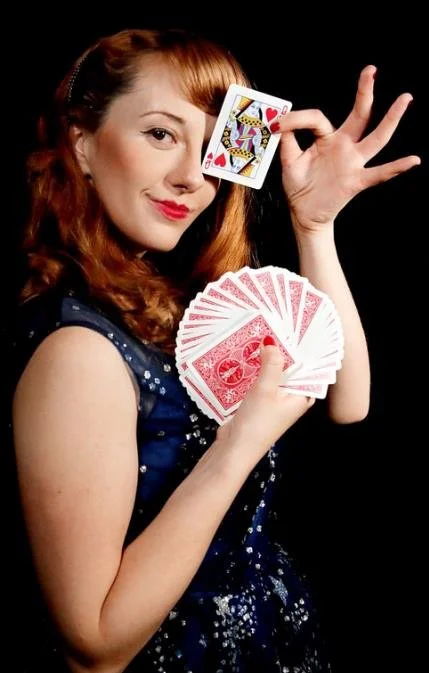


Illusionist NYC for Gallery Openings and Art World Events
Illusionist NYC for Gallery Openings and Art World Events
An art event has a rule the rest of the events industry doesn't: nothing in the room may compete with what's on the walls. Gallery openings, auction previews, and fair receptions exist so that people look at work and talk to each other about it, and anything demanding attention away from that has misunderstood the evening.

Which makes this a careful brief rather than an impossible one. I'm Magical Katrina, an award winning magician and mentalist, and I want to set out what an illusionist NYC booking does at an art world event, and the conditions it has to meet.
The Work Comes First, Always
Start with the constraint that governs everything. Your guests came to see the exhibition, the lots, or the booth, and the programming exists to support that rather than to be the reason anybody is there.
That rules out anything scheduled, amplified, or staged, since all three ask the room to stop looking and start watching. Something moving quietly through a space works because it never makes that demand: guests encounter it in the group they're standing in, and return to the work when they choose. If a format can't operate on those terms, it doesn't belong at an opening.
Tone Is the Whole Question
Worth being direct about, since this audience reads it instantly. An art crowd will forgive almost anything except the wrong register, and entertainment pitched even slightly broad reflects on the gallery, the house, or the brand hosting it.
Magic can be elegant and quiet, performed close and conversationally for four people at a time, or it can be none of those things. Ask to see footage of a performer working rooms like yours and ask directly how they'd pitch the tone for your evening. Somebody who works these spaces will answer that immediately, and the answer tells you whether to continue the conversation.
Collectors and Press Are Working
Worth considering, since this isn't a leisure audience. A collector is assessing, a dealer is in the middle of a conversation that matters commercially, and a critic is forming a view they'll publish.
A performer who works these rooms reads that and leaves it alone. The right moment is the guest standing slightly apart, the partner who came along and isn't engaged with the work, or the group between conversations, never the pair in discussion about a piece. That judgment is the actual skill in this setting, and it's worth asking about explicitly.
Your Team Needs Openings Too
Practically the most useful function. Gallery and auction staff spend these evenings trying to begin conversations with specific people, and approaching a stranger looking at a painting is awkward for everybody.
Something that happens in the room creates a natural route in, since two people who just reacted to the same thing have an obvious first sentence. For an evening whose commercial purpose is relationships with collectors and clients, that's substantive rather than decorative, and it's why strolling outperforms anything staged here.
Guests Arrive Across Two Hours
Worth planning for, particularly in New York. People come from other openings, from work, from dinner, and from across a city where nothing runs to time, so a six to eight event fills at seven and empties unevenly.
Something that begins with whoever is present and continues as the room changes suits that exactly. Early guests are looked after rather than standing in a thin room, and later arrivals encounter the same evening. Nothing at an art event should be scheduled for a single moment, because a third of your list will be elsewhere when it happens.
Galleries Have Nothing and Can Spare Nothing
Practically relevant for format. A Chelsea gallery, a Tribeca loft, an auction house viewing room, or a fair booth has no stage, no sound, limited power, and very strict rules about what may be placed where.
Close up magic needs none of it and introduces nothing to the room: no stand, no cable, no case left in a corner, nothing near the work. For a space where the installation is the point and the insurance conditions are real, entertainment with no physical footprint is the only version that gets approved.

Discretion Is Expected Here Too
Worth confirming when booking. Collectors frequently prefer their attendance and their interest to stay private, and conversations at a preview concern money and provenance in ways that don't belong on anybody's social media.
A performer who doesn't photograph guests, doesn't post about the evening, and doesn't trade on who was in the room afterwards is the baseline rather than the differentiator. Ask the question before you book, since an evening that appears online the next morning is a problem for the host rather than for the performer.
Fair Weeks Book Out Early
The scheduling reality. New York's art calendar concentrates sharply around fair weeks and the main auction seasons, and during those stretches every venue, caterer, and performer in the city is committed.
If your event falls in one of those weeks, arrange it months ahead. If you're programming a regular opening schedule rather than a single evening, it's usually simpler to set several dates at once than to arrange each one as it comes.
A Note on "Local vs. Traveling In"
Worth knowing: I'm based in the Los Angeles area and travel to New York regularly for corporate and brand events. Travel is discussed openly and factored into the quote rather than being your problem to arrange, and for fair weeks and the autumn season it's worth asking early.
Why Book Magical Katrina
If you're programming an art world evening, here's my case. I'm a member of the Magic Circle in London and the Academy of Magical Arts in Hollywood, I've earned multiple magic awards, and I've performed for clients including Prada, Porsche, Formula 1, the Olympics, and the Ritz Carlton, with appearances on Penn & Teller: Fool Us and Masters of Illusion. I work luxury and brand rooms regularly and pitch the tone to match, I bring nothing into the space and leave nothing in it, I read a conversation that shouldn't be interrupted, and I don't photograph guests or post about the evening.
Frequently Asked Questions
Won't entertainment compete with the exhibition?
Not in the right format. Anything scheduled, amplified, or staged asks the room to stop looking, whereas something moving quietly through the space is encountered in the group a guest is already standing in and left behind when they want to return to the work.
How do we know the tone will be right?
Ask to see footage of the performer in rooms like yours and ask directly how they'd pitch it. An art crowd forgives almost anything except the wrong register, and entertainment pitched slightly broad reflects on whoever is hosting, so somebody who works these spaces will answer immediately.
Our guests are collectors and press. Is that a problem?
It's the reason to choose carefully. They're working rather than relaxing, so the right moment is the guest standing apart or the partner who isn't engaged with the work, never the pair discussing a piece, and that judgment is the real skill here.
What does it do for our team?
It creates openings, since approaching a stranger looking at a painting is awkward and two people who just reacted to the same thing have an obvious first sentence. For an evening whose purpose is relationships with collectors, that's substantive.
Our guests arrive across the whole evening. Does that matter?
It's normal in New York and worth planning for, since people come from other openings and from across a city where nothing runs to time. Something starting with whoever is present means early guests are looked after and later ones get the same evening.
Will it work in a gallery?
Yes, because close up magic introduces nothing to the room: no stage, no sound, no stand, no cable, nothing near the work. For a space where the installation is the point and the insurance conditions are real, no physical footprint is what gets approved.
How is discretion handled?
By not photographing guests, not posting about the evening, and not trading on who attended. Collectors frequently prefer their attendance and their interest to stay private, so that's the baseline rather than a differentiator, and it's worth confirming before you book.
When should we book?
Months ahead for fair weeks and the main auction seasons, when every venue, caterer, and performer in the city is committed. For a regular opening schedule it's usually simpler to set several dates at once than to arrange each evening as it arrives.

Support the Evening, Don't Compete With It
An art event succeeds if people looked properly at the work and your team had the conversations they needed. An illusionist NYC booking fits that only on specific terms: nothing staged, nothing amplified, nothing placed in the room, nothing that interrupts a collector mid conversation, and a register that matches whoever is hosting.
Meet those conditions and it does real work: it holds the room longer, gives your staff a way into a conversation with somebody they'd otherwise approach cold, and looks after the guest who came along and isn't looking at the art.
Reach out with your date, the space, and a sense of the evening, and I'll tell you how I'd pitch it.