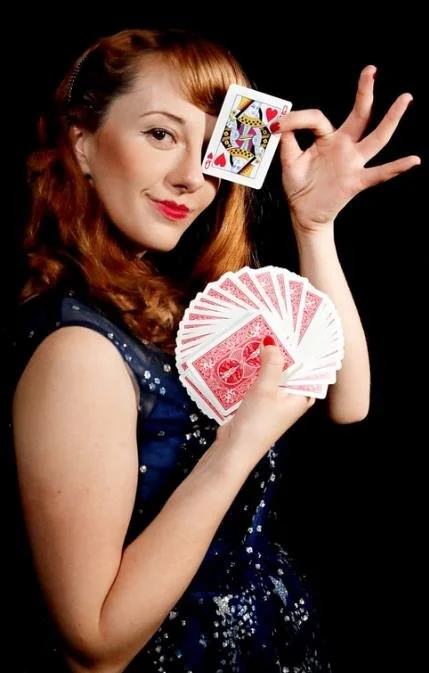


London Magician: Booking a Keynote Speaker for Your Conference or Company Event
London Magician: Booking a Keynote Speaker for Your Conference or Company Event
Most people searching for a London magician want entertainment: a drinks reception, a summer party, a client evening. That's a legitimate booking and it isn't what this page is about.

This is about the keynote, which is a different product entirely. I'm Magical Katrina, an award winning magician and mentalist and a member of the Magic Circle here in London, and I want to explain what a magic led keynote involves, why it suits a London audience, and how to judge whether it fits your program.
A Speaker Who Uses Magic
Worth establishing immediately, since both versions exist and the marketing rarely distinguishes them. One is an entertainer who adds remarks about resilience at the end, which audiences recognize instantly and quietly discount.
The other is a keynote with genuine content, where the magic is the delivery mechanism rather than the interval. Ideas are demonstrated rather than described, points are proven on the audience rather than asserted at them, and the argument and the performance are the same object. Ask any speaker you're considering which of the two they're offering, because the difference is substantial and the description frequently isn't.
London's Speaking Market Is Crowded
The context worth acknowledging. London has an enormous professional speaking circuit, and delegates at a conference here have sat through a great many competent talks by credible people with good slides.
That makes differentiation genuinely hard, and it means a keynote booked purely on credentials arrives into a room that has heard someone similar before. What holds a London audience isn't authority, which they've seen plenty of, it's unpredictability. A London magician delivering a keynote is doing something the room hasn't got a template for, which is worth more in a saturated market than another impressive biography.
Your Audience Is Trained to Evaluate
The second local factor. London corporate and conference rooms are full of people from finance, law, consulting, and professional services, whose working lives consist of examining claims, finding the weakness, and not accepting propositions at face value.
That's a poor audience for a conventional keynote, since they'll assess rather than absorb, and an unusually good one for a keynote that demonstrates. The evidence becomes their own experience rather than the speaker's credentials, and a room applying genuine scrutiny that still cannot account for what happened is more affected than a casual one, not less.
Demonstration Beats Assertion
The mechanism underneath the format. A conventional keynote asserts things: that perception is unreliable, that attention is narrower than people assume, that expectation shapes what an audience notices before anyone has spoken.
A magic led keynote demonstrates them in real time, using what just happened to the audience as the evidence. Delegates don't accept the point because it was argued well, they accept it because they experienced it. Among reasons to book a London magician as a speaker rather than as entertainment, that difference in how an argument lands is the substantive one.
What the Talk Covers
A keynote needs subject matter rather than only a device. My talks draw on building a career in an unusual field and cover areas including marketing and attention, entrepreneurship and building something without a template, communication and how people actually receive information, and ADHD and working with the way your own mind operates.
Those are shaped to the audience and the brief rather than delivered as fixed sets, and the right emphasis depends on who's in the room. If your event has a theme, tell me at the enquiry stage and I'll tell you honestly whether I can serve it well or whether you need a different speaker.
London Venues Restrict Production
Practically relevant here more than in most cities. A great many London events happen in historic buildings, livery halls, listed interiors, and converted spaces where nothing can be fixed to walls, amplified sound is limited, and production requirements meet a policy list.
A keynote needs a microphone and the staging your other speakers are already using, with no additional rigging, no special lighting, no technical rehearsal beyond a normal sound check, and nothing added to your production budget. That means it works in rooms that couldn't accommodate a staged performance, which widens where you can program it considerably.
Where It Sits in a Program
The difficult slots are where it earns most. The opening session, where it establishes that this event isn't the usual sequence of presentations.
The post lunch stretch, where attention reliably collapses and a conventional speaker struggles hardest. The closing address, where it sends delegates away with something they'll describe rather than a summary they'll forget. And the second morning of a multi day event, where attendance itself dips. Among placements for a London magician speaking rather than performing, anywhere a conventional talk would struggle is where this has the clearest advantage.
The Magic Circle Connection
Worth mentioning, since it's genuine rather than decorative. I'm a member of the Magic Circle, the world's most prestigious magic society, which is headquartered in London, and that's a real tie to the city's magic world rather than a credential quoted from elsewhere.
For a keynote it matters mainly as evidence that the performance side is serious, since a talk built on demonstration depends entirely on the demonstration being genuinely good. A keynote where the magic is mediocre doesn't work, however strong the content, and credentials are one way of establishing that the foundation is sound.

When Another Speaker Suits Better
Worth saying honestly. If your keynote needs detailed technical content, sector specific analysis, or a particular expert credential, you need a subject matter expert rather than a speaker whose expertise lies elsewhere.
If your event is purely social, book entertainment instead, since nobody at a reception wants a message delivered at them. And if your program has no slot and no seated audience, a keynote has nowhere to go. I'd rather establish that at the enquiry stage than take a booking that's wrong for the brief.
A Note on "Local vs. Traveling In"
Worth knowing: I'm based in the Los Angeles area and travel to London for conferences and corporate events, with travel discussed openly and factored into the quote rather than appearing later. Speaking slots are usually fixed well in advance, so early enquiries genuinely help.
Why Book Magical Katrina
If you're considering a keynote, here's my case. I'm a member of the Magic Circle in London and the Academy of Magical Arts in Hollywood, I've earned multiple magic awards, and I've performed and spoken for organizations including Formula 1, the Olympics, Porsche, Prada, and the Ritz Carlton, with appearances on Penn & Teller: Fool Us and Masters of Illusion, across events in over 20 countries. I write to the brief rather than delivering a fixed set, I need only the staging your other speakers use, and I'll tell you honestly if another speaker would serve your theme better.
Frequently Asked Questions
Is this a keynote or a magic show?
A keynote, with magic as the delivery mechanism rather than the interval. There's a version that's an entertainer adding remarks about resilience at the end, which audiences recognize and discount immediately. The version worth booking has genuine content where the argument and the performance are the same object, so ask any speaker which they're offering.
Why does it suit a London audience?
Because the speaking circuit here is crowded and delegates have sat through a great many competent talks by credible people, so authority doesn't differentiate. It also suits rooms full of finance, law, and consulting professionals trained to examine claims and find the weakness, since a demonstrated keynote makes the evidence their own experience rather than the speaker's credentials.
What does the talk actually cover?
Material drawn from building a career in an unusual field: marketing and attention, entrepreneurship and building without a template, communication and how people receive information, and ADHD and working with how your own mind operates. These are shaped to the audience and brief rather than delivered as fixed sets, so tell me your theme and I'll say whether I can serve it.
What does it need from our venue?
A microphone and the staging your other speakers are already using, with no additional rigging, special lighting, technical rehearsal beyond a sound check, or anything added to your production budget. That matters in London where many events are in historic and listed buildings with policy lists, and it means the talk works in rooms that couldn't host a staged performance.
Where should it sit in our program?
Wherever a conventional speaker would struggle: the opening session to establish this isn't the usual sequence, the post lunch stretch where attention collapses, the closing address so delegates leave with something they'll describe, or the second morning of a multi day event where attendance dips. The difficult slots are where this format has the clearest advantage.
Does the Magic Circle membership matter for a keynote?
Mainly as evidence that the performance side is serious, since a talk built on demonstration depends entirely on the demonstration being genuinely good. A keynote where the magic is mediocre doesn't work however strong the content. It's also a real tie to London's magic world rather than a credential quoted from elsewhere, the society being headquartered here.
When would you tell us to book someone else?
When your keynote needs detailed technical content, sector specific analysis, or an expert credential I don't have, when your event is purely social and entertainment would serve better, or when your program has no slot and no seated audience. I'd rather establish that at the enquiry stage than take a booking that's wrong for the brief.

A Keynote in a Market Full of Keynotes
London delegates have heard a great many good speakers, which makes credentials a weak differentiator and unpredictability a strong one. Booking a London magician as a keynote speaker rather than as entertainment addresses that: a room that can't anticipate what's coming, points demonstrated on an audience trained to evaluate rather than asserted at them, a message that survives past the following week, and nothing your venue has to accommodate.
If you have a difficult slot or something you need to land, I'd be glad to hear what you're planning.
Reach out with your dates and theme, and let's talk about the room.