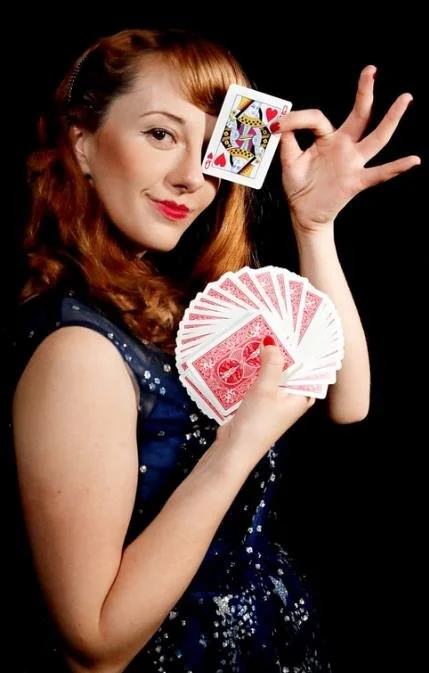


Illusionist NYC for Finance and Professional Services Client Events
Illusionist NYC for Finance and Professional Services Client
Client entertaining in finance, law, and consulting has a particular character. The groups are small and senior, the conversations matter, the relationships are worth a great deal, and the evening exists to advance something rather than to be enjoyable in itself.

That makes entertainment a more delicate proposition than it is at a company party. I'm Magical Katrina, an award winning magician and mentalist, and I want to explain what an illusionist NYC firms book brings to a client evening in this sector, and what these events genuinely require.
Small and Senior Is the Format
Start with the shape, since it rules out most options. These evenings are typically eight to twenty people, senior on both sides, over dinner or drinks in a private room.
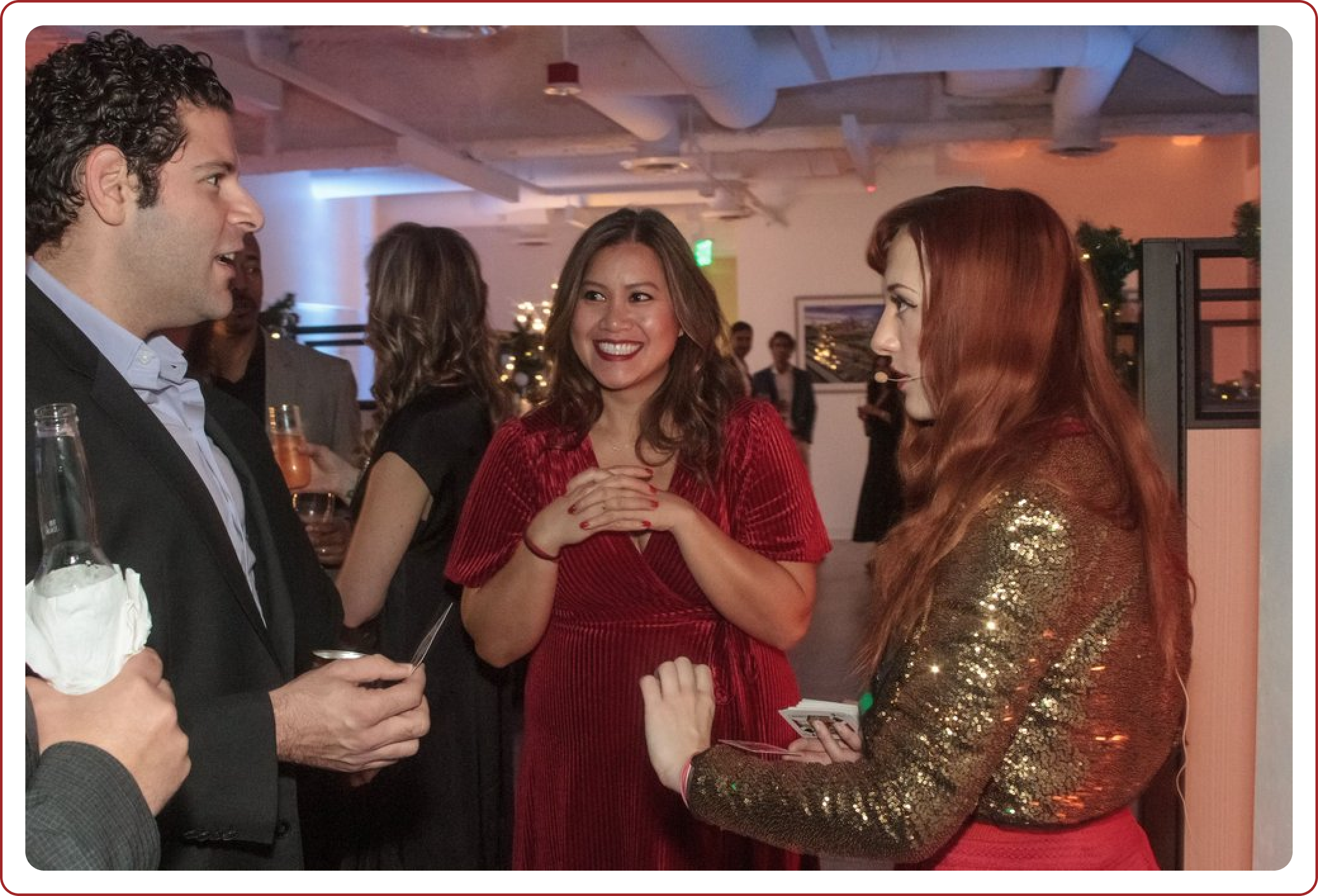
Almost all performance entertainment is designed for scale and fails badly at that headcount: a band makes no sense, a comedian for twelve is uncomfortable, and anything asking for participation risks a managing director being asked to do something undignified. Close up magic is the exception, since it's built for exactly this, performed at conversational distance for a handful of people at a time and improving as the group shrinks.
Discretion Is a Requirement
Worth stating first among the practical considerations, since in this sector it's non negotiable. These evenings involve people whose attendance isn't advertised, conversations that aren't public, and firms that would rather the occasion wasn't discussed elsewhere.
Any supplier at that table should treat that as a condition of the booking: no photographs, no social media, no mention of who was present, and no lingering after the engagement ends. An illusionist NYC firms use at this level understands it without being asked, and it's worth confirming explicitly at booking alongside insurance and terms rather than assuming.
Nobody Can Be Made to Look Foolish
The risk that makes firms hesitate, and correctly. A senior client cannot be embarrassed in front of peers, competitors, or their own team, and a performer who doesn't grasp that will produce an evening your relationship managers spend months recovering from.
Done properly, a participant becomes the person something extraordinary happened to rather than the subject of anything. Nobody is put on the spot without an easy exit. Ask directly how a performer handles senior participants, and expect an answer that reflects experience rather than reassurance, since at this kind of event it's genuinely the only thing that can go badly wrong.
Your Guests Assess Everything
Worth knowing, since it determines what lands. People in finance, law, and consulting are trained to evaluate claims, find the weakness, and not accept what they're shown at face value, and they apply that instinctively rather than deliberately.
That makes them a demanding audience for most entertainment and an unusually good one for skilled mentalism. Someone applying genuine analytical attention who still cannot account for what happened experiences it more forcefully than a casual observer, because their certainty was better founded. The guest who arrived most confident they'd work it out is generally the one still discussing it at the end.
The Objective Is the Relationship
Worth being clear about what you're buying. A client dinner in this sector is a business expense justified by what happens afterwards rather than by the evening itself, and entertainment either serves that or is decoration.
What serves it is anything that moves the evening from formal to human faster. These dinners begin carefully, with both sides slightly performing and aware of the commercial relationship underneath, and everything valuable happens after that dissolves. Genuine astonishment produces an unguarded reaction from people who spend their working lives composed, which arrives an hour earlier than the wine would manage.
It Gives Them Something to Recount
The commercial mechanism, stated plainly. What a firm wants from client hospitality is that it comes up in a conversation nobody from the firm is present for.
An excellent dinner rarely achieves that, because there's nothing specific to describe. An evening where something genuinely inexplicable happened at the table produces a story a client tells colleagues, with your firm attached every time. Among reasons to book an illusionist NYC for client entertaining, that downstream reach is the one that justifies the line in a sector where hospitality budgets are scrutinized.
It Suits the Venues These Evenings Use
Practically relevant. Client dinners in New York happen in restaurant private rooms, members clubs, firm dining rooms, and occasionally an office floor, and those spaces have no stage, no available sound system, and no space to spare.
That eliminates nearly every alternative. Close up magic needs no stage, power, sound, or setup, works at a table between courses without altering service, and requires nothing from a building with its own rules about what suppliers may bring in. For a firm hosting somewhere characterful rather than somewhere equipped, that flexibility is what makes entertainment possible at all.
Keep It Proportionate
Worth saying, since the instinct to over program exists. These evenings are primarily conversation, and entertainment should punctuate rather than dominate.
Twenty minutes to forty across a dinner, worked between courses, is generally right. A performer who understands the setting stops when the conversation is going well and returns when it flags, which requires judgement rather than a running order. If a performer wants a fixed slot and the room's full attention, they've misread what a client dinner is, and it's worth establishing that expectation before the evening rather than during it.
A Note on "Local vs. Traveling In"
Worth knowing: performers who travel to New York work from a different calendar than those based there, so a date that's impossible locally is sometimes straightforward for someone travelling. I'm based in the Los Angeles area and travel to New York for corporate and client events, with travel discussed openly and factored into the quote rather than appearing later.
Why Book Magical Katrina
If you're hosting clients in this sector, here's my case. I'm a member of the Magic Circle in London and the Academy of Magical Arts in Hollywood, I've earned multiple magic awards, and I've performed for clients including Formula 1, the Olympics, Porsche, Prada, and the Ritz Carlton, with appearances on Penn & Teller: Fool Us and Masters of Illusion. I work particularly well with small senior groups, I blend close up magic with mentalism, which suits a sharp analytical room, I treat participants carefully so nobody is ever the joke, and I understand that discretion is a condition rather than a courtesy.
Frequently Asked Questions
Our dinner is twelve people. Does entertainment make sense?
More than at scale, which surprises people. Almost all performance entertainment is designed for a crowd and fails badly at that headcount, whereas close up magic is built for exactly this, performed at conversational distance for a handful at a time. A band makes no sense for twelve and a comedian is uncomfortable, but this improves as the group shrinks.
How is discretion handled?
As a condition of the booking rather than a courtesy. No photographs, no social media, no mention of who was present, and no lingering after the engagement ends. An illusionist NYC working at this level understands that without being asked, and it's worth confirming explicitly at booking alongside insurance and terms rather than assuming it's understood.
Could a senior client be embarrassed?
Not with a performer who understands the requirement, and it's the only thing that can genuinely go wrong at this kind of event. A participant should become the person something extraordinary happened to rather than the subject of anything, with nobody put on the spot without an easy exit. Ask directly how they handle senior participants and expect experience rather than reassurance.
Will guests who assess things professionally enjoy it?
More than most audiences. People in finance, law, and consulting are trained to evaluate claims and find the weakness, and they apply that instinctively, so someone giving genuine analytical attention who still cannot account for what happened is more affected than a casual observer. The guest most confident they'd work it out is usually the one still discussing it.
How does it help the business relationship?
By moving the evening from formal to human faster. These dinners begin carefully with both sides slightly performing, and everything valuable happens after that dissolves. Genuine astonishment produces an unguarded reaction from people who spend their working lives composed, which arrives an hour earlier than it otherwise would, leaving more of the evening for the conversation that matters.
How long should it run?
Twenty to forty minutes across a dinner, worked between courses, since these evenings are primarily conversation and entertainment should punctuate rather than dominate. A performer who understands the setting stops when conversation is going well and returns when it flags. Anyone wanting a fixed slot and the room's full attention has misread what a client dinner is.
Will it work at our venue?
Almost certainly, since client dinners here happen in restaurant private rooms, members clubs, firm dining rooms, and offices, which have no stage, no available sound, and no space to spare. Close up magic needs none of it, works at a table between courses without altering service, and requires nothing from a building with its own rules about supplier equipment.
How do I book you, and what do you need to get started?
Reach out with your date, the venue, how many will attend, and whether it's clients, prospects, or a mixed group. That's enough for me to check availability and send a quote including travel. Mention anything sensitive about the group or the evening, and I'll confirm discretion terms in writing alongside everything else.

An Evening That Does Its Job
Client entertaining in finance and professional services is judged by what follows rather than by the evening itself, and the room is small, senior, professionally skeptical, and expecting discretion. An illusionist NYC working close up fits those requirements precisely: built for twelve rather than two hundred, effective on people who assess for a living, careful with participants who can't be embarrassed, and requiring nothing from a private dining room.
And it gives your clients something to recount, which is the only part of the evening that reaches the people who weren't there.
Reach out with your date and group, and let's make the evening worth their time.