


Female Mentalist for Weddings: What It Adds and What to Watch
Female Mentalist for Weddings: What It Adds and What to Watch
Couples considering entertainment for a reception usually think about magic, and mentalism is a slightly different proposition. It produces a quieter, stranger reaction than magic does, it suits an adult room, and it carries one consideration that matters more at a wedding than anywhere else.

Worth understanding before you book either. I'm Magical Katrina, an award winning magician and mentalist, and I want to set out what a female mentalist adds to a wedding reception, and the thing to brief carefully.
Skill Decides It
Worth establishing first. Skill in mentalism has nothing to do with gender, and you should book a female mentalist because she's genuinely excellent, assessed on exactly the criteria you'd apply to anyone: sustained footage, wedding experience, and professional communication.
What follows is distinctiveness, which at a wedding is a real consideration since your guests have attended a great many and the format rarely varies. That's a bonus on top of genuine excellence rather than a reason by itself.
It Produces a Different Reaction
Start with what distinguishes it. Magic delights: an object behaves impossibly, people laugh, and the reaction is warm and immediate.
Mentalism unsettles gently: somebody appears to know what a guest is thinking, and the reaction is quieter, slower, and frequently more memorable. At a wedding reception, where the day is already full of warmth, that change of register is noticeable. Guests who've seen magic at three weddings have usually not seen this.
Adults Respond to It Particularly
Worth knowing when choosing. A wedding reception is largely an adult room, and mentalism engages people intellectually as well as producing astonishment, which suits that audience better than it suits children.
If you have a lot of children at your wedding, a performer who blends both is the better booking, since mentalism alone can go over younger guests. Ask what the mix would be for your room rather than assuming, since most performers who do this work adjust across a reception naturally.
The Couple Moment Is Worth Asking For
The thing couples remember. A moment built around the two of you, where something impossible involves you both while your guests watch, is a different kind of wedding memory from a performance everybody observed.
Mentalism suits that particularly, since it can be built around things specific to you rather than being a general effect performed in your direction. Tell your performer a little about the two of you when you book, and whether you'd enjoy being the centre of something or would find it excruciating, since couples vary enormously.
Brief the Family Situation Honestly
The caution that matters more at a wedding than at any other event. A wedding room contains family history a performer cannot see: a divorce, an estrangement, a recent loss, a complicated relationship between two tables.
A mentalist asking about relationships, names, or people somebody is thinking of is operating close to that without knowing it. Tell them what they need to avoid, including anybody who shouldn't be approached and any subject to stay away from. Ten minutes of honest briefing prevents the one awkward moment that would otherwise be remembered.
Mention Anybody Grieving
Worth separating, since it's the most common version and the easiest to get wrong. A great many weddings include somebody who has recently lost a partner, a parent who isn't there, or a family member whose absence is felt by everybody.
Tell the performer. Anything touching on absent people, memories, or who somebody is thinking of needs steering well clear of that, and a professional will handle it invisibly once they know. Without knowing, they're performing in a minefield they can't see, and the risk is entirely preventable with one sentence.
The Reception Is the Slot
Practically, the drinks reception during photographs is where this earns most. Guests are standing, waiting, and talking to whoever they arrived with, and there's typically an hour with nothing programmed.
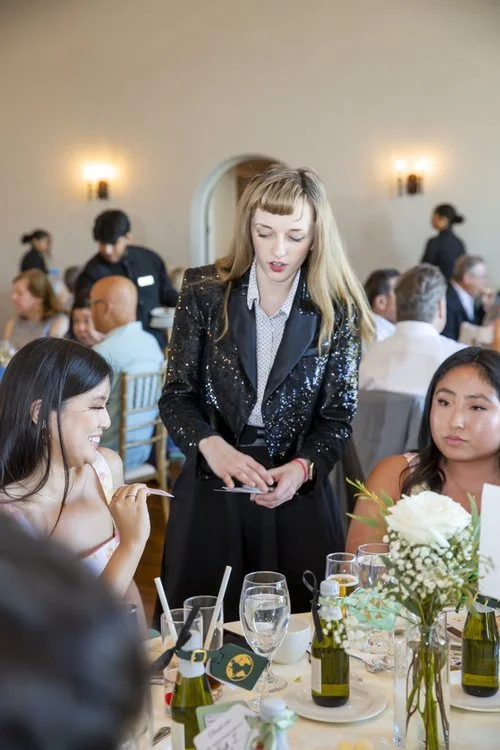
A female mentalist working that hour means guests who travelled and know half the room have something to do, and it mixes two families who otherwise stay on their own sides. It also needs no stage, sound, or slot in a schedule already containing a ceremony, photographs, a meal, speeches, and dancing.
It Works Between Courses Too
Worth knowing if your day is seated. A wedding breakfast has natural gaps while plates are cleared, and a performer working tables during service reaches a defined group properly rather than catching people in passing.
That's particularly useful at a long seated meal where guests are with the same eight people for two hours, since it gives each table something shared. It also means the tables furthest from the top table get attention, which at a wedding they otherwise frequently don't.
Why Book Magical Katrina
If you'd like a female mentalist at your wedding, here's my case. I'm a member of the Magic Circle in London and the Academy of Magical Arts in Hollywood, I've earned multiple magic awards, and I've performed for clients including Formula 1, the Olympics, Porsche, and Prada, with appearances on Penn & Teller: Fool Us and Masters of Illusion. I blend mentalism with close up magic so a mixed room is covered, nobody is put on the spot, I brief carefully on family situations, and I need no stage, sound, or time from your schedule.
Frequently Asked Questions
How is mentalism different from magic at a wedding?
It produces a different reaction. Magic delights, with an object behaving impossibly and a warm immediate response, whereas mentalism unsettles gently, with somebody appearing to know what a guest is thinking, producing something quieter and frequently more memorable. Guests who've seen magic at three weddings usually haven't seen this.
Does it suit all guests?
It suits an adult room particularly, since it engages people intellectually as well as astonishing them, and mentalism alone can go over younger guests. If you have a lot of children, a performer who blends both is the better booking, so ask what the mix would be for your room.
Can you do something for just the two of us?
Yes, and it's worth asking for, since a moment built around you both while guests watch is a different memory from a performance everybody observed. Mentalism suits that particularly, and tell your performer whether you'd enjoy being the center of something or would find it excruciating.
What should we brief about the family?
Anything a performer cannot see: a divorce, an estrangement, a complicated relationship between two tables, and anybody who shouldn't be approached. A mentalist asking about relationships or people somebody is thinking of operates close to that without knowing, and ten minutes of honest briefing prevents the one awkward moment.
What if somebody is grieving?
Tell the performer, since a great many weddings include somebody who recently lost a partner or a parent who isn't there. Anything touching on absent people or memories needs steering clear, and a professional handles it invisibly once they know. Without knowing, they're working in a minefield they can't see.
When should it happen?
The drinks reception during photographs usually, since guests are standing, waiting, and talking to whoever they arrived with, with typically an hour unprogrammed. It mixes two families who otherwise stay on their own sides, and needs no stage, sound, or slot in a schedule that's already full.
Does it work during the meal?
Well, since a wedding breakfast has natural gaps while plates are cleared and a performer working tables reaches a defined group properly. That's useful at a long seated meal where guests are with the same eight people for two hours, and it means tables far from the top table get attention.
How do I book you, and what should I tell you?
Reach out with your date, venue, guest numbers, and the rough shape of your day. Then tell me about the two of you, anybody who shouldn't be approached, and anything sensitive about the family, since that briefing is what lets me work your room without stepping anywhere I shouldn't.

Brief It Properly and It's the Thing They Remember
A female mentalist adds something to a wedding that magic doesn't: a quieter, stranger reaction in a day already full of warmth, a moment that can be built around the two of you specifically, and a format that needs nothing from a schedule you've spent months arranging.
What it needs from you is honesty about the room. Tell your performer who shouldn't be approached, what subjects to avoid, and who's grieving, and they'll work around all of it invisibly. That conversation takes ten minutes and it's the difference between a wedding story people tell for years and one nobody mentions.
Reach out with your date and a little about your day, and let's talk about where it would fit.