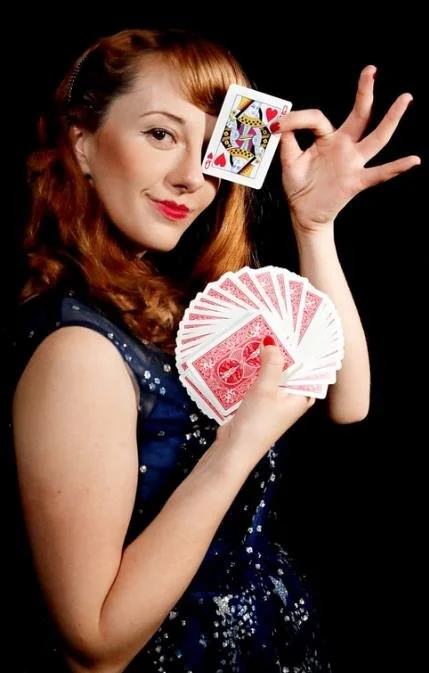


Strolling Magician Los Angeles for Brand Activations and Pop Ups
Strolling Magician Los Angeles for Brand Activations and Pop Ups
An activation lives or dies on whether people stop. You've paid for a space, a build, staff, and a week of somebody's time, and the entire investment depends on passers by breaking stride and then staying long enough for the brand to register.

Most walk past. I'm Magical Katrina, an award winning magician and mentalist based right here in Los Angeles, and I want to explain what a strolling magician Los Angeles does at a brand activation or pop up, which is a footfall and dwell time question rather than an entertainment one.
Stopping People Is the Whole Problem
Start with what actually fails. People walking past an activation are in transit, scanning, and predisposed to keep moving, and a well designed space alone rarely interrupts that.
Something impossible happening at eye level does, because it breaks a walking rhythm involuntarily rather than asking permission. That's the mechanism, and everything else follows from it. Among strolling magician Los Angeles bookings, an activation is the setting where the interruption itself is the product rather than a supplement to it.
Dwell Time Is What You're Buying
The objective underneath. A visitor who stops for thirty seconds, takes a photograph, and leaves has been counted and hasn't absorbed anything.
A visitor who stays four minutes has seen the space, encountered your staff, and formed an impression that survives the afternoon. Something genuinely engaging extends that considerably, which is the metric activations actually run on even when the reporting is a headcount. Small groups turning over continuously produce more of that than a scheduled performance drawing a crowd that disperses afterwards.
It Gives People Something to Film
Increasingly the point, and worth designing for deliberately. Attendees document activations, and a space with nothing happening produces photographs of a space rather than content anybody shares.
Something surprising at close range gets filmed, and the resulting content reaches people who never visited. Tell your performer if that matters, since moments designed to be captured differ from moments designed only to be watched. It's also worth having somebody on your team filming rather than relying entirely on attendees, since your own footage is usable and theirs isn't.
Brand Safety Matters More Here
Worth establishing, since an activation carries a client's name in public. Material that's edgy, that could embarrass somebody, or that puts a member of the public in an awkward position is a risk in a way it isn't at a private party.
A performer at an activation should be reading people carefully, letting anybody decline invisibly, and treating participants as the person something extraordinary happened to rather than the subject of a joke. Ask how they handle someone who doesn't want to take part, and expect an answer reflecting experience rather than reassurance.
Activations Run Across Days
Practically relevant when budgeting. Most pop ups and activations run for a weekend, a week, or longer, which means booking across the run rather than a single day.
That's cheaper per day than separate bookings and produces better results, since a performer who understands the brand and the space by the second day directs people more precisely and answers basic questions rather than deflecting them. Ask about multi day rates when you enquire, and be clear about the hours you actually need rather than the hours you're open, since footfall is rarely even across a day.
Your Space Has No Infrastructure
The practical constraint. Activations happen in retail units, courtyards, parking areas, street adjacent spaces, and temporary builds, frequently with limited power and nothing that was designed for a performance.
Close up magic needs no stage, power, sound, or footprint, works in a doorway or beside a display exactly as it is, and doesn't consume floor area you've paid to build. For an activation where every square foot is either a brand element or a person, entertainment occupying none of it is worth more than it appears on a budget line.

Permits and Venue Rules Apply
Worth checking early, since activations sit in public or semi public space. Depending on the site, you may have conditions covering amplified sound, where people can gather, obstruction of walkways, and what suppliers can bring in.
A performer arriving with a case and working at conversational volume avoids nearly all of it, which is a genuine practical advantage in a setting where anything amplified or structural invites a conversation with somebody official. Confirm insurance requirements early too, since site owners almost always ask and frequently have specific wording.
Measure Content and Dwell, Not Headcount
Worth deciding in advance, since it determines whether this gets judged fairly. A headcount tells you about your location and your promotion, not about whether the activation worked.
Better measures: average dwell time, how much content was generated, and how many people actually engaged with your staff rather than walking through. Those are what entertainment affects, and an activation that held two hundred people for four minutes each did considerably better than one that counted five hundred passing through.
Being Local Helps Across a Run
Worth mentioning, since activations shift. Unlike a performer flying in, I'm based right here in the LA area and serve all of Southern California, so there are no travel or accommodation costs across a multi day run and no logistics to coordinate.
It also means flexibility if your hours change or you want to add a day once you've seen the traffic, which at an activation is a decision frequently made mid run rather than in advance.
Why Book Magical Katrina
If you're running an activation, here's my case. I'm based in the LA area, I'm a member of the Magic Circle in London and the Academy of Magical Arts in Hollywood, I've earned multiple magic awards, and I've performed for brands including Formula 1, the Olympics, Porsche, and Prada, with appearances on Penn & Teller: Fool Us and Masters of Illusion. I work continuous small groups rather than gathering crowds, I treat participants carefully in a public setting, and I need no power, sound, or floor space.
Frequently Asked Questions
What problem does this solve?
Stopping people, since passers by are in transit, scanning, and predisposed to keep moving, and a well designed space alone rarely interrupts that. Something impossible happening at eye level breaks a walking rhythm involuntarily rather than asking permission, which is the mechanism an activation actually needs.
What are we buying beyond footfall?
Dwell time, since a visitor who stops for thirty seconds and leaves has been counted without absorbing anything, whereas one who stays four minutes has seen the space, met your staff, and formed an impression. Small groups turning over continuously produce more of that than a scheduled performance drawing a crowd that disperses.
Does it help with content?
Considerably, and it's worth designing for, since attendees document activations and a space with nothing happening produces photographs of a space rather than content anybody shares. Tell your performer if it matters, and have somebody on your team filming rather than relying on attendees, since your own footage is usable.
Is there a brand safety risk?
There is with the wrong performer, since an activation carries a client's name in public and material that's edgy or puts a member of the public in an awkward position is a risk. Ask how they handle someone who doesn't want to take part, and expect experience rather than reassurance.
Should we book across the whole run?
Usually, since it's cheaper per day than separate bookings and produces better results, as a performer who understands the brand and space by the second day directs people more precisely. Be clear about the hours you actually need rather than the hours you're open, since footfall is rarely even across a day.
Our space has no power. Does that matter?
Not for this format, and it's the usual situation across retail units, courtyards, and temporary builds. Close up magic needs no stage, power, sound, or footprint, works in a doorway or beside a display exactly as it is, and doesn't consume floor area you've paid to build.
What about permits and site rules?
Worth checking early, since activations sit in public or semi public space with conditions covering amplified sound, gathering, and obstruction. A performer arriving with a case and working at conversational volume avoids nearly all of it, and confirm insurance requirements early since site owners almost always ask.
How do I book you, and what do you need to get started?
Reach out with your dates, the location, your opening hours, and the peak periods you want covered. That's enough for me to check availability and send a quote, with better rates across a run than single days, and being local means no travel costs and flexibility if you add a day mid run.

Interrupt the Walk, Then Keep Them
An activation is a bet that people will stop, and most of them don't. A strolling magician Los Angeles addresses exactly that: breaking a walking rhythm at eye level, holding small groups long enough for your staff to engage, generating content that reaches people who never visited, occupying no floor space among your brand elements, and needing nothing from a site with no power and a list of conditions.
Book it across the run rather than a single day, and measure dwell and content rather than a door number.
Reach out with your dates and location, and let's talk about the run.