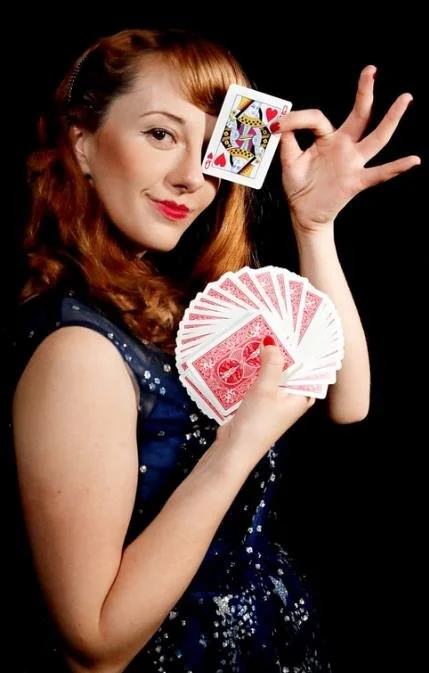


Strolling Magician Los Angeles for Premieres, Screenings, and After Parties
Strolling Magician Los Angeles for Premieres, Screenings, and After Parties
An event built around a screening has an unusual structure. The main thing happens in a dark room where nobody talks, and everything that determines how the evening feels happens in the twenty minutes before it and the two hours after.

Those windows are where premieres and screening events succeed or don't. I'm Magical Katrina, an award winning magician and mentalist based right here in Los Angeles, and I want to set out what a strolling magician Los Angeles contributes to a premiere, a screening, or an after party.
The Arrival Window Is Dead Time
Start with the part nobody plans. Guests arrive across twenty or thirty minutes before a screening, stand about holding a drink, and wait for a room to open.
That's the least designed portion of most screening events and the first impression of the evening. A performer working that window means guests who arrived early have something rather than checking their phones, and the room is animated when it goes in rather than subdued. For an evening whose main event requires everyone to sit silently for two hours, arriving warm matters more than it would elsewhere.
The After Party Is Where Opinions Form
The more consequential window. People leave a screening with a reaction they haven't articulated yet, and the following hour is where they decide what they think and, more importantly, what they'll say.
A flat after party lets a room disperse before that happens. Something in it keeps people there longer, talking to each other rather than drifting out, which for an event whose purpose is word of mouth is the practical objective. A strolling magician Los Angeles working an after party extends the time people stay in the room, which is the only thing that affects what leaves it.
Your Room Is Professionally Hard to Impress
The local reality. A screening audience in this city contains people who make things for a living, have attended events with budgets no independent production can approach, and produce impressive experiences professionally.
Competing on production is therefore pointless and expensive. What large production cannot deliver is intimacy: something impossible happening six inches from a guest's face with no crew, no camera, and nothing between them and it. People who understand how effects are constructed frequently react hardest, because the explanations their expertise usually supplies aren't available to them.
People Are Working, Not Relaxing
Worth understanding about the register. A premiere or industry screening is a professional occasion for a substantial proportion of the room: press are working, executives are assessing, and talent are being seen.
That means entertainment demanding participation, enthusiasm, or performance is misjudged. What works is something people can encounter while doing what they came to do, which for a room of professionals networking is exactly what strolling close up work is. Nobody has to stop, gather, or engage beyond what they choose.
Discretion Around Talent
Worth establishing, since these events involve people whose presence and behavior are of interest. Talent, executives, and guests may not want to be photographed by a supplier, mentioned afterwards, or approached at all.
Any performer at that event should treat that as a condition rather than a courtesy: no photographs, no social media, no mention of who was present, and no approaching anybody who signals they'd rather not. A performer who works these events understands it without being told, and it's worth confirming explicitly at booking alongside insurance and terms.

Venues Are Screening Rooms and Lots
Practically relevant. These events happen in screening rooms, on studio lots, in cinemas, at private clubs, and in restaurants booked for an after party, and the reception spaces attached to those are rarely designed for events.
A lobby, a foyer, a courtyard, or a bar area has no stage, no available sound, and no spare room, particularly with a crowd in it. Close up magic needs none of it, works in a lobby exactly as it is, and moves between a reception space and an after party venue without anything being relocated.
It Will Be Arranged Late
The practical constraint. Screening dates move, venues are confirmed close to the date, and the event is frequently organized inside a fortnight by somebody doing it alongside the actual production or release.
That rules out anything requiring lead time or a production plan, and it means performers who confirm quickly matter. A strolling magician Los Angeles needing no stage, power, or setup is one of the few things bookable at that notice without compromise, and being local means no travel logistics to coordinate when there's no time to coordinate them.
Give People a Reason to Stay
Worth stating plainly, since it's the objective underneath everything. A screening event succeeds when people stay in the room afterwards, talk to each other, and leave having formed a view they'll repeat.
Every practical decision should serve that: a reception space people want to remain in, something happening that isn't the film, and enough reason to stay past the polite twenty minutes. Among reasons to book a strolling magician Los Angeles for a premiere, extending dwell time in the room where opinions are forming is the one that matters commercially.
Why Book Magical Katrina
If you're planning a screening event, here's my case. I'm based in the LA area, I'm a member of the Magic Circle in London and the Academy of Magical Arts in Hollywood, I've earned multiple magic awards, and I've performed for clients including Formula 1, the Olympics, Porsche, Prada, and the Ritz Carlton, with appearances on Penn & Teller: Fool Us and Masters of Illusion, alongside work on Blippi as a performer and magic consultant. I understand production rooms, I treat discretion as a condition, I need no stage or setup, and being local means I can confirm at short notice.
Frequently Asked Questions
Where does entertainment fit at a screening event?
In the arrival window and the after party, since the screening itself is two hours in a dark room. Arrival is the least designed part of most screening events, and the after party is where people decide what they think, so those two windows are where the evening is actually made.
Why does the after party matter most?
Because people leave a screening with a reaction they haven't articulated, and the following hour is where they decide what they'll say. A flat after party lets the room disperse before that happens, whereas something in it keeps people there longer talking to each other, which for an event whose purpose is word of mouth is the objective.
Will it impress an industry room?
More reliably than production will, since this audience makes things for a living and has attended events with budgets no independent production can approach. Intimacy is what production can't deliver, and people who understand how effects are constructed frequently react hardest because their usual explanations aren't available.
Our guests are working rather than relaxing. Does that matter?
It rules out anything demanding participation or enthusiasm, since press are working, executives are assessing, and talent are being seen. What works is something people encounter while doing what they came to do, which is exactly what strolling close up work is, since nobody has to stop or gather.
How is discretion handled?
As a condition rather than a courtesy, since talent, executives, and guests may not want to be photographed by a supplier, mentioned afterwards, or approached at all. No photographs, no social media, no mention of who attended, and no approaching anybody who signals otherwise, confirmed explicitly at booking.
Will it work in a screening room lobby?
Yes, and those spaces are rarely designed for events, with no stage, no available sound, and no spare room once a crowd is in. Close up magic needs none of it, works in a lobby or courtyard exactly as it is, and moves between a reception space and an after party venue without anything being relocated.
We're arranging this late. Is that a problem?
Not for this format, and it's the usual situation since screening dates move and venues are confirmed close to the date. It rules out anything needing lead time or a production plan, whereas this needs no stage, power, or setup, and being local means no travel logistics when there's no time to coordinate them.
How do I book you, and what do you need to get started?
Reach out with your date, the venue or venues, expected numbers, and whether press or talent will be present. That's enough for me to check availability and send a quote. Being local means no travel costs, straightforward rescheduling if the date moves, and a genuine chance of helping at short notice.

Design the Parts Where People Talk
A screening event is built around two hours in which nobody speaks, which means everything that determines how the evening lands happens in the reception before and the party afterwards. A strolling magician Los Angeles works exactly there: filling an arrival window nobody plans, keeping people in the room where opinions form, offering an industry audience intimacy rather than scale, and needing nothing from a lobby that was never meant to host anything.
If you're planning something around a screening, I'd be glad to hear about it, and as a local, I'm right here.
Reach out with your date and venue, and let's talk about the evening.