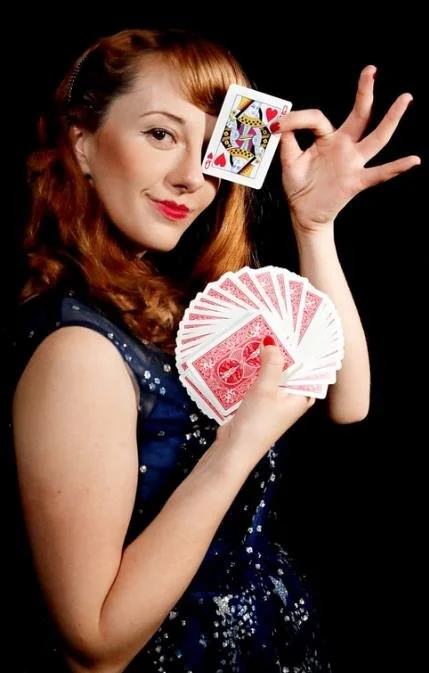


Strolling Magician New York for Trade Shows and Exhibitions
Strolling Magician New York for Trade Shows and Exhibitions
Exhibiting in New York is expensive before anything happens. Floor space is priced at a premium, the booth build costs what it costs, your team is out of the office for three days, and the whole investment depends on whether people stop walking.

Most of them don't. I'm Magical Katrina, an award winning magician and mentalist, and I want to explain how a strolling magician New York exhibitors book works on a stand, which is a lead generation question rather than an entertainment one.
The Problem Is Stopping People
Start with what actually fails at a trade show. Attendees walk aisles at pace, scanning, avoiding eye contact with booth staff, and having decided in advance which three companies they came to see.
Your stand has roughly two seconds to interrupt that, and a banner doesn't. A performer working the front of your booth does, because something impossible happening at eye level is the one thing that reliably breaks an attendee's walking rhythm. Among reasons exhibitors book a strolling magician New York, stopping traffic is the whole mechanism and everything else follows from it.
Stopping Isn't Enough
Worth being clear about the next step, since it's where most booth entertainment fails. A crowd gathered around a performer is not a result, it's an opportunity that your team either uses or wastes.
What matters is the handover: the performer holds a small group for two or three minutes, finishes, and your staff are positioned to start a conversation with people who are now relaxed, smiling, and standing still. If your team is standing behind a counter looking at phones while a crowd forms, you've paid for a spectacle rather than for leads. Brief them properly.
Small Groups Beat a Crowd
A counterintuitive point worth understanding. A performer who draws forty people creates a photograph and very few conversations, since your staff can't engage forty people and most of them drift off once it ends.
Continuous small groups of four or five, turning over every few minutes, produce considerably more useful contact across a day. That's what close up magic naturally does, and it's worth asking any performer whether they work that way rather than gathering a crowd for scheduled sets. For a booth with three staff, a steady stream is worth more than a spectacle.
New York Floor Space Changes the Math’s
The local factor. Exhibiting here costs more per square foot than most markets, which means every element in your booth is competing for space you're paying a premium for.
A strolling magician New York occupies no permanent footprint: the performer stands in the space your attendees stand in, needs no stage, no power, no rigging, and nothing built into your stand. That matters when a demo station or a screen wall means fewer square feet for people, and it means the entertainment costs you floor space rather than money.
Venue and Union Rules Rule Out Alternatives
Practically relevant in New York more than most cities. Major exhibition venues have their own rules about installation, electrical work, rigging, and who may do what, and bringing in anything requiring setup can involve labor requirements that add cost and time.
Entertainment needing no installation avoids all of it. There's nothing to rig, nothing to power, nothing requiring an electrical order, and nothing for your booth contractor to accommodate. For an exhibitor already navigating a rules document and a deadline schedule, that simplicity has genuine value beyond the performance itself.
Qualify, Don't Just Collect
Worth thinking about, since scan counts flatter. A performer draws people indiscriminately, which means some of your crowd are genuine prospects and some are collecting free things and walking on.
That's fine provided your team qualifies rather than scanning everybody and calling it a lead. Brief your staff to have a real conversation with the people who linger and let the rest go, and measure the day on qualified conversations rather than scans. Among the ways booth entertainment gets judged unfairly, being measured on scan volume rather than on genuine contact is the most common.
Position the Performer at the Edge
A practical detail that materially affects results. A performer at the back of your stand draws people in and traps them away from your staff, while one at the front edge intercepts the aisle and keeps the interaction where your team is.
The front corner, facing the aisle, is generally right. It also matters that they're clearly part of your stand rather than appearing to perform in the aisle itself, which some venues discourage and which makes the association with your brand less obvious. Worth agreeing before the day rather than adjusting on the hour.

Brief the Booth Team, Not Just the Performer
Worth stating, since it's the commonest reason this underdelivers. Your staff need to know what's happening, where to stand, when to step in, and that their job during a performance is to be ready rather than to watch.
Ten minutes on the first morning covers it. Staff who've never worked a stand with a performer instinctively become an audience, which doubles the crowd and halves the conversations. Once they understand the rhythm, the whole thing works considerably better, and by the second day most teams are managing it themselves.
Multiple Days Are Cheaper Per Day
Practically worth knowing when budgeting. Most New York shows run across two or three days, and booking a performer for the full run costs less per day than booking single days separately.
It also produces better results, since a performer who understands your product by the second morning can direct people towards your staff more precisely and answer basic questions rather than deflecting them. Ask about multi day rates when you enquire, and mention your show dates early, since the major New York shows book performers out well in advance.
A Note on "Local vs. Traveling In"
Worth knowing: performers who travel to New York work from a different calendar than those based there, which matters during major show weeks when local performers are heavily committed. Travel is discussed openly and factored into the quote. I'm based in the Los Angeles area and travel to New York for exhibitions and corporate events.
Why Book Magical Katrina
If you're exhibiting in New York, here's my case. I'm a member of the Magic Circle in London and the Academy of Magical Arts in Hollywood, I've earned multiple magic awards, and I've performed for companies including Formula 1, the Olympics, Porsche, Prada, and the Ritz Carlton, with appearances on Penn & Teller: Fool Us and Masters of Illusion. I work small groups continuously rather than gathering crowds, I hand over to your team rather than holding people, I need no power, rigging, or floor space, and I'll brief your staff on the first morning.
Frequently Asked Questions
What problem does this actually solve?
Stopping people. Attendees walk aisles at pace, scanning, avoiding eye contact, and having decided which three companies they came to see, so your stand has about two seconds to interrupt that and a banner doesn't. Something impossible happening at eye level reliably breaks an attendee's walking rhythm, which is the whole mechanism.
Isn't a crowd the point?
No, and it's where booth entertainment usually fails. A performer drawing forty people creates a photograph and few conversations, since your staff can't engage forty and most drift off. Continuous small groups of four or five, turning over every few minutes, produce considerably more useful contact across a day.
What does our team need to do?
Be ready rather than watching. The performer holds a small group for two or three minutes, finishes, and your staff start conversations with people who are relaxed and standing still. Staff who've never worked a stand with a performer instinctively become an audience, which doubles the crowd and halves the conversations, so brief them on the first morning.
How much space does it take?
None permanently, which matters in New York where floor space is priced at a premium and every element competes for square feet you're paying for. A strolling magician New York stands where your attendees stand, needing no stage, power, rigging, or anything built into your stand, so it costs you nothing in floor area.
What about venue and union rules?
They rule out most alternatives and don't affect this. Major exhibition venues have rules about installation, electrical work, rigging, and who may do what, and anything requiring setup can involve labor requirements adding cost and time. Entertainment needing no installation avoids all of it, which has real value when you're already navigating a rules document.
Where should the performer stand?
At the front edge of your stand facing the aisle, since a performer at the back draws people in and traps them away from your staff. They should also be clearly part of your stand rather than appearing to perform in the aisle, which some venues discourage and which weakens the association with your brand.
How do we measure whether it worked?
On qualified conversations rather than scan counts, since a performer draws people indiscriminately and some are collecting free things. Brief your team to have real conversations with the people who linger and let the rest go. Being judged on scan volume rather than genuine contact is how booth entertainment gets unfairly dismissed.
How do I book you, and what do you need to get started?
Reach out with your show dates, the venue, your stand size and position, and roughly how many staff you'll have. That's enough for me to check availability and send a quote, with better rates across a full show run than for single days. Major New York shows book out well ahead, so earlier helps considerably.

Turn the Aisle Into Conversations
A New York exhibition stand is an expensive bet on people stopping, and most of them walk past. A strolling magician New York addresses that specific point: interrupting the walking rhythm, holding small groups long enough for your team to step in, occupying no floor space you're paying premium rates for, and requiring nothing from a venue with a rules document as thick as your brief.
The rest is your team being ready, which is ten minutes of briefing and the difference between a crowd and a pipeline.
Reach out with your show dates and stand details, and let's talk about the run.