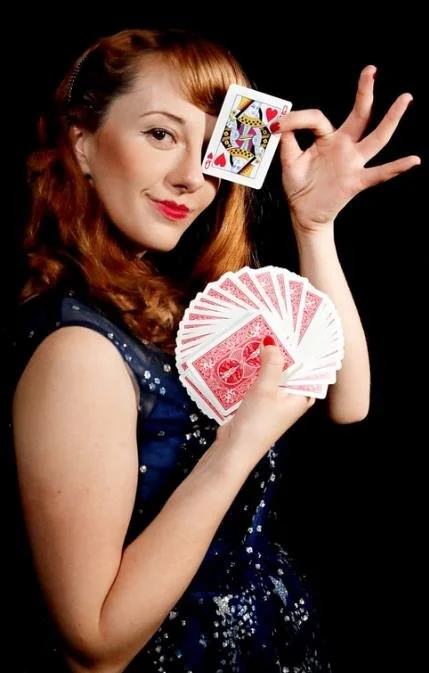


Strolling Magician Las Vegas for Arena Suites and Season Hospitality
Strolling Magician Las Vegas for Arena Suites and Season Hospitality
Las Vegas now has professional sport across the calendar, which has quietly created a category of corporate hospitality that barely existed here a decade ago: companies holding suites across a season and hosting clients in them a dozen or more times a year.

That's a different problem from a one off event, because you have to make the same suite feel worth attending repeatedly. I'm Magical Katrina, an award winning magician and mentalist, and I want to explain where a strolling magician Las Vegas fits into arena hospitality, which is around the game rather than in competition with it.
The Game Is Not the Problem
Start with the obvious point, because it's the one that governs everything. Your guests came for the sport, the sport is genuinely entertaining, and nothing should be happening while play is live.
What surrounds the game is a different matter. Guests arrive well before the first whistle, there are intermissions or quarters, there's the stretch when the score has settled and attention drifts, and there's time afterwards. Those gaps are where hospitality either works or simply provides seating with a view. A strolling magician Las Vegas working those windows adds something without touching the reason people came.
Every Suite Offers the Same Thing
The competitive reality worth naming. Your client has been in suites before, frequently in the same building, hosted by your competitors, and the offering is broadly identical: good seats, a bar, food arriving at intervals, and a decent view.
That makes differentiation genuinely hard, and spending more on catering doesn't achieve it because nobody remembers the catering. Something happening in your suite that isn't happening in the forty others is what gets mentioned afterwards, and a strolling magician Las Vegas provides that at a fraction of what any comparable upgrade would cost.
Suites Rule Out Almost Everything Else
Practically decisive. A suite has seating oriented towards the glass, a bar, a counter, and perhaps twenty people, with no stage, no sound system available to you, and no floor space that isn't a walkway.
That eliminates every entertainment option except one. Close up magic needs nothing at all, works in the space exactly as it is, and operates at conversational volume so it never competes with the broadcast or the crowd noise. For a host who cannot install, move, or add anything to a suite the building controls, entertainment with no requirements is the only workable kind.
It Fills the Arrival Stretch
The most useful placement, and the one most hosts overlook. Guests arrive across half an hour before the game, and that period is currently a drink and a look at the view.
It's also when your guests are most available for conversation, before the game starts and attention moves to the ice or the field. A strolling magician Las Vegas working that arrival window means guests who came separately are talking to each other by the first whistle, in a good mood, rather than standing in the clusters they arrived in. For hospitality whose purpose is relationships, that early window is worth more than the third period.
Intermissions Are Longer Than They Feel
The second placement, and it addresses a real lull. An intermission is fifteen to twenty minutes of people standing up, queueing for something, and making conversation that stops abruptly when play resumes.
Something happening in those windows uses time that's currently spent waiting. It also has a natural stopping point, which matters: a performer working an intermission finishes when the game restarts, with no awkward negotiation about attention. A strolling magician Las Vegas experienced with this setting will read that instinctively rather than needing to be told.
Your Guests Came for Something Else
Worth being clear about the register, since this determines whether it lands. Suite hospitality entertainment must be secondary by design, and a performer who tries to become the center of the evening has misunderstood the booking.
The right approach is quiet, brief, and worked around the sport: small groups, a few minutes each, stopping entirely when play matters. A strolling magician Las Vegas who understands hospitality behaves like an excellent addition to your evening rather than a feature of it, and that judgement is worth checking when you book, since a performer used to parties may not adjust.
Season Long Hospitality Has Different Economics
Worth thinking about if you hold a suite across a season rather than for a single event. You're hosting different clients repeatedly in the same room, and the challenge is that your tenth guest group should have as good an evening as your first.
Rotating entertainment through a few dates across the season, rather than every game, gives you something to offer clients on those nights specifically and keeps the hospitality from becoming routine. Some companies use it for their most important accounts and keep the other nights simple, which is a sensible allocation and considerably cheaper than upgrading everything.

Corporate Nights and Season Ticket Events
Beyond client hospitality, there's an internal version. Companies with season tickets frequently run employee nights, and organisations hosting partner or dealer groups use arena events for the same reason they use dinners.
Those evenings have the same shape and the same gaps, and the same logic applies. A strolling magician Las Vegas works equally for a suite of employees, a group of partners, or a mixed room, since the format adapts to whoever is standing there rather than requiring a particular kind of audience.
A Note on "Local vs. Traveling In"
Worth knowing: many performers travel to Las Vegas, with travel discussed openly and factored into the quote rather than being your problem to arrange. I'm based in the Los Angeles area and travel to Vegas regularly, which suits selected dates across a season rather than a standing weekly arrangement. If you want someone at every home game, a Vegas based performer will serve you better, and I'd say so rather than taking something I can't sustain.
Why Book Magical Katrina
If you're hosting in a suite, here's my case. I'm a member of the Magic Circle in London and the Academy of Magical Arts in Hollywood, I've earned multiple magic awards, and I've performed for clients including Formula 1, the Olympics, Porsche, Prada, and the Ritz Carlton, with appearances on Penn & Teller: Fool Us and Masters of Illusion. I've worked plenty of hospitality where the event itself is the draw, so I work the gaps and stop when attention returns to the game, I need no stage, power, or setup, and I'm fully insured with a COI available for the venue.
Frequently Asked Questions
Won't it compete with the game?
Not if it's handled properly, and a performer who tries to become the center of the evening has misunderstood the booking. Guests came for the sport and nothing should happen while play is live. The right approach works the arrival stretch and intermissions in small groups, stopping entirely when the game resumes, which has a natural stopping point built in.
Where does it fit best?
The arrival window before the first whistle, which is currently a drink and a look at the view and is when guests are most available for conversation. Working that stretch means people who came separately are talking to each other by the time play starts. Intermissions are the second placement, using fifteen or twenty minutes that are otherwise spent queueing.
Does it work in a suite?
It's one of very few things that does. A suite has seating oriented to the glass, a bar, a counter, and perhaps twenty people, with no stage, no available sound system, and no floor space that isn't a walkway. Close up magic needs nothing, works in the space as it is, and operates at conversational volume so it never competes with the broadcast.
Every suite is the same. Does this actually differentiate ours?
That's precisely the argument. Your client has been in suites before, often in the same building hosted by your competitors, and the offering is identical: good seats, a bar, food, and a view. Spending more on catering doesn't differentiate because nobody remembers catering. Something happening in your suite that isn't happening in the others is what gets mentioned afterwards.
We hold a suite all season. Should we do it every game?
Rarely worth it, and rotating across a few dates works better. You're hosting different clients repeatedly in the same room, and the challenge is that your tenth group should have as good an evening as your first. Many companies use it for their most important accounts and keep other nights simple, which is a sensible allocation and cheaper than upgrading everything.
Does it work for employee or partner nights?
Yes, since those evenings have the same shape and the same gaps. Companies with season tickets frequently run employee nights, and organizations hosting partner or dealer groups use arena events for the same reasons they use dinners. The format adapts to whoever is standing there rather than requiring a particular kind of audience.
How do I book you, and what do you need to get started?
Reach out with your dates, the venue and suite, roughly how many guests, and whether they're clients, employees, or a mixed group. That's enough for me to check availability and send a quote including travel. If you're considering several dates across a season, mention that, since selected dates suit me better than a standing weekly arrangement and are easier to schedule with notice.

Host the Gaps, Not the Game
A suite gives you excellent seats and a view, and so does every other suite in the building. What distinguishes yours is what happens in the stretches around the sport: the arrival window when guests are most available, the intermissions currently spent queueing, and the periods when the score has settled. A strolling magician Las Vegas works exactly there, needing nothing from a room you don't control and stopping the moment attention returns to the game.
If you're hosting clients across a season, I'd be glad to hear which dates matter most.
Reach out with your dates and suite details, and let's make the evenings work.