


Women's History Month for Kids: Programming at Museums and Science Centres
Women's History Month for Kids: Programming at Museums and Science Centres
Museums have two completely different audiences in March and frequently programme for one. There are booked school groups, who arrive at a known time with a known age range and a teacher, and there are weekend families, who arrive when they like, stay as long as they like, and came for the exhibits.

Those need different approaches. I'm Magical Katrina, an award winning magician and mentalist, and I want to set out what Women's History Month for kids looks like in a museum or science center, where the building itself is competing for attention.
Your Exhibits Are the Competition
Start with what makes this setting different from a classroom or a library. A child in a gallery can see the things they came for, and anything scheduled has to be more interesting than a dinosaur, a rocket, or a button that does something.
That rules out anything static or explanatory, and it argues for programming placed where people already are rather than in a room they must choose to enter. A talk in an education suite reaches whoever found it, whereas something happening in a gallery reaches everybody passing through.
Drop In Needs Repetition, Not Length
The structural answer for weekend families. Visitors arrive across the whole day and stay for varying lengths, which means a single session at two o'clock reaches whoever was there at two o'clock.
Short sessions repeated through the day reach considerably more people. Fifteen or twenty minutes, several times, with families able to join and leave without disruption, suits how people actually use a museum. Among Women's History Month for kids approaches in this setting, repetition beats duration every time.
School Groups Are a Different Product
Worth planning separately. A booked group arrives with a teacher, a curriculum link they need, an age range you know in advance, and a fixed slot.
That supports something longer, more structured, and more explicitly educational than a drop in session could be. It also means you can prepare: ask what they're covering, what they've already done, and what the teacher wants them to take away. Schools book these weeks in advance, so promote March programming in January rather than February, since by then their trips are planned.
Use What's Already in the Building
The most underused resource. Most collections contain work by women, objects associated with them, or subjects where women's contributions are part of the story and simply aren't foregrounded.
A trail, a set of labels, or a guided route through the existing collection costs almost nothing and does something a visiting speaker can't: it changes how visitors see the permanent displays, including after March. That's the version of this that lasts, and it's frequently more valuable than a one day event with better attendance figures.
Your Front of House Team Matters More Than the Program
Worth investing in, since they have far more conversations than any event does. Gallery staff and volunteers talk to hundreds of visitors a day, and a short briefing on two or three women represented in your collection changes a great many of those conversations.
That costs an hour of training and reaches more children than a scheduled session will. It also works for the drop in audience specifically, who never look at a program and encounter your museum entirely through what's in front of them and who happens to be standing near it.

Mixed Ages Arrive Together
The practical constraint for family programming. A museum group is a five year old, a nine year old, and two adults, and anything pitched at one age loses the others immediately.
That's worth stating to anybody you book, since a performer or presenter used to school groups may deliver the same thing to a family audience and find half of it disengages. Something that works across the range simultaneously is what this setting needs, and it's a specific skill rather than a general claim.
Don't Program Only March
Worth saying, since it's the pattern. A museum that runs March programming and nothing else for the rest of the year has treated the subject as an annual obligation, which visitors and staff both notice.
A trail that stays up, labels that remain changed, or a permanent adjustment to how the collection is interpreted does more than an event. March is a reasonable prompt for that work rather than the whole of it, and a small permanent change is worth more than a large temporary one.
Measure Reach, Not Attendance
Worth deciding in advance, since it determines what you conclude. Attendance at a scheduled session tells you how well it was promoted, not how many children encountered the subject.
A better measure for a museum is reach: how many visitors passed through a trail, how many conversations your front of house team had, and how many school groups booked. Those numbers are less flattering and more accurate, and they tend to argue for exactly the low cost, high reach work that gets overlooked in favor of one well attended event.
Where a Live Performance Fits
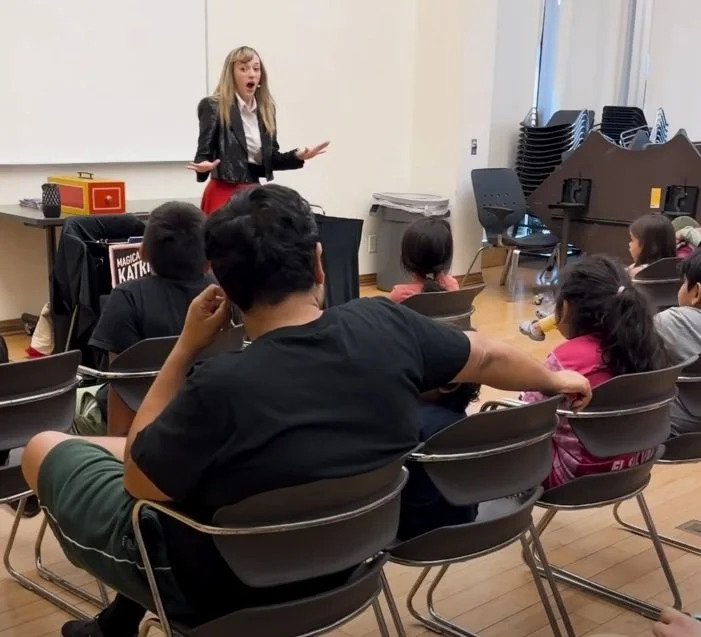
Briefly, since it's my corner. A performance works best in this setting as a drop in draw: something happening in a gallery or atrium that families encounter rather than attend, repeated across a day so the whole visiting population has a chance at it.
Magic has been overwhelmingly male throughout its history, which means a woman doing something genuinely difficult carries the theme without a word of framing, and it competes with the exhibits on their own terms, which most programming can't. If you're planning March, I'm glad to talk it through.
Frequently Asked Questions
What makes a museum different from a school or library?
The exhibits compete, since a child in a gallery can see what they came for and anything scheduled must be more interesting than a dinosaur or a button that does something. That argues for programming placed where people already are rather than in a room they must choose to enter.
How should we program for weekend families?
Short sessions repeated through the day rather than one longer one, since visitors arrive across the whole day and a single session at two reaches whoever was there at two. Fifteen or twenty minutes, several times, with families able to join and leave without disruption, suits how people use a museum.
Are school groups different?
Entirely, since a booked group arrives with a teacher, a curriculum link, a known age range, and a fixed slot, which supports something longer and more structured. Ask what they're covering and what the teacher wants them to take away, and promote in January rather than February since trips get planned early.
What's the most underused resource?
Your own collection, since most contain work by women, objects associated with them, or subjects where women's contributions are part of the story and simply aren't foregrounded. A trail or a set of labels costs almost nothing and changes how visitors see the permanent displays, including after March.
Who has the most impact?
Your front of house team, since gallery staff and volunteers talk to hundreds of visitors a day and a short briefing on two or three women in your collection changes a great many of those conversations. That's an hour of training reaching more children than a scheduled session will.
What about the age range?
It's the practical constraint, since a family group is a five year old, a nine year old, and two adults, and anything pitched at one age loses the others immediately. Say so to anybody you book, since a presenter used to school groups may deliver the same thing and find half the audience disengages.
Should everything happen in March?
No, since a museum that programs March and nothing else has treated the subject as an annual obligation, which visitors and staff both notice. A trail that stays up or labels that remain changed does more than an event, and a small permanent change is worth more than a large temporary one.
What should we measure?
Reach rather than attendance at one event, since attendance tells you how well something was promoted rather than how many children encountered the subject. Count visitors through a trail, conversations your front of house team had, and school groups booked, which argues for the low cost high reach work that gets overlooked.
Program Where the Visitors Already Are
The most effective Women's History Month for kids work in a museum happens in the galleries rather than in a room people have to find: short sessions repeated across a day, a trail through the collection you already own, and a front of house team briefed to mention two or three women whose work is on the walls.
Plan school groups as a separate product, promote to them in January, and measure reach rather than attendance. Then leave something in place after March, since that's the part visitors encounter for the rest of the year.
Reach out if you're planning March programming, and I'm glad to talk about what works in a gallery.