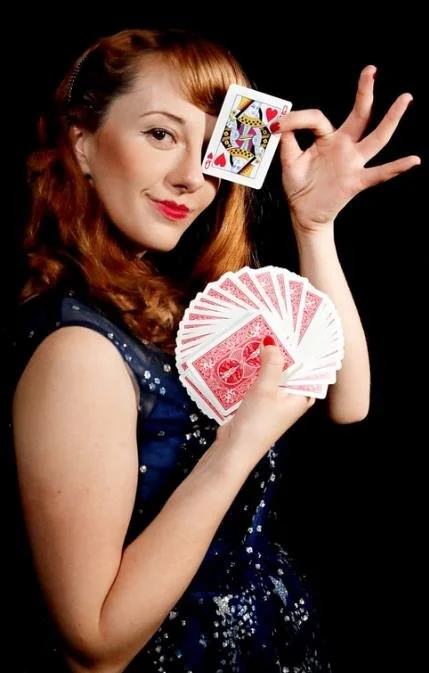


So You Want to Be a Female Magician: Honest Advice for Getting Started
So You Want to Be a Female Magician: Honest Advice for Getting Started
Every so often someone emails me asking how to start. Sometimes it's a woman in her thirties who has been quietly practising for a year and wonders whether it's too late. Sometimes it's a teenager. Occasionally it's a parent asking on behalf of a daughter who has just watched something and announced this is what she's doing now.

The advice is largely the same in each case, and it's less about being a woman than people expect. I'm Magical Katrina, an award winning magician and mentalist, and this is what I'd tell anyone thinking about becoming a female magician, including the parts nobody puts on a poster.
The Craft Comes First and It Takes Ages
Let's be honest at the outset. The thing that will determine whether this works is whether your magic is genuinely good, and getting there involves an unglamorous number of hours alone with a deck of cards, doing the same move until it stops looking like a move.
There is no shortcut, no natural talent that substitutes for it, and no amount of stage presence that covers weak technique in close up work. A female magician who is excellent will find opportunities, and one who isn't won't, which is both the hard news and, if you think about it, quite a fair arrangement. If you enjoy the practice itself, you're in a good position. If you only enjoy the performing, this will be a difficult road.
Learn From Books First
An unfashionable opinion that most working professionals share. There's an enormous amount of magic on video now, much of it excellent, and it's tempting to learn entirely that way.
But the foundational books, and every magician will point you to the same handful, teach structure, theory, and why things work rather than just what to do. People who learn only from video tend to acquire a collection of tricks, while people who work through the classic texts acquire an understanding they can build on for decades. Start with the standard beginner texts on card and coin work, and take them slowly. A female magician with genuine grounding in fundamentals will outpace someone with a larger repertoire and no theory.
Find a Society, Genuinely
The single most useful practical step, and the one most beginners avoid because it feels intimidating. Magic clubs and societies exist in most cities, they generally welcome newcomers, and they are where you will learn fastest.
Watching experienced performers up close, having your work criticized by people who know what they're looking at, and simply being around others doing this seriously accelerates everything. Yes, you will frequently be one of few women in the room. That's the current reality of the field and it's improving. It is also, in my experience, considerably less hostile than the anecdotes suggest, and the performers worth learning from tend to care about whether you're serious rather than anything else.
Perform Before You Feel Ready
The mistake almost everyone makes is waiting until they're good enough, which never arrives, because performing is a separate skill from technique and can only be learned by doing it.
Start with friends, then family gatherings, then a friend's party where nobody is paying you. You will be worse than you hoped and it will teach you more than another six months of practice would. A female magician who has performed fifty times badly is further along than one who has practiced alone for two years and never faced an audience. The gap between doing a move correctly and doing it while someone is watching, talking, and picking up your props is enormous, and only reps close it.
Develop Your Own Register
Something worth thinking about early. There is a default performing style, patter heavy, presentational, faintly showbiz, that many beginners absorb because it's what magic sounded like historically.
You do not have to perform that way, and you'll be considerably better if you find something closer to how you actually speak. Conversational, warm, dry, understated, whatever is genuinely yours. Audiences respond to a person rather than a persona, and for a female magician in particular, adopting a style built by and for men decades ago rarely fits well. The strongest performers are recognizably themselves with the volume slightly raised.

The Business Is Half the Job
Nobody mentions this and it's true. Working professionally means quoting, contracts, invoices, insurance, a website, answering enquiries promptly, marketing, and turning up reliably.
Plenty of technically gifted magicians earn very little because they're poor at the rest of it, and plenty of merely good performers do well because they're organized, easy to work with, and answer emails. If you want this as a career rather than a hobby, treat the business side as a discipline to learn rather than an annoyance around the real work. Clients rebook people who are excellent and straightforward, in roughly that order of importance.
On Being One of Few
The part people expect me to lead with. Being a female magician means you'll frequently be the only woman at a lecture, a convention, or a booking, and occasionally someone will assume you're the assistant.
That's real and it's mostly minor. It also carries a genuine advantage: you're memorable in a field where most performers aren't, and audiences arrive with an expectation you get to overturn, which is a head start on astonishment. What I'd say to anyone worrying about it is that the difficulty of this career is overwhelmingly the craft rather than the reception. Be good enough and the rest becomes a footnote reasonably quickly.
It's Better Than It Was
Worth saying, because the story of women in magic gets told as a grievance and it's more hopeful than that. There are more women working professionally now, more visibly, and at higher levels. Societies are more welcoming than decades old anecdotes suggest. Clients increasingly ask for women specifically.
Progress is uneven and the numbers remain lopsided, but the direction is clear, and someone starting today will have an easier time than the generation before mine did. If you're weighing whether the field will have you, the honest answer is that it will, provided you do the work the same as anyone else.
Where to Actually Start This Week
Practically, if you want to begin: get one of the standard beginner books on card magic and work through the first chapter properly rather than skimming for tricks. Find your nearest magic society and go once, even though you'll feel like an impostor.
Learn three things properly rather than thirty badly, and perform them for actual people within a month. Film yourself, which is unpleasant and instructive. And accept that the first year is mostly frustration, because everyone's is. Becoming a female magician worth booking follows exactly the same path as becoming any magician worth booking, and the path is long, unglamorous, and entirely open to you.
Frequently Asked Questions
Is it too late to start?
Almost certainly not, and this question comes overwhelmingly from people in their twenties and thirties who imagine everyone else began at eight. Plenty of working professionals started as adults. What matters is the hours you're willing to put in rather than when you began, and adults frequently progress faster than children because they practice deliberately rather than randomly.
How do I actually learn?
Books first, whatever the internet suggests. The foundational texts teach structure, theory, and why things work rather than just what to do, and people who learn only from video tend to acquire tricks without understanding. Start with the standard beginner books on card and coin work, take them slowly, and learn three things properly rather than thirty badly.
Should I join a magic club if I'll be the only woman?
Yes, and it's the most useful practical step available. Societies are where you'll learn fastest, through watching experienced performers up close and having your work criticized by people who know what they're looking at. You will often be one of few women, which is the field's current reality and improving, and in my experience it's considerably less hostile than the anecdotes suggest.
When should I start performing?
Before you feel ready, since performing is a separate skill from technique and can only be learned by doing it. Start with friends, then family, then an unpaid party. You'll be worse than you hoped and learn more than another six months of practice would teach you. Someone who has performed fifty times badly is further along than someone who has practiced alone for two years.
Does being a woman make it harder?
Less than people expect. You'll frequently be the only woman in a room and occasionally someone will assume you're the assistant, which is real and mostly minor. It also makes you memorable in a field where most performers aren't, and audiences arrive with an expectation you get to overturn. The difficulty of this career is overwhelmingly the craft rather than the reception.
What do people underestimate about doing this professionally?
The business half. Quoting, contracts, invoices, insurance, a website, prompt replies, marketing, and reliability. Plenty of technically gifted magicians earn very little because they're poor at all of that, and plenty of merely good performers do well because they're organized and easy to work with. Clients rebook people who are excellent and straightforward, roughly in that order.
What should I do first?
Get a standard beginner book on card magic and work through the first chapter properly rather than skimming for tricks. Find your nearest magic society and attend once despite feeling like an impostor. Learn three things well and perform them for real people within a month. Film yourself, which is unpleasant and instructive. And expect the first year to be mostly frustration, because everyone's is.

Do the Hours
If you take one thing from this, make it that the path to becoming a female magician worth booking is identical to the path for anyone else: books, a society, an unreasonable number of practice hours, performing before you're ready, and learning the business side properly. Being a woman will make you memorable and occasionally mildly irritated. It will not make you good, and nothing except the work will.
The field is more open than it was and considerably more open than the stories suggest. Go and do the hours.