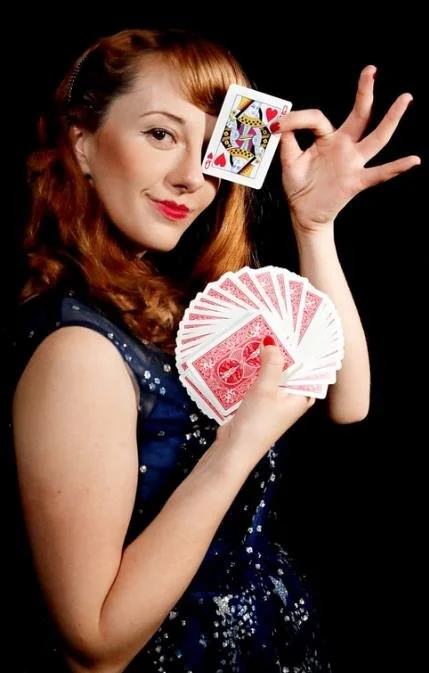


Illusionist NYC for Fashion, Showroom, and Industry Events
Illusionist NYC for Fashion, Showroom, and Industry Events
New York's fashion and industry calendar runs on events that are exhausting to attend and harder still to make memorable. Presentations, showroom appointments, market week receptions, and industry parties, all attended by editors, buyers, stylists, and creators who go to several a week and have refined a professional method for moving through them efficiently.
That's the audience your event is competing for. I'm Magical Katrina, an award winning magician and mentalist, and I want to explain how an illusionist NYC brands and showrooms book actually helps, which is more specific than adding atmosphere to a room.
Your Guests Are Professionally Efficient
Start with the behavior. Industry guests arrive, take in the collection or the product, photograph what's relevant, greet the two or three people they need to greet, and leave. It's not rudeness, it's how anyone attending four events in a week manages their time.
Which means your event has a very short window to be anything other than a stop on a list. An illusionist NYC performing close up magic interrupts that pattern, because astonishment stops people involuntarily before the decision to leave has been made. Someone genuinely surprised has already stayed longer than they planned, which is the whole difficulty solved.
Appointment Based Events Have Dead Time
The structural feature of showroom work that entertainment can actually address. Appointments run late, guests arrive staggered, and there's frequently a stretch where someone is waiting for a rail to free up or for a colleague to finish.
That waiting is where a showroom either feels considered or feels like a queue. An illusionist NYC working those gaps gives waiting guests something genuinely enjoyable rather than a seat and a beverage, and it does so without interfering with the appointments themselves. For a showroom running back to back meetings across market week, entertainment that fills the interstitial time rather than requiring its own slot is the only workable kind.
Showroom Space Is Too Expensive to Give Away
The practical argument, and it's sharper in this industry than most. New York showroom space is costly per square foot and every part of it is working: rails, tables, seating for appointments, and room for people to move.
Anything requiring a stage, staging, sound, or a footprint takes space you're paying premium rates for and that your collection needs. An illusionist NYC performing close up magic requires no stage, power, sound, rigging, or setup, and no floor area beyond where guests already stand. Nothing to install, nothing to remove afterwards, and no negotiation with a building that probably has views about load in anyway.
Content People Film Because They Want To
Every industry event brief includes coverage, and the usual approach is a branded moment guests photograph out of professional obligation.
An illusionist NYC produces something guests film because they'd rather not have missed it. Astonishment is inherently shareable, and your product or space appears in the frame of something people chose to post rather than were prompted to. For an audience whose own channels carry genuine reach, content produced willingly is worth considerably more than another step and repeat, and it reaches beyond the guest list, which the room itself never does.
Industry Parties Have the Opposite Problem
Distinct from showroom appointments and worth separating. A market week party is loud, crowded, and full of people who mostly know each other, where the difficulty isn't dead time but rather that nothing distinguishes it from the three other parties happening that evening.
Guests will attend, stay forty minutes, and go to the next one. An illusionist NYC gives them a reason to describe yours specifically, and gives people standing in clusters something to react to together. In a week where everyone's schedule is identical, being the event people mention the following morning is genuinely valuable and surprisingly cheap to achieve.
Mentalism Suits a Creative Room
Worth a specific note on format. This audience works in image, presentation, and constructed impressions professionally, which makes them sharp about how effects are produced and slightly resistant to anything that looks like production.
Mentalism sits differently, since it isn't about objects behaving impossibly but about someone appearing to know what you were thinking. For a room of people who spend their working lives reading and creating signals, that lands harder than a traditional trick would, and it produces the conversation that follows guests out of the door. An illusionist NYC blending close up magic with mentalism suits this crowd better than either alone.
It Fits a Space That Isn't Yours
Practical for anyone doing a temporary activation, which this industry does constantly. Pop up showrooms, borrowed galleries, hotel suites during market, and short lease spaces all come with restrictions on what you can install and how long you have to do it.
Entertainment requiring production is difficult in that context and occasionally impossible. Something arriving in a case, needing nothing, and leaving no trace fits a temporary space exactly. Among illusionist NYC options for a short activation, that's frequently the deciding factor rather than anything about the performance itself.
A Note on "Local vs. Traveling In"
Worth knowing: the right performer needn't be New York based. Many travel in, with travel discussed openly, factored into the quote, and handled by the performer rather than by you. I'm based in the Los Angeles area and travel to New York for events. Market weeks book out early across every supplier category, so if your dates fall in one, widening the search geographically genuinely helps.
Why Book Magical Katrina
If you'd like an illusionist NYC for a showroom or industry event, here's my case. I'm a member of the Magic Circle in London and the Academy of Magical Arts in Hollywood, I've earned multiple magic awards, and I've performed for brands including Formula 1, the Olympics, Porsche, Prada, and the Ritz Carlton, with appearances on Penn & Teller: Fool Us and Masters of Illusion. My work is elegant rather than showy, which suits a fashion room, I blend close up magic with mentalism, and I need no stage, power, or setup, so nothing competes with your collection for space. I'm fully insured with a COI available.
Frequently Asked Questions
Will this hold guests who attend events constantly?
Better than most things, because it interrupts behaviour rather than competing with it. Industry guests arrive, take in what's relevant, greet who they need to, and leave, which is how anyone attending four events a week manages time. Astonishment stops people involuntarily before they've decided to go, and someone genuinely surprised has already stayed longer than they planned.
How does it work with appointment based showroom events?
By filling the interstitial time. Appointments run late, guests arrive staggered, and there's usually a stretch where someone waits for a rail to free up or a colleague to finish, which is where a showroom either feels considered or feels like a queue. An illusionist NYC works those gaps without interfering with the appointments themselves.
What space does it need?
None beyond where guests already stand, which matters when showroom space is expensive per square foot and every part of it is working. Close up magic needs no stage, power, sound, rigging, or setup, so nothing takes room your collection needs, nothing gets installed, and there's no negotiation with a building that probably has views about load in anyway.
Will it generate content?
Yes, and the useful kind. The usual approach produces photographs taken out of professional obligation, whereas an illusionist NYC produces something guests film because they'd rather not have missed it, with your product or space in frame. For an audience whose own channels carry real reach, content produced willingly is worth more than another step and repeat.
Is it different at an industry party?
The problem is inverted. A market week party isn't short of energy, it's short of distinction, since guests will attend, stay forty minutes, and move to the next one. Entertainment gives them a reason to describe yours specifically and gives people standing in clusters something to react to together, which in a week of identical schedules is worth a great deal.
Why mentalism for this audience?
Because this room works in image, presentation, and constructed impressions professionally, which makes them sharp about how effects are produced and slightly resistant to visible production. Mentalism isn't about objects behaving impossibly but about someone appearing to know what you were thinking, which lands harder with people who read and create signals for a living.
How do I book you, and what do you need to get started?
Reach out with your dates, the space, expected guest numbers, and whether it's a presentation, showroom appointments, or a party, since those are genuinely different jobs. That's enough for me to check availability and send a quote including travel. Market weeks book out early across every category, so earlier enquiries help considerably.
Be the One They Mention
New York's industry calendar produces guests who are efficient, well practised at moving through events, and difficult to impress with anything they've seen before. An illusionist NYC addresses that directly: it stops people involuntarily rather than asking for their attention, fills the waiting time appointment based events create, occupies none of the space your collection needs, and produces content guests choose to share.
If you're hosting during market week or opening a showroom, I'd love to hear what you're planning.
Reach out with your dates and space, and let's make yours the one they talk about.