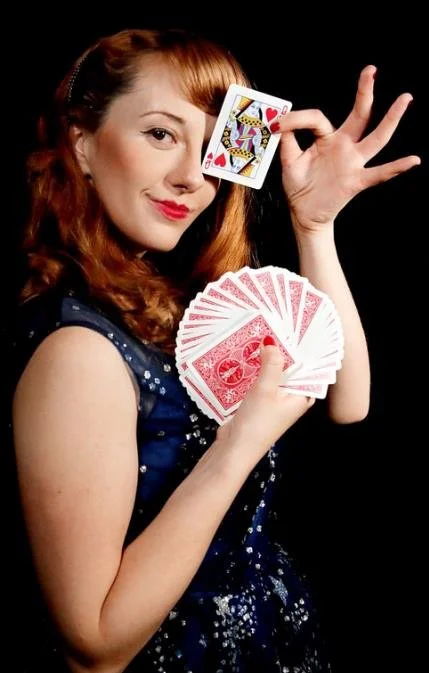


Female Magician in New York for Advertising and Creative Agencies
Female Magician in New York for Advertising and Creative Agencies
Booking entertainment for an agency is harder than booking for almost any other client. The room is full of people whose job is noticing how things are made, they have attended a great many events, and they will form a collective verdict on whatever you put in front of them within about ninety seconds.

They are also one of the best audiences there is, when you get it right. I'm Magical Katrina, an award winning magician and mentalist, and I want to set out what booking a female magician in New York does at an agency event, and what this particular room demands.
Skill Decides It
Let me be direct about the keyword. Skill has nothing to do with gender, and you should book me because I'm genuinely good at this: thirteen years of performance, awards from my peers, and rooms full of creative people who analyse craft professionally and still can't account for what they watched.
There's a bonus, and in this industry it isn't trivial. Who gets hired, who gets put in the room, and who gets credited is an active conversation in every agency in this city, and an agency's choices are visible to its own people and its clients. Somebody different registers. Book me for the work and take the rest as a bonus.
Production Value Impresses Nobody Here
Start with what doesn't work. A room containing art directors, editors, and producers knows exactly what everything cost, has probably made something similar, and is unimpressed by scale as a matter of professional habit.
What does land is craft they can't reverse engineer. An audience that spends its working life understanding how effects are achieved is a hard room for anything technical and a very good one for something done three feet away with nothing to hide behind. The agency room is where close up work beats spectacle most clearly.
The Verdict Forms Fast and Travels
Worth understanding about this audience specifically. Agency people talk, within the building and across the industry, and an event that was good becomes a thing people mention at other agencies.
That cuts both ways, which is the risk. Something mediocre is discussed too, and in a city where your staff interview at four other shops a year, the internal view of what the agency spends money on matters. If you're programming for this audience, it's worth doing properly or not doing it.
Client Events Need a Different Shape From Staff Events
Worth separating out. An agency summer party is for your own people and can be loose. A client evening, a new business dinner, or an event around a pitch has a commercial purpose, and the entertainment is there to serve conversation rather than to be the event.
For a client evening, strolling during drinks works and a scheduled performance usually doesn't, because your team's actual job that night is specific conversations with specific people. For a staff party, you have far more freedom. Decide which you're planning before you book, since the same booking does different jobs.
It Gives Your Team a Way Into the Room
Practically the most useful function at a client event. Your account people spend the evening trying to start conversations with clients who are standing in groups, and that approach is awkward however experienced you are.
Something happening creates an opening, since two people who just reacted to the same thing have an obvious first sentence. For a new business evening in particular, that's the difference between your strategist getting twenty minutes with the marketing director and spending the night talking to colleagues.
Agency Spaces Are Not Event Spaces
Practically relevant for format. Agency parties happen in the office with the desks pushed back, on a roof terrace, in a converted loft, or in a bar you've taken over, and almost none of those have a stage, usable sound, or spare power.
Close up magic needs none of it, works in the room exactly as it is, and leaves nothing to clear before people arrive to work in the morning. For a space that has to function as a studio on Monday, entertainment with nothing to install is the practical answer.

Nobody Will Stand Still
Worth planning around. Agency events are standing, circulating, loud affairs where people move constantly, and anything announced from a microphone competes with a room that didn't want to stop.
Something mobile works with that rather than against it. Guests encounter it in the group they're already in, give it the attention they choose to, and go back to their conversation. For a room this self directed, that's the only format that doesn't fight the evening.
Say What the Evening Is For
Worth settling when you book. An agency party celebrating a win, a client evening before a pitch, a holiday party, and an event marking a departure are different rooms with different needs.
Tell whoever you're booking what the evening is actually about. A performer with that information works the room accordingly, spends time with the people who matter to you, and avoids the conversation in the corner that shouldn't be interrupted.
A Note on "Local vs. Traveling In"
Worth knowing: I'm based in the Los Angeles area and travel to New York regularly for corporate and brand events. Travel is discussed openly and factored into the quote rather than being your problem to arrange, and for December and the contested autumn weeks it's worth asking early.
Why Book Magical Katrina
If you're programming for an agency, here's my case. I'm a member of the Magic Circle in London and the Academy of Magical Arts in Hollywood, I've earned multiple magic awards, and I've performed for clients including Prada, Porsche, Formula 1, the Olympics, and the Ritz Carlton, with appearances on Penn & Teller: Fool Us and Masters of Illusion. I work brand and creative rooms regularly and pitch the tone to match, I need no stage, power, or sound so your office or a roof terrace works as it is, I read a closed conversation and leave it alone, and I'll work the people who matter to you if you tell me who they are.
Frequently Asked Questions
Why is an agency a difficult room?
Because it's full of people who analyse how things are made, have attended a great many events, and form a collective verdict quickly. They're unimpressed by production value as a matter of professional habit, since they know what it cost.
What actually works with this audience?
Craft they can't reverse engineer. An audience that understands how effects are achieved is a hard room for anything technical and a very good one for something done three feet away with nothing to hide behind.
Does it matter if we get it wrong?
More than elsewhere, since agency people talk within the building and across the industry, so a good event is mentioned at other shops and a mediocre one is too. In a city where your staff interview regularly, the internal view of your spending matters.
Is a client evening different from a staff party?
Yes, and decide which you're planning. A client evening has a commercial purpose, so strolling during drinks works and a scheduled performance doesn't, because your team's job is specific conversations. A staff party gives you far more freedom.
How does it help on a new business night?
It creates openings, since approaching clients standing in groups is awkward however experienced you are, and two people who just reacted to the same thing have a first sentence. That's the difference between twenty minutes with the marketing director and a night talking to colleagues.
Will it work in our office?
Yes, since close up magic needs no stage, power, or sound and leaves nothing to clear before people arrive to work. That suits a space that's a studio again on Monday, a roof terrace, or a bar you've taken over.
Our events are loud and everybody moves. Is that a problem?
It's the reason to choose a mobile format, since anything announced from a microphone competes with a room that didn't want to stop. Guests encounter something moving through in the group they're already in and go back to their conversation.
What should we tell you beforehand?
What the evening is actually for, since a win celebration, a client night before a pitch, and a holiday party are different rooms. With that I can work the people who matter to you and stay clear of the conversation that shouldn't be interrupted.

Book for the Room, Not the Occasion
An agency audience judges fast, talks afterwards, and is immune to the things that impress other corporate rooms. Booking a female magician in New York works here because craft performed close up is the one thing a room of professional makers can't account for, and because it fits an evening where nobody is going to stand still or face forward.
Decide whether you're programming for your people or for your clients, tell whoever you book what the night is for, and expect the verdict to travel.