

Corporate Magician for Executive Dinners and Board Events
Corporate Magician for Executive Dinners and Board Events
Entertainment for twelve senior people is a genuinely awkward problem, and most organizations solve it by not attempting it. A band makes no sense, a comedian for a dozen people is uncomfortable for everyone including the comedian, and anything involving participation risks asking a chief executive to do something undignified in front of their board.

So executive dinners tend to be a good room, a good menu, and conversation, which is fine and occasionally rather flat. I'm Magical Katrina, an award winning magician and mentalist, and I want to explain why a corporate magician is one of the few things that genuinely works with a small senior group, and what to be careful about.
Most Entertainment Needs a Crowd
Start with why the problem exists. Almost all performance entertainment is designed for scale, drawing energy from an audience large enough to have a collective reaction, and it fails when there isn't one.
A stage act performing to twelve people at a dinner table is uncomfortable in a way everyone in the room feels, since there's no crowd to hide in and every reaction is individually visible. That's why organisations stop looking. Close up magic is the exception: it isn't a scaled down version of a show, it's a form built for exactly this situation, performed at conversational distance for a handful of people at a time.
It Improves as the Group Shrinks
Worth stating plainly, because it's counterintuitive. At a reception for two hundred, a performer reaches groups in sequence and most guests get a few minutes each.
At a dinner for fourteen, everyone sees everything, from a few feet away, together, and the entire group shares each reaction rather than hearing about it afterwards. A corporate magician working an executive dinner is operating in the format's ideal conditions rather than adapting to difficult ones. The small guest list that makes other entertainment impossible is precisely what makes this work better than it would at a larger event.
It Moves a Formal Room to Human
The functional argument, and the reason to consider it for a board or leadership dinner specifically. These evenings usually begin formally, with people slightly performing for each other, aware of hierarchy and of who's watching.
That formality dissolves eventually, usually somewhere into the second course, and everything useful happens afterwards. A corporate magician accelerates it considerably, because genuine astonishment is one of the few things that produces an unguarded reaction from people who spend their working lives being composed. A room that has been surprised together is a different room, and if your dinner has a purpose beyond eating, arriving at that state earlier is worth something.
Dignity Is the Whole Requirement
The thing to be careful about, and the reason many executives are wary of entertainment. Senior people cannot be made to look foolish in front of their peers, their board, or their team, and any performer who doesn't understand that will create a genuinely bad evening.
Done properly, a participant becomes the person something extraordinary happened to rather than the butt of anything. Nobody is asked to perform, guess wrong publicly, or do anything undignified. Worth asking any corporate magician directly how they handle senior participants, and expecting an answer that reflects experience rather than reassurance, since this is the single risk that matters at this kind of event.
Discretion Matters at This Level
Related, and worth establishing. An executive dinner or board event frequently involves conversations that aren't public, people whose presence isn't advertised, and an organisation that would rather the evening wasn't discussed elsewhere.
A performer at that table should understand it: no photographs, no social media, no mention of who was present, and no lingering once the booking is finished. Among corporate magician options, the ones who work regularly at this level treat that as a requirement rather than a courtesy, and it's worth confirming at the outset alongside insurance and terms rather than assuming.
Where It Fits in the Evening
Practically, the strongest placement is between courses, which is when a long dinner has its natural gaps and when conversation at a table of twelve tends to fragment into two or three separate ones.
A corporate magician working those gaps gives the whole table a shared focus without interrupting service or requiring anyone to move. Some hosts prefer the drinks reception beforehand, particularly if guests don't all know each other. What generally doesn't work is anything after the substantive discussion, since senior people leave promptly once business concludes and you'll be performing to whoever's left.

Client Hospitality at Executive Level
A specific application worth considering. Entertaining a small number of senior clients is expensive per head and justified entirely by relationship value, and the usual solution is a very good restaurant.
The difficulty is that your client has also been to very good restaurants with your competitors. A corporate magician at that table provides something they haven't had at the last three dinners, gives them a story to tell colleagues afterwards with your organisation attached, and creates the informal moment where a business relationship becomes a human one. For hospitality whose entire purpose is the relationship, that's a better return than a more expensive wine.
What to Brief
Getting this right takes about a minute of preparation. Tell your performer who's in the room, roughly how senior, and whether it's internal, a board, or clients.
Mention anything sensitive: a difficult period, a recent departure, a deal in progress, or any individual who would particularly enjoy or particularly dislike being involved. Say whether you want anything referenced or would rather it stayed entirely neutral. A corporate magician can only calibrate to what they know, and at this kind of event calibration is most of the job, since the difference between a suitable evening and an awkward one is largely a matter of pitch.
Why Book Magical Katrina
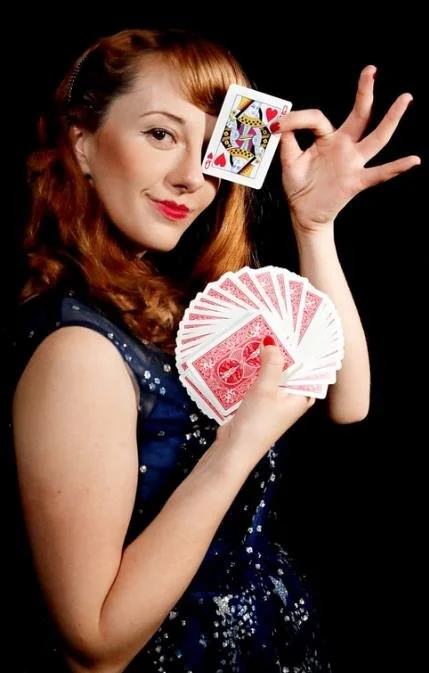
If you'd like a corporate magician for an executive dinner, here's my case. I'm a member of the Magic Circle in London and the Academy of Magical Arts in Hollywood, I've earned multiple magic awards, and I've performed for companies including Formula 1, the Olympics, Porsche, Prada, Zapier, and the Ritz Carlton, with appearances on Penn & Teller: Fool Us and Masters of Illusion. I work particularly well with small senior groups, I blend close up magic with mentalism, which suits a room that thinks for a living, and I treat participants with care so nobody is ever the joke. I need no stage, sound, or setup, so a private dining room works exactly as it is, and I'm fully insured.
Frequently Asked Questions
Isn't twelve people too few for entertainment?
For most entertainment, yes, since almost all of it is designed for scale and draws energy from a crowd. A stage act performing to twelve at a dinner table is uncomfortable for everyone, which is why organisations stop looking. Close up magic is the exception, because it's built for exactly this situation rather than being a scaled down version of a show.
Does it really work better with a small group?
It does, which surprises people. At a reception for two hundred a performer reaches groups in sequence and most guests get a few minutes, whereas at a dinner for fourteen everyone sees everything from a few feet away and the whole group shares each reaction. A corporate magician at an executive dinner is working in the format's ideal conditions rather than adapting.
How do you avoid embarrassing senior people?
By treating it as the entire requirement. Senior people cannot be made to look foolish in front of peers, a board, or their team, and a participant should become the person something extraordinary happened to rather than the butt of anything. Ask any performer directly how they handle senior participants and expect an answer reflecting experience, since this is the one risk that matters here.
When during the evening should it happen?
Between courses, when a long dinner has natural gaps and conversation at a table of twelve fragments into separate ones. That gives the whole table a shared focus without interrupting service or moving anyone. Some hosts prefer the drinks reception, particularly if guests don't all know each other. What fails is anything after the substantive discussion, since senior people leave promptly once business concludes.
Is this suitable for client hospitality?
Particularly, since entertaining senior clients is expensive per head and justified entirely by relationship value, and your client has also been to very good restaurants with your competitors. A corporate magician provides something they haven't had at the last three dinners, gives them a story with your organisation attached, and creates the moment where a business relationship becomes a human one.
What about confidentiality?
It should be treated as a requirement rather than a courtesy. These evenings frequently involve conversations that aren't public and people whose presence isn't advertised, so expect no photographs, no social media, no mention of who was present, and no lingering afterwards. Performers who work at this level understand that, and it's worth confirming at the outset alongside insurance and terms.
How do I book you, and what do you need to get started?
Reach out with your date, the venue or restaurant, how many will attend, and whether it's an internal, board, or client dinner. That's enough for me to check availability and send a quote. It's also worth telling me anything sensitive about the group or the moment, since calibration is most of the job at this kind of event and a minute of briefing changes what I can do.

The Format Built for This Room
A dinner for a dozen senior people is the situation most entertainment cannot serve, which is why so many of these evenings consist of a good menu and hope. A corporate magician performing close up magic is the exception: it needs no stage or crowd, it works better at fourteen than at two hundred, it moves a formal room to something human before the conversation that matters, and it treats everyone in it with the dignity a senior audience requires.
If you're planning a board dinner, an executive evening, or hospitality for a small group of clients, I'd be glad to hear about it.
Reach out with your date and the shape of the evening, and let's talk.