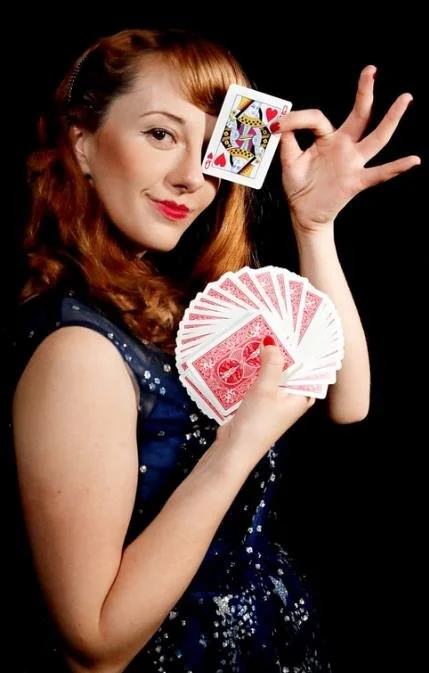


San Francisco Magician for Product Launches and Customer Events
San Francisco Magician for Product Launches and Customer Events
A launch event exists to get people in a room with your product and your team, and to have them leave with an impression that lasts longer than the evening. Everything else in the room either serves that or works against it.

That's a narrower brief than a party, and entertainment frequently gets booked without anybody checking which side it falls on. I'm Magical Katrina, an award winning magician and mentalist, and I want to explain where a San Francisco magician fits into a product launch or customer event, which is around the demos rather than instead of them.
The Product Is the Point
Start with the constraint that governs the whole evening. Guests came to see something, your team wants to show it, and anything competing for the room's attention reduces the number of people who actually engage with it.
That rules out anything with a stage, a focal point, or a scheduled moment where everybody watches. What works is something that keeps people in the room, circulating, and available for conversation, which is a supporting role rather than a starring one. Among San Francisco magician bookings, a launch is where the format's ability to work in small groups matters most.
Keeping People There Is the Objective
The practical version. A guest who arrives, takes a drink, glances at a demo, and leaves in twenty five minutes has attended without absorbing anything, and a launch full of those is an expensive evening that produced nothing.
Something happening extends that considerably. People stop, engage, and stay longer than they planned, which is precisely the condition under which your team can have a real conversation rather than a handshake. Dwell time is the metric a launch actually runs on, and it's the one entertainment affects directly.
Your Team Needs Openings
Worth planning for, since it's where launches underperform. Approaching a guest cold at a launch is awkward for both parties, and your people spend the evening looking for a way in while guests stand with whoever they arrived with.
A group that has just reacted to something together is considerably easier to join, and the conversation starts from a shared moment rather than a pitch. Brief your team on that before the doors open, since the value isn't the entertainment but what it makes possible, and a team standing at the side watching a performer is wasting the thing they were given.
Your Audience Will Try to Work It Out
The Bay Area factor. A launch or developer event here fills a room with engineers, researchers, and product people whose instinct on encountering something impossible is to reverse engineer it.
That's an advantage rather than an obstacle, since someone applying genuine analytical attention who still cannot account for what happened is more affected than a casual observer. It also gives them something to discuss with the person next to them, which at an event where guests mostly don't know each other is exactly what you need happening near your demos.
Press and Analysts Are Working
Worth knowing about the register. Launch guest lists frequently include press, analysts, and investors who are there professionally rather than socially, and who are assessing rather than relaxing.
Entertainment demanding participation or enthusiasm is misjudged for that group. What works is something they can encounter while doing what they came to do, which for people circulating and forming views is exactly what strolling close up work is. Nobody has to stop, gather, or perform interest, and they get something worth mentioning in a write up that otherwise covers the product alone.
Your Venue Is Probably an Office
Practically, launches here happen in company offices, converted spaces, and venues booked for character rather than facilities, frequently with demo stations consuming whatever floor area exists.
Close up magic needs no stage, power, sound, or footprint, works in an office reception or around demo tables exactly as it is, and doesn't compete with a demo for space you're already short of. For an event where every square foot is either a person or a product, entertainment occupying none of it is worth more than it appears.

Don't Let It Become the Event
Worth stating plainly, since it's the failure mode. A performer who draws a crowd and holds it has created a second attraction competing with the one you're launching.
What you want is continuous small groups turning over every few minutes, which keeps people circulating through the space rather than gathering in one part of it. Ask any performer whether they work that way rather than gathering an audience, since at a launch the distinction is the difference between supporting your event and distracting from it.
Measure Conversations, Not Attendance
Worth deciding in advance. A headcount tells you about your invitation list, and what matters is whether your team had substantive conversations and whether guests left with the product in mind.
Ask your team afterwards how many genuine conversations they had compared with a typical launch, which is a more useful measure than a door number and is the thing entertainment actually affects. Forty guests who stayed an hour and talked to somebody beats eighty who passed through.
A Note on "Local vs. Traveling In"
Worth knowing: performers who travel to the Bay Area work from a different calendar than those based there, which matters during the conference weeks when launches cluster and local performers are committed. Travel is discussed openly and factored into the quote. I'm based in the Los Angeles area and travel to San Francisco and the wider Bay Area.
Why Book Magical Katrina
If you're launching something, here's my case. I'm a member of the Magic Circle in London and the Academy of Magical Arts in Hollywood, I've earned multiple magic awards, and I've performed for companies including Formula 1, the Olympics, Porsche, Zapier, and the Ritz Carlton, with appearances on Penn & Teller: Fool Us and Masters of Illusion. I work small groups continuously rather than gathering crowds, I hand people back to your team rather than holding them, and I need no stage, power, or floor space.
Frequently Asked Questions
Won't entertainment distract from the product?
Only if it's the wrong format, and that's the genuine risk. Anything with a stage, a focal point, or a scheduled moment competes with what you're launching, whereas something working in small groups keeps people in the room, circulating, and available for conversation. The role is supporting rather than starring.
What are we actually buying?
Dwell time, since a guest who arrives, glances at a demo, and leaves in twenty five minutes has attended without absorbing anything. Something happening extends that considerably, and people who stay longer than they planned are the ones your team can have a real conversation with rather than a handshake.
How does it help our team?
By creating openings, since approaching a guest cold is awkward for both parties and your people spend the evening looking for a way in. A group that has just reacted to something together is far easier to join, and the conversation starts from a shared moment rather than a pitch. Brief your team beforehand.
Will it land with a technical audience?
Better than with most, since a launch or developer event here fills a room with people whose instinct is to reverse engineer what they've seen, and someone applying genuine analytical attention who still can't account for it is more affected than a casual observer. It also gives them something to discuss near your demos.
Press and analysts will be there. Does that matter?
It rules out anything demanding participation or enthusiasm, since they're there professionally rather than socially and are assessing rather than relaxing. What works is something they encounter while circulating and forming views, and it gives them something worth mentioning in a write up that otherwise covers the product alone.
Our venue is an office with demo stations everywhere. Does that work?
Yes, and it's the usual situation. Close up magic needs no stage, power, sound, or footprint, works in a reception area or around demo tables exactly as it is, and doesn't compete with a demo for space you're already short of. For an event where every square foot is a person or a product, that matters.
How do we stop it becoming the main attraction?
Book someone who works continuous small groups rather than gathering a crowd, since a performer who draws forty people and holds them has created a second attraction competing with your launch. Ask directly how they work, since at a launch that distinction is the difference between supporting your event and distracting from it.
How do I book you, and what do you need to get started?
Reach out with your date, the venue, expected numbers, and whether press or customers will be present. That's enough for me to check availability and send a quote including travel, and I'll work in small groups that keep people moving through your space rather than gathering them in one corner of it.

Support the Launch, Don't Compete With It
A launch event succeeds when guests stay long enough to see the product properly and talk to someone from your team, which means everything else in the room should be keeping them there rather than pulling attention elsewhere. A San Francisco magician working in continuous small groups does exactly that: extending dwell time, giving your team openings that don't require a cold approach, occupying no floor space among the demos, and giving an analytical room something they can't immediately explain.
Just make sure you've booked someone who works the room rather than gathering it.
Reach out with your date and venue, and let's talk about the evening.