

Strolling Magician Los Angeles for Dinner Parties and House Gatherings
Strolling Magician Los Angeles for Dinner Parties and House Gatherings
A dinner party has a shape everybody recognizes. Drinks, a first course where the table finds its feet, a main course where the conversation is genuinely good, and then a stretch after the plates are cleared where the evening either lifts or quietly starts winding towards people checking the time.

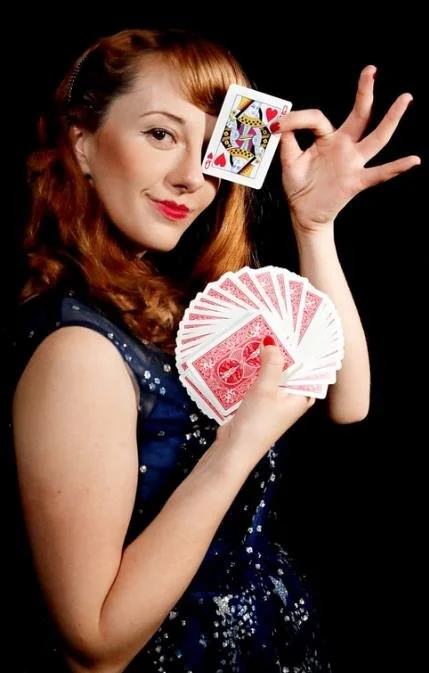
That second half is where something helps. I'm Magical Katrina, an award winning magician and mentalist based right here in Los Angeles, and I want to set out what a strolling magician Los Angeles does at a dinner party or house gathering of twelve to thirty people.
The Evening Has a Natural Dip
Start with the thing hosts recognize without naming. After the main course, the table has had the conversation it came to have, people have paired off with whoever they're next to, and the energy either gets a lift or starts declining.
A host usually tries to supply that themselves, by opening more wine, moving people around, or suggesting something. Something arriving between courses does it without the host having to engineer anything, and a table that has reacted to something together talks differently afterwards. That's the function, and it's more useful at a dinner than at any other kind of party.
Table Magic Fits a Seated Evening
Practically, the format suits a dinner more neatly than it suits a reception. Guests are seated, they aren't going anywhere, and there are natural gaps between courses while plates are cleared and the next thing arrives.
A performer works those gaps, moving around the table or between tables without requiring anybody to stop eating or face a particular direction. Nothing is scheduled, nothing interrupts, and the meal proceeds exactly as planned. For a host who's spent two days cooking, entertainment that doesn't touch the timings is the only kind worth considering.
Twelve People Is Ideal
Worth saying, since hosts assume small numbers don't justify it. Close up magic improves as the group shrinks, because everybody sees everything from a few feet away and the whole table shares each moment rather than hearing about it afterwards.
A dinner for twelve is better conditions than a party of two hundred, not worse. It also means every guest gets the full experience rather than a proportion of the room catching some of it, which at a dinner where you invited each person deliberately is what you'd want.
You're Cooking, Which Means You're Absent
The host's problem, and it's particular to dinners. You're in the kitchen between courses, plating, checking, and serving, which means you miss stretches of your own party and spend the rest of it half listening for something boiling over.
A performer working the table during exactly those gaps means your guests are having a good time at the moments you can't be there. Hosts mention that afterwards more than anything else, and at a dinner party, where the host is structurally absent at intervals, it does more than it would at a standing party.
Mixed Tables Don't Always Mix
Worth planning around, since dinner parties frequently assemble people who don't all know each other. Work friends, neighbors, a couple somebody brought, and family, seated together and expected to find common ground.
Conversation at a table of twelve fragments into two or three clusters within minutes, and the people at the ends talk to each other all night. Something the whole table reacts to together resets that, which is one of the few things that does. For a host whose seating plan was a small act of optimism, it's the mechanism that makes it work.

Your Guests May Be Hard to Impress
The local consideration. An LA dinner table frequently includes people who work in or adjacent to entertainment, who make convincing things professionally and have seen a great deal.
Scale won't impress them and intimacy might, since something impossible happening six inches from somebody's face, with no crew and no camera, is precisely what large production can't deliver. People who understand how effects are constructed frequently react hardest, because their usual explanations aren't available to them at that distance.
Nothing to Set Up, Nothing to Clear
Practically decisive in a home. A strolling magician Los Angeles performing close up needs no stage, power, sound, or floor space, arrives with a case, and sets up in the time it takes to take a coat.
That matters at a dinner party more than at a venue, since there's no spare room, no corner that isn't being used, and nobody to dismantle anything at midnight. At the end of the evening there's nothing to clear beyond the glasses you already have, which after two days of cooking is the only acceptable arrangement.
Being Local Keeps It Simple
Worth mentioning for a private evening. Unlike a performer travelling in, I'm based right here in the LA area and serve all of Southern California, so there are no travel costs on a private budget and no logistics to coordinate.
It also means flexibility if your evening shifts, which with a dinner party it frequently does once people are relaxed and nobody wants to move to the next thing on time.
Why Book Magical Katrina
If you're hosting a dinner, here's my case. I'm based in the LA area, I'm a member of the Magic Circle in London and the Academy of Magical Arts in Hollywood, I've earned multiple magic awards, and I've performed for clients including Formula 1, the Olympics, Porsche, and Prada, with appearances on Penn & Teller: Fool Us and Masters of Illusion. I work between courses without touching your timings, I need nothing from your house, and I'm as happy at a table of twelve as at a party of two hundred.
Frequently Asked Questions
When in the evening does it work best?
After the main course, since that's where a dinner party has its natural dip: the table has had the conversation it came for, people have paired off with whoever they're next to, and the energy either lifts or starts declining. Something arriving then does what a host usually tries to engineer themselves.
Will it interrupt the meal?
No, since a performer works the natural gaps between courses while plates are cleared and the next thing arrives, moving around the table without requiring anybody to stop eating or face a particular direction. Nothing is scheduled and your timings proceed exactly as planned.
Is twelve people too few?
Better rather than worse, since close up magic improves as the group shrinks and everybody sees everything from a few feet away, with the whole table sharing each moment. Every guest gets the full experience rather than a proportion of the room catching some of it.
I'll be cooking. Does that matter?
It's rather the point, since you're in the kitchen between courses and structurally absent from stretches of your own party. A performer working the table during exactly those gaps means your guests are having a good time at the moments you can't be there, which hosts mention afterwards more than anything else.
Our guests don't all know each other. Does it help?
Considerably, since conversation at a table of twelve fragments into two or three clusters within minutes and the people at the ends talk to each other all night. Something the whole table reacts to together resets that, which is one of the few things that does.
Some of our guests work in entertainment. Will they be impressed?
Frequently more than anybody, since scale won't impress them and intimacy might: something impossible six inches from their face with no crew or camera is what large production can't deliver. People who understand how effects are constructed react hardest when their usual explanations aren't available.
What do you need from our house?
Somewhere to leave a case and nothing else, since close up magic needs no stage, power, sound, or floor space and sets up in the time it takes to take a coat. There's nothing to clear at the end beyond the glasses you already have.
How do I book you, and what do you need to know?
Reach out with your date, the area, guest numbers, and roughly how the evening is structured, including whether it's seated throughout or starts with drinks. That's enough for me to check availability and send a quote, and being local means no travel costs and flexibility if the evening shifts.

Lift the Second Half
A dinner party's first half takes care of itself and its second half is where hosts quietly work. A strolling magician Los Angeles addresses exactly that: arriving in the gaps between courses without touching your timings, resetting a table that has fragmented into clusters, giving your guests something at the moments you're in the kitchen, and leaving nothing to clear at the end of the night.
Twelve people around a table is the best version of this rather than the smallest, and as a local there's nothing on your budget but the evening itself.
Reach out with your date and numbers, and let's talk about the evening.