

Corporate Magician for an Awards Evening or Recognition Dinner
Corporate Magician for an Awards Evening or Recognition Dinner
Awards evenings have a structural problem that everyone notices and nobody quite addresses. For the people being recognized, it's a genuinely significant night. For everyone else, it's a long dinner punctuated by applauding colleagues they may not know, in categories that don't concern them, for roughly two hours.
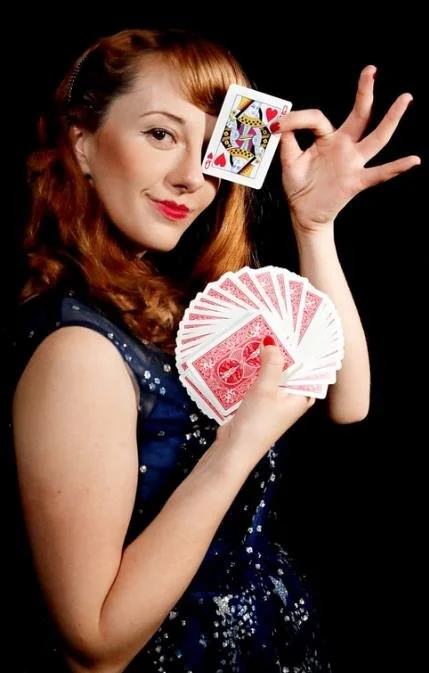
That imbalance is built into the format rather than being anyone's fault. I'm Magical Katrina, an award winning magician and mentalist, and I want to explain where a corporate magician fits into a recognition evening, which is specifically in the stretches the program doesn't serve.
Most of the Room Isn't Being Recognized
Start with the arithmetic. A typical awards evening has perhaps twelve winners and three hundred guests, which means the overwhelming majority of the room is present to witness rather than to receive.
That's fine and it's the point of having an audience, but it does mean most attendees are experiencing a long sequence of moments that belong to other people. Energy dips between categories, conversation resumes and gets shushed, and by the eighth award the applause is polite rather than warm. A corporate magician gives the evening something for the audience rather than only for the recipients, which is what most recognition dinners lack entirely.
The Reception Is Underused
Before the program starts there's almost always a drinks reception, treated as the period during which people arrive and find their tables.
It's actually the most valuable stretch of the evening, because it's the only part where guests can move, talk, and mix before being seated for two hours. A corporate magician working that reception means people arrive at dinner having already talked to someone outside their team, in a good mood, rather than filing in from a corridor. That matters for the rest of the evening, since a warm room applauds differently and a table that's already talking behaves differently through a long program.
Between Courses, Between Categories
Awards dinners are structured in blocks, and the gaps between them are where evenings lose momentum: the pause while the next presenter finds the stage, the interval between courses, the stretch after the third award when everyone has settled into passive spectating.
A corporate magician performing table side during those gaps keeps the room lifted without competing with the program. Nobody has to be gathered, no announcement is needed, and it stops entirely when the next category begins. For an evening built from segments, having something that occupies the joins rather than requiring its own segment is unusually practical.
It Gives the Evening a Second Thing
Worth stating plainly. Most awards evenings consist of exactly one element: the awards. Dinner is the vehicle and the room is the setting, but there is nothing else happening.
That places enormous weight on the recognition itself carrying two hours, which it can't quite do for people who aren't nominated. A corporate magician gives the evening a second element, so guests have something to describe afterwards besides who won what. For organizations that run this annually and struggle to make each year feel different from the last, that's frequently the easiest lever available.
Guests Who Travelled Deserve More Than a Certificate
A consideration for organization bringing people in. Winners and their managers often travel for an awards dinner, sometimes considerable distances, for a moment on stage lasting under a minute.
That's a lot of effort for a short reward, and the surrounding evening is what determines whether the trip felt worthwhile. A corporate magician contributes to that directly, giving the evening substance beyond the ceremony. It also matters for the finalists who didn't win, who travelled on the same basis and go home with nothing, and for whom the quality of the evening is the entire return on the journey.

It Takes No Program Time
Practically decisive, and the first question most organizers ask. Your run of show is already tight: welcome, dinner service, a video, categories, speeches, a closing, and something always overruns.
A corporate magician performing close up magic requires no stage, no microphone, no sound, and no slot in the program, because it happens during the reception and in the gaps between segments. For a committee that has spent weeks negotiating minutes out of the running order, entertainment that costs nothing from the schedule is unusually easy to approve, and it's often the reason this gets chosen over a band or a comedian.
It Suits a Seated Room
Something worth knowing about the format. Many entertainment options need a standing, mingling audience to work properly, which an awards dinner doesn't have once people are seated.
Close up magic is one of the few things that works perfectly at a table. Performed for eight or ten people at conversational distance, it's arguably better than working a standing crowd, since everyone sees everything and the whole table shares the reaction. A corporate magician moving between tables during the natural gaps is operating in ideal conditions rather than adapting to difficult ones.
Why Book Magical Katrina
If you'd like a corporate magician for your awards evening, here's my case. I'm a member of the Magic Circle in London and the Academy of Magical Arts in Hollywood, I've earned multiple magic awards, and I've performed for companies including Formula 1, the Olympics, Porsche, Prada, Zapier, and the Ritz Carlton, with appearances on Penn & Teller: Fool Us and Masters of Illusion. I understand that at a recognition dinner the awards are the point and the entertainment serves the room around them, so I work the reception and the gaps and stop when the program resumes. I need no stage, sound, or program time, and I'm fully insured with a COI available.
Frequently Asked Questions
Why does an awards dinner need entertainment at all?
Because most of the room isn't being recognized. A typical evening has a dozen winners and several hundred guests, so the majority are witnessing moments that belong to other people for around two hours. Energy dips between categories and applause becomes polite rather than warm. A corporate magician gives the evening something for the audience rather than only for the recipients, which most recognition dinners lack entirely.
When during the evening does it happen?
The drinks reception before the program, which is the only stretch where guests can move and mix before being seated, and then in the gaps between segments: while a presenter finds the stage, between courses, or after the room has settled into passive spectating. It stops when the next category begins, so it occupies the joins in your evening rather than requiring a segment of its own.
Does it take time from our program?
No, and it's usually the reason this gets chosen over a band or a comedian. Close up magic needs no stage, microphone, sound, or slot in the run of show, since it works during the reception and in the natural gaps. For a committee that has spent weeks negotiating minutes out of an already tight running order, entertainment costing nothing from the schedule is unusually easy to approve.
Will it work with everyone seated at tables?
Particularly well, and better than most alternatives. Many entertainment options need a standing, mingling audience, which an awards dinner doesn't have once people are seated. Close up magic performed for eight or ten people at conversational distance is arguably the format at its best, since everyone sees everything and the whole table shares each reaction rather than hearing about it afterwards.
What about guests who travelled and didn't win?
They're among the people this helps most. Finalists and their managers often travel considerable distances for a moment on stage lasting under a minute, and those who don't win go home with nothing but the evening itself. A corporate magician gives the night substance beyond the ceremony, which for those guests is the entire return on the journey they made.
Will it distract from the awards?
It shouldn't, and a professional will work to that. The awards are the point, and the entertainment exists to serve the room around them rather than compete for attention. Performing during the reception and in the gaps, stopping when the program resumes, means the recognition keeps its full weight while the stretches between categories stop losing the room. Brief your performer on the run of show and expect them to respect it.
How do I book you, and what do you need to get started?
Reach out with your event date, venue, guest numbers, and an outline of your run of show including how many categories you're presenting. That's enough for me to check availability, suggest where the magic sits, and send a quote. From there we'll settle timing around your program, and a deposit secures the date. Awards season concentrates in certain months, so early enquiries help.

Look After the Audience, Not Just the Winners
An awards evening is designed around the people receiving something, which is right, and it leaves several hundred guests spectating through an evening that belongs to others. A corporate magician fills exactly that gap: the reception nobody plans for, the pauses between categories, and the tables where guests are seated for two hours with nothing to do between rounds of applause.
If you're planning a recognition dinner and want the whole room to enjoy it, I'd be glad to hear about it.
Reach out with your date and run of show, and let's look after the audience too.