

What a Female Mentalist Actually Does: Skill, Psychology, and Why It Isn't Psychic
What a Female Mentalist Actually Does: Skill, Psychology, and Why It Isn't Psychic
The question comes up at nearly every event, usually delivered slightly nervously, as though asking might be rude: is it real? Sometimes it's asked as a challenge, sometimes as genuine hope, and occasionally by someone who has quietly decided the answer is yes and would rather not have it confirmed either way.

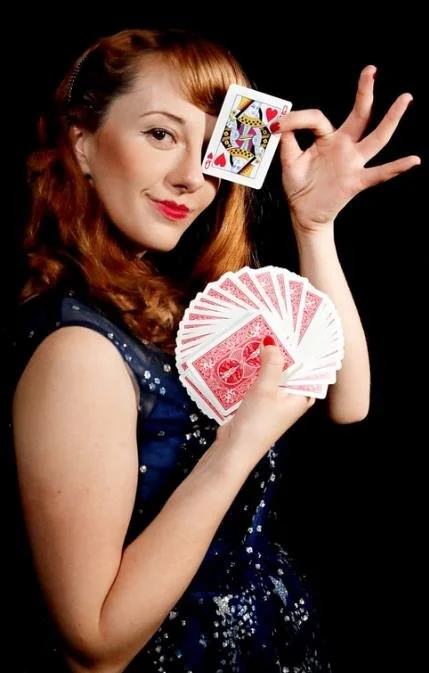
It's a fair question and it deserves a straight answer. I'm Magical Katrina, an award winning magician and female mentalist, and I want to give one, along with a broader account of what this discipline actually is, why performers disagree about how to present it, and why the honest version is both more ethical and, I'd argue, more impressive.
What Mentalism Is
Mentalism is a branch of magic concerned with the mind rather than with objects. Where traditional magic makes things vanish, appear, and transform, a female mentalist appears to know what someone is thinking, to predict a choice made freely, to influence a decision, or to reveal information she has no way of possessing.
The effects feel categorically different from card tricks, which is why mentalism suits adult and corporate audiences so well. Watching a coin disappear is delightful. Hearing a stranger say the name of the person you were thinking about is genuinely unsettling, in a way people talk about for weeks. The discipline trades in intimacy and impossibility rather than spectacle.
The Honest Answer to the Question
So: no. What I do is entertainment built on skill, practice, psychology, showmanship, and technique. It is not genuine psychic ability, and I have never met anyone who has demonstrated such a thing under conditions that would satisfy a curious observer.
A female mentalist performing ethically will tell you this freely rather than being cornered into it, and I think the field is better for performers who do. The alternative, allowing an audience to believe you possess real powers, means accepting a kind of belief from people that you know isn't warranted, and it has consequences beyond the evening, which I'll come to.
Why Honesty Doesn't Spoil It
The instinctive objection is that admitting this deflates the whole thing. In practice it doesn't, and understanding why is genuinely interesting.
The astonishment produced by mentalism doesn't depend on believing in the supernatural, it depends on being unable to explain what happened. Those are different things. When your thought is revealed and you know the performer isn't psychic, you're left with a harder and more absorbing question: then how? That question is more engaging than a supernatural explanation, which closes the matter rather than opening it. A female mentalist who is honest about the nature of the work leaves the audience with the interesting problem intact.
What the Craft Actually Involves
Without going near method, which I won't, it's worth saying what the discipline draws on, because "psychology" is often used as a vague hand wave.
Mentalism sits at the intersection of several things: an understanding of how attention works and where it goes, how people make choices they experience as free, how memory reconstructs rather than replays, and how conviction is produced in an audience. It also involves an enormous amount of unglamorous practice, and a great deal of thought about structure, timing, and how a moment is framed. The skill of a female mentalist is largely invisible by design, which is why it's so frequently mistaken for something else.
Where Performers Disagree
There's a genuine ethical divide in this field, and it's worth clients understanding it. Some performers present mentalism honestly as entertainment. Others present themselves as genuinely psychic, or maintain a deliberate ambiguity that lets audiences conclude whatever they'd like.
The ambiguous position is common because it's commercially convenient: it heightens the effect for the credulous without an outright claim. My own view is that it's a mistake, partly because it treats an audience's sincere belief as a resource, and partly because a female mentalist who cultivates that impression is trading on something adjacent to industries that genuinely harm vulnerable people. The line between an evening's entertainment and a grieving person paying for contact with the dead is thinner than it should be, and it's worth performers staying well clear of it.

Why This Matters When You're Booking
For clients, this is a practical consideration rather than a philosophical one. Your guests are a mixed group, and some of them will have views about psychic claims ranging from mild skepticism to genuine discomfort.
An honest female mentalist is comfortable for everybody in the room, because nobody is being asked to believe something. The skeptical guest can enjoy the puzzle without feeling their intelligence is being tested, and the guest who takes such things seriously isn't having a belief exploited for an evening's entertainment. For a corporate event, a wedding, or any mixed audience, that comfort is worth more than the marginal extra frisson an ambiguous performer might produce.
It Suits Skeptical Audiences Best
A useful consequence: honest mentalism plays extremely well to exactly the audiences you'd expect to be hardest. Engineers, scientists, lawyers, and anyone professionally trained in scrutiny are excellent audiences for a female mentalist, not difficult ones.
They arrive knowing it isn't psychic, which removes the argument they'd otherwise be having, and they engage with the far more interesting question of method. Someone applying genuine analytical attention who still cannot account for what happened experiences a stronger effect than a casual observer, because their certainty was better founded. The room you'd expect to be a problem is usually the room that enjoys it most.
The Woman Part
Since the keyword brings it up, a brief and honest note. Being a female mentalist has no bearing on the skill involved, and I'd be uncomfortable suggesting otherwise. Mentalism is mentalism.
What it does affect is expectation, and expectation is a working part of this discipline. The field has historically been overwhelmingly male, so audiences arrive with an image that doesn't match what they get, and the resulting recalibration is a few seconds of extra attention at the start. What happens after those seconds is entirely down to whether the work is any good. It's a small advantage in the setup, not a substitute for the craft.
Why Book Magical Katrina
If you'd like a female mentalist for your event, here's my case. I'm a member of the Magic Circle in London and the Academy of Magical Arts in Hollywood, I've earned multiple magic awards, and I've performed for clients including Formula 1, the Olympics, Porsche, and Prada, with appearances on Penn & Teller: Fool Us and Masters of Illusion, across events in over 20 countries. I perform mentalism honestly as entertainment, which makes it comfortable for a mixed audience, I blend it with close up magic for a range most performers don't offer, and I read a room carefully so participants feel like the stars rather than the subjects of an experiment.
Frequently Asked Questions
Is mentalism real?
No, in the sense people usually mean. What a female mentalist does is entertainment built on skill, practice, psychology, showmanship, and technique rather than genuine psychic ability. An ethical performer will say so freely rather than being cornered into it. That honesty is a considered position rather than a disclaimer, and it makes the performance comfortable for a mixed audience with a range of views about such claims.
Doesn't admitting that ruin the effect?
It genuinely doesn't, and understanding why is interesting. Astonishment from mentalism depends on being unable to explain what happened, not on believing in the supernatural, and those are different things. When your thought is revealed and you know the performer isn't psychic, you're left with a harder and more absorbing question, which is more engaging than a supernatural explanation that closes the matter rather than opening it.
What does the craft actually involve?
Without going near method, it draws on an understanding of how attention works, how people make choices they experience as free, how memory reconstructs rather than replays, and how conviction is produced in an audience. It also involves an enormous amount of unglamorous practice and a great deal of thought about structure, timing, and framing. The skill of a female mentalist is largely invisible by design, which is why it's mistaken for something else.
Why do some performers claim to be psychic?
Because ambiguity is commercially convenient: it heightens the effect for credulous audience members without an outright claim. I think it's a mistake, partly because it treats sincere belief as a resource, and partly because cultivating that impression trades on something adjacent to industries that genuinely harm vulnerable people. The line between an evening's entertainment and a grieving person paying for contact with the dead is thinner than it should be.
Does this matter when booking for an event?
Practically, yes. Your guests are a mixed group with views ranging from mild skepticism to genuine discomfort about psychic claims. An honest female mentalist is comfortable for everyone, since nobody is asked to believe anything: the sceptic enjoys the puzzle without feeling tested, and the guest who takes such things seriously isn't having a belief used for entertainment. For mixed audiences, that comfort is worth more than an ambiguous performer's extra frisson.
Will skeptical guests enjoy it?
Usually most of all. Engineers, scientists, lawyers, and anyone professionally trained in scrutiny are excellent audiences rather than difficult ones. They arrive knowing it isn't psychic, which removes the argument they'd otherwise be having, and they engage with the more interesting question of method. Someone applying real analytical attention who still cannot account for what happened experiences a stronger effect, because their certainty was better founded.
How do I book you, and what do you need to get started?
Reach out with your event date, location or venue, type, and rough guest count, plus the mood you're aiming for. That's enough for me to check availability and send a quote. From there we'll talk through format, whether anyone should particularly be involved or left alone, and any customization, and a deposit secures your date.

Wonder Without the Woo
The best argument for honest mentalism is that it's more interesting. A supernatural explanation resolves the mystery, whereas knowing that a person did this with nothing but skill and an understanding of how minds work leaves you with a genuinely open question and a healthy respect for the years behind it.
That's what a female mentalist performing honestly offers: complete impossibility, delivered by someone who will tell you plainly that she isn't psychic, and who is confident the work stands up without needing you to believe otherwise.
Reach out with your event details, and let's give your guests something they can't explain.