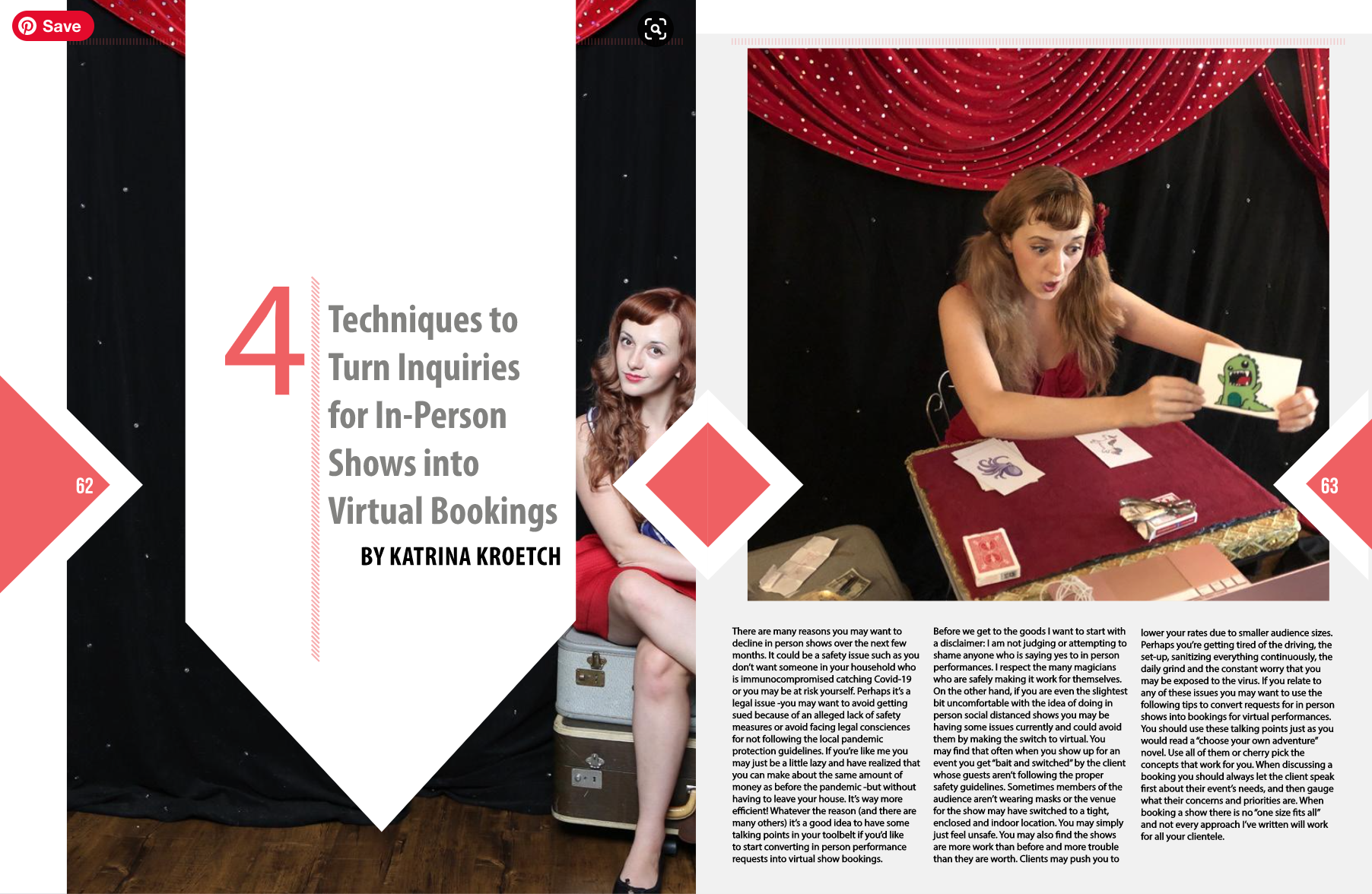
Katrina Kroetch, a circus performer and magician, does a card trick in her at-home studio.
PHOTO: COURTESY OF SHAYNE SLAUGHTER
One year ago, magic shows were some of the most sought-after experiences across the country. White’s $150-per-person show The Magician at the NoMad in New York was preparing for its fifth anniversary of sold-out performances. New York Times crossword constructor Kwong was getting ready to take his show The Enigmatist from New York’s High Line Hotel to the Geffen Playhouse in Los Angeles. Willman, a Netflix star, had suitcases ready for a nationwide tour to promote his show Magic for Humans. And Kroetch, a circus performer, had just filmed her act involving a Tinder version of a card trick on Penn and Teller’s show Fool Us, which airs on the CW.
Then the world stopped.
Like many other workers and performers, magicians’ jobs vanished. “I lost like $30,000—all of my gigs for the next few months—instantly. It was really scary,” says Kroetch. White described his show closing just before its fifth anniversary as devastating. “My whole life revolved around performing for people live,” he says.
Magician Dan White moved from New York City to Connecticut to gain studio space.
PHOTO: COURTESY OF THEORY11
Unlike other forms of entertainment, such as a musical or dance performance, magic is participatory and interactive. Audience members are asked to participate by touching items, examining objects and stepping onstage. It wasn’t as simple as just performing the in-person show online. “We couldn’t take a single trick from the in-person show because it would be like watching a music concert on YouTube versus seeing it live. The two things are not interchangeable,” says Jonathan Bayme, CEO of the production company Theory11, which produced The Magician at the NoMad and The Magic Show at the Roosevelt. “So, we realized we’d have to make a whole new show.”
When it became clear that Covid restrictions weren’t disappearing anytime soon, magicians realized they needed to go virtual to perform. This unforeseen pivot involved the magicians creating at-home studios, learning how to use new equipment and pulling together a team of remote producers. And then they had to develop new tricks.
Kwong decided to create an interactive show of puzzles, called Inside the Box, rather than traditional tricks after his impromptu quarantine Instagram Live series Puzzle Corner became popular.
“It’s very difficult to get an ambience of drama and mystery,” says Kwong. “So, I just had a different approach in the pandemic, which became my hybridization or crossover of magic puzzles.” In his show, he asks a viewer to choose a random square on a chessboard and then completes a knight’s tour, which is when a player moves the piece around a board, so it touches each square only once. In a typical Kwong show, he would have an audience member hold a piece of fruit from which a surprise would emerge later.
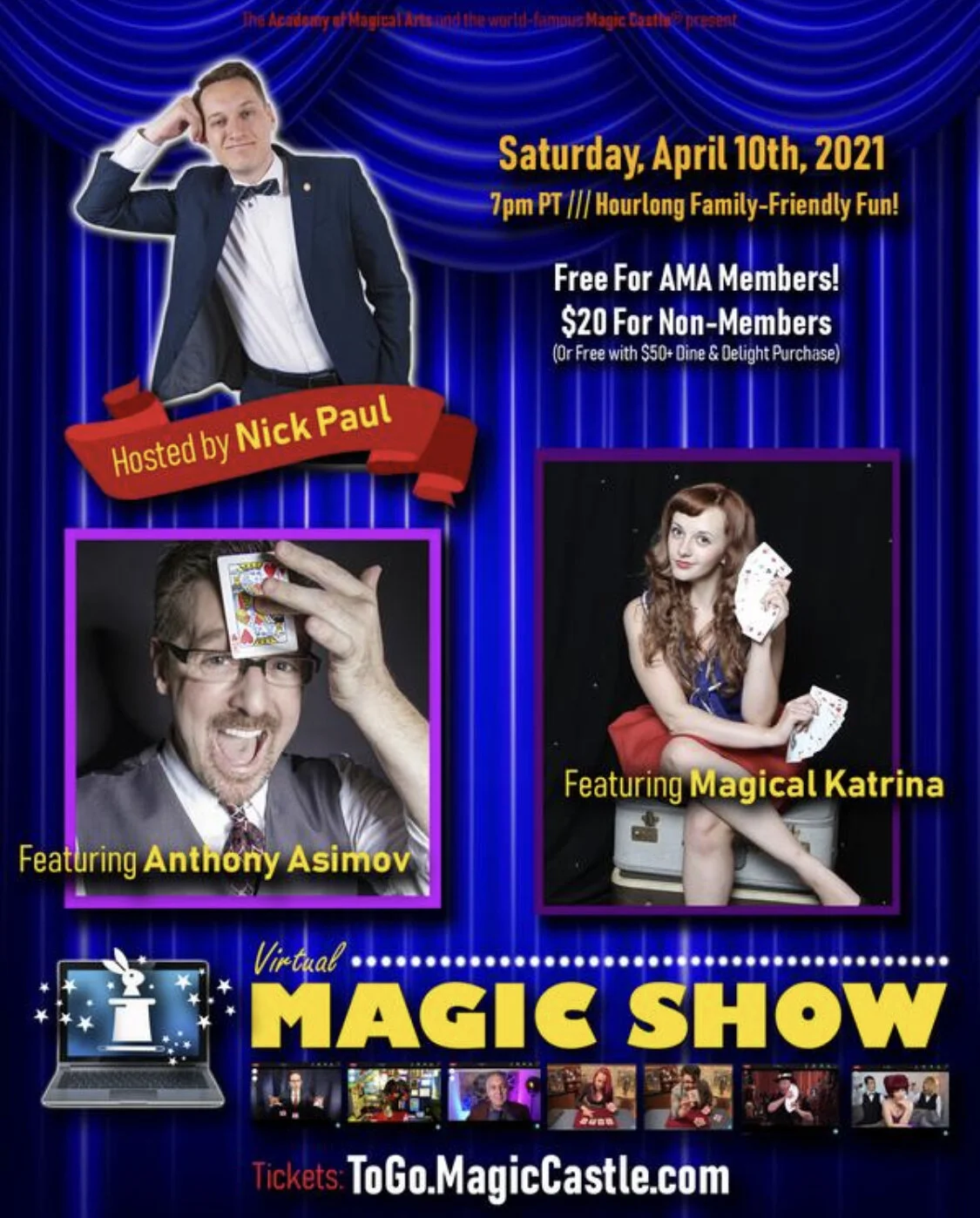
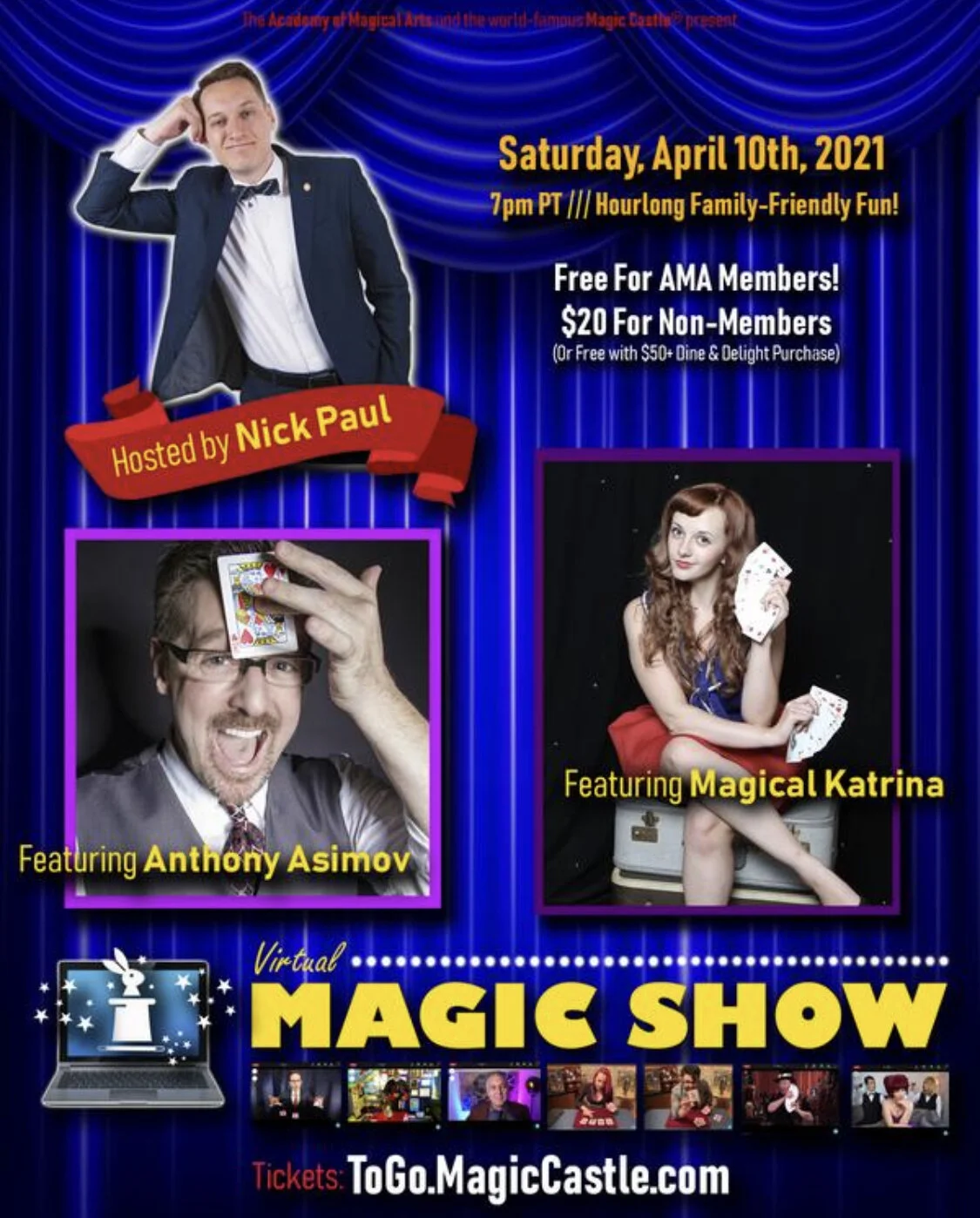
Willman, father of a 2-year-old son, embraced the work-from-home juggle and developed a large-scale family-friendly virtual performance that includes a mind-reading trick involving an audience member wearing a kitchen colander. Suran, a mentalist, altered his show to include all 30 participants, helping each viewer to move an object in their home by apparently using their thoughts. And Kroetch, who can perform up to five shows in a day, opted to book only private gigs for corporations and children’s birthday parties, developing virtual tricks such as making an audience-chosen card appear in an empty cup next to her. She prefers private shows—though a public virtual show with the famed L.A. venue the Magic Castle is scheduled for April 10—as they tend to pay better and the material can be tailored to the client.
Justin Willman has performed for over 600,000 people since August, including James Corden and Kelly Clarkson, from his dining room table.
PHOTO: COURTESY OF JILLIAN SIPKINS
For White and Bayme, they had to find a way to retain the in-person show’s upscale ambience and translate it to an intimate online performance where people would still be willing to pay $135–$155 per ticket. The result was sending a specially designed box pre-show that contains a cocktail kit and several interactive items. The box itself ultimately becomes a magical revelation.
“I didn’t want it just to be people seeing me do 20 tricks,” says White, who moved from New York to Connecticut to have space for an at-home studio setup. “It took me months to figure out a twist ending. But once I did, everything else sort of fit into place.”
For Willman, who produces the entire show on his own from his dining room, it was balancing quality control. “I wanted to create a show that was high energy, fast-paced, that had the production value of a TV show, but also rough around the edges to remind people it’s 100 percent live,” he says.
Figuring out the technological challenges was a separate feat. Kwong has a video operator, a stage manager and three house managers who help him put on his show. He’s dealt with a range of problems, from rapid-fire muting and unmuting to screaming babies, and has used emergency video placeholders to ensure a trick goes off without a hitch. Suran says of his apartment-turned-studio setup, “It took me three months just to get the right battery charger to keep the camera from dying after two hours.”
Mentalist David Kwong has a staff of five helping him produce his virtual show.
PHOTO: COURTESY OF GEFFEN PLAYHOUSE
“We’ve got thousands of years of magic books that teach how to do magic onstage, in person, close-up, comedy, etc.,” says White, who also described logistical shipping challenges with the boxes. “But no one’s ever written a book about how to do magic on Zoom. It’s a lot harder to force people to escape their reality when they’re in their own house.”
Where usually it could take years to develop new tricks and a show, magicians were forced to figure it out in months.
“We wouldn’t have had the time to come up with new things creatively,” says Bayme. “So, the constraints were a huge catalyst for creativity because once you provide the canvas, it’s much easier to paint the picture inside of it.”
“It’s this new modality where people can interact and have to have all the wonders of a magic show within the house,” says Tony Award–winning actor Alan Cumming, an executive producer on Suran’s show Reconnected.
While all the magicians agreed they are eager to return to live entertainment, the success of these shows—combined with a growing remote workforce and technological advances—has made it clear that virtual magic will become a regular part of the industry.
For one, there’s the reach. “We had [people from] Singapore the other day, and Canberra, Australia. There were three people from Spain, just in three different boxes,” says Kwong.
Jason Suran has performed at Carnegie Hall, but currently is broadcasting shows from his apartment.
PHOTO: COURTESY OF JASON SURAN