


Corporate Christmas Party Ideas for the First Christmas After a Merger
Corporate Christmas Party Ideas for the First Christmas After a Merger
The first Christmas party after a merger is not an ordinary party. Two workforces who have spent months wondering about each other are in one room, both sides notice whose traditions survived, and the evening gets read as a signal about how the combined organisation intends to behave.

That's a great deal of weight for an event with a bar and some canapés. I'm Magical Katrina, an award winning magician and mentalist, and I want to set out corporate Christmas party ideas for an organization holding its first combined Christmas, where the stakes are higher than the budget suggests.
Everything Will Be Read as a Signal
Start with the thing to accept rather than resist. After a merger, employees read every decision for information about the new organization, and a party is unusually legible: where it's held, who organized it, whose traditions appear, and who speaks.
That isn't paranoia, it's people trying to work out what happens next with limited information. The practical implication is that the choices deserve more thought than they normally would, since a party that accidentally signals that one side's culture prevailed does more damage than no party would.
Don't Let One Side Organize It
The most important structural decision. If the acquiring company's events team runs it exactly as they always have, the message is unambiguous regardless of intention.
A joint committee with genuine representation from both organizations changes what gets planned and, more importantly, changes how it's perceived. It also surfaces the traditions each side cared about, which nobody on the other side knows exist. Among corporate Christmas party ideas after a merger, who plans it matters at least as much as what they plan.
Find Out What Each Side Used to Do
Practical and genuinely useful. Most organizations have Christmas traditions they've stopped noticing: an awards moment, a particular format, a thing the chief executive always does, a charity element, a venue they always used.
Ask both sides what theirs were and why they mattered. You won't keep all of them and keeping one from each, visibly, does considerably more than any amount of messaging about integration. Dropping both and starting fresh is also a legitimate choice, provided it's a choice both sides were consulted on rather than a default nobody discussed.
Neutral Ground Helps
Worth considering, since venue is one of the most legible signals available. Holding the party at the acquiring company's usual venue, or in their office, reads exactly as you'd expect.
Somewhere neither side has used before puts everybody in the same position, which is a small thing that's noticed. If one organization is considerably larger, that matters more rather than less, since the smaller side will be alert to whether they're guests at somebody else's party. Neutral ground makes the evening a shared occasion rather than an invitation.
The Room Will Not Mix on Its Own
The practical problem, and it's reliable. People arrive with colleagues they know, which after a merger means arriving with their original company, and they stay that way all evening unless something intervenes.
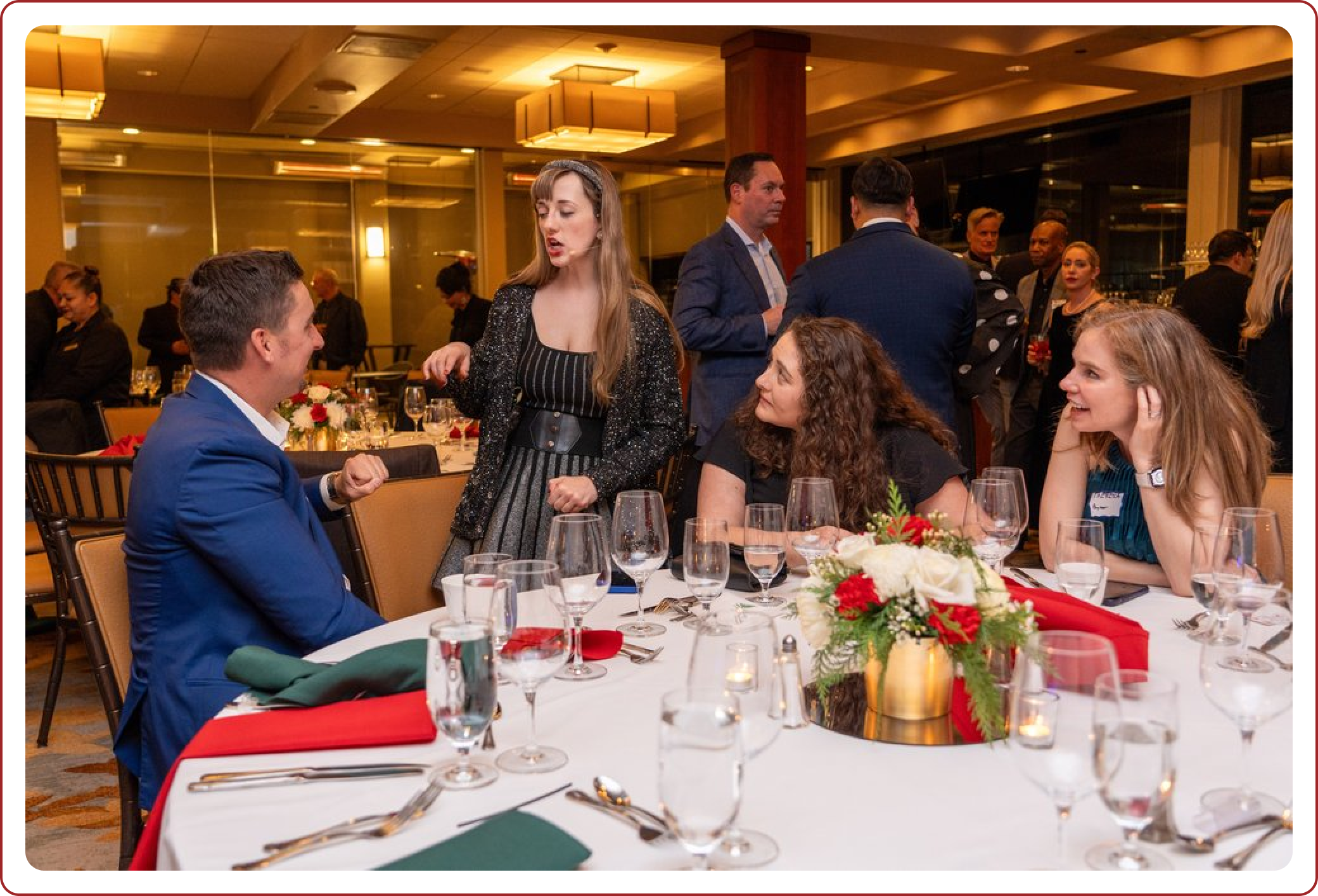
That's precisely the failure mode the party exists to prevent. Assigned seating with deliberate mixing, table hosts, and something that moves people around the room all address it, and none of them happens by default. A performer working the room reshuffles groups continuously, which is one of the few mechanisms that mixes a room without asking anybody to introduce themselves.
Name Badges Are Worth the Awkwardness
Small, mildly embarrassing, and effective. After a merger, a substantial proportion of the room doesn't know who anybody is, including people they're now expected to work with.
Badges with name, role, and original company remove a genuine barrier, since people avoid conversations where they'd have to admit not knowing who someone is. It looks like a conference and it solves the problem, and by the second hour nobody notices. If badges feel too much, consider a daytime or lunch format where they read as entirely normal.
Both Leadership Teams Should Be Visible
Worth arranging deliberately. If the combined leadership is present and visibly mixed, talking to people from both sides rather than standing with their own, the room reads it immediately.
The reverse is also true and considerably more damaging. Ask leaders from both organizations to attend, to circulate deliberately, and ideally to say something brief jointly rather than having one person speak for everybody. It costs nothing and it's the clearest available signal that the combined organization is genuinely combined.
Be Careful If Restructuring Is Ongoing
The honest caution. If redundancies or role changes are still being worked through, a celebratory party lands very differently, and some of your employees are attending an event thrown by an organization that may not employ them in March.
That doesn't necessarily mean cancelling, and it does mean keeping the scale modest, the tone warm rather than triumphant, and attendance genuinely optional. Nobody should feel obliged to celebrate an integration they're anxious about. If the process is at its most acute, postponing to a calmer month is frequently kinder than proceeding.
Say Something Short and Honest
Worth getting right, since somebody will speak. What works is brief and factual: acknowledging that it's been a year of change, that this is the first time everybody has been in one room, and thanking people genuinely.
What fails is a speech about synergy, culture, or the exciting journey ahead, which after a merger is exactly the language people have learned to discount. Two minutes, plainly said, from someone who sounds like a person rather than a statement. The room will forgive a great deal if the tone is honest.
Frequently Asked Questions
Why does this party matter more than usual?
Because after a merger employees read every decision for information about the new organization, and a party is unusually legible: where it's held, who organized it, whose traditions appear, and who speaks. A party that accidentally signals one side's culture prevailed does more damage than no party would.
Who should organize it?
A joint committee with genuine representation from both organizations, since if the acquiring company's events team runs it exactly as they always have, the message is unambiguous regardless of intention. It also surfaces traditions each side cared about that nobody on the other side knows exist.
What should we do about each side's traditions?
Ask both sides what theirs were and why they mattered, then keep one from each visibly, which does considerably more than any messaging about integration. Starting fresh is also legitimate, provided it's a choice both sides were consulted on rather than a default nobody discussed.
Does the venue matter?
It's one of the most legible signals available, since holding it at the acquiring company's usual venue or in their office reads exactly as you'd expect. Somewhere neither side has used puts everybody in the same position, which matters more when one organization is considerably larger and the smaller side is alert to being guests.
Will the two sides actually mix?
Not on their own, since people arrive with colleagues they know, which after a merger means arriving with their original company, and they stay that way all evening. Assigned seating with deliberate mixing, table hosts, and something that moves people around all address it, and none happens by default.
Are name badges too much?
Mildly awkward and effective, since a substantial proportion of the room doesn't know who anybody is, including people they're now expected to work with, and people avoid conversations where they'd have to admit that. Include name, role, and original company, and by the second hour nobody notices.
What if restructuring is still ongoing?
Keep the scale modest, the tone warm rather than triumphant, and attendance genuinely optional, since some employees are attending an event thrown by an organization that may not employ them in March. If the process is at its most acute, postponing to a calmer month is frequently kinder than proceeding.
What should leadership say?
Something brief and factual: acknowledging a year of change, noting that this is the first time everybody has been in one room, and thanking people genuinely. What fails is a speech about synergy or the journey ahead, which is exactly the language people have learned to discount after a merger.

Plan It Like the Signal It Is
The first combined Christmas party is read as evidence, which means the corporate Christmas party ideas that matter here are structural rather than decorative: a joint committee rather than one side's events team, a venue neither side owns, a visible tradition kept from each, seating that mixes people deliberately, badges so nobody has to admit not knowing who anybody is, and both leadership teams circulating rather than clustering.
Get those right and the party does something no announcement can, which is demonstrate that the combined organization intends to behave like one.
Reach out with your date and headcount, and let's talk about getting the room mixed.