






Online Magician: How to Vet One Before You Book

Online Magician: How to Vet One Before You Book

Hiring for an online event is not the same as hiring for a room, and the usual checks miss the things that actually go wrong. A performer can be genuinely excellent in person and still deliver a flat hour on a video call, because the skills only partly overlap.
That's worth knowing before you commit a company wide session to somebody. I'm Magical Katrina, an award winning magician and mentalist, and I want to set out what to check when you're booking an online magician, and which questions separate the people who do this properly from the people who moved online and hoped.

Ask for Footage of an Actual Online Show

Start with the single most useful request. Plenty of performers advertise virtual work using footage of live stage performances, which tells you nothing about how they are on camera.

Ask for a recording of a real online session with a real audience, not a promotional edit and not a showreel. If somebody can only offer stage footage, they may still be excellent and you're taking a risk you don't need to take. Anybody who does this regularly has recordings, because clients ask for them.

Look at Their Setup, Not Just Their Act

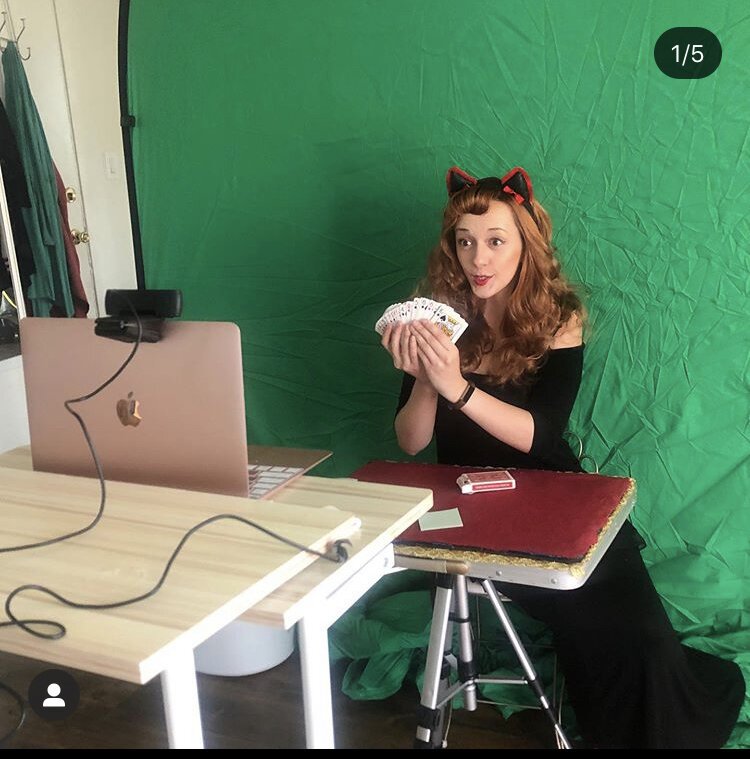
Practically important and easy to assess from footage. Check the lighting on their face, whether the camera is at eye level, the audio quality, and whether the background is considered rather than accidental.

None of that is vanity. A dark, badly framed window with echoing audio is tiring to watch for an hour, and your audience will disengage from it regardless of how good the material is. Somebody who has invested in a proper setup has taken the format seriously, and that tells you something about the rest of it.

Ask How They Handle a Room With Cameras Off

The question that reveals the most. A performer used to a visible gallery will struggle badly when four hundred people join with cameras off, which is what happens at most large corporate sessions.

A good answer describes building around chat, simultaneous actions everybody can do at home, polls, and a small number of prepared volunteers. A vague answer, or an insistence that everybody must have cameras on, tells you they're expecting a room they won't get. Ask before you book rather than discovering it on the day.

Check They've Worked at Your Scale

Worth confirming, since thirty and three hundred are different jobs. A session that works beautifully for a team of twenty five relies on naming individuals and responding to people, and none of that is available at scale.

Ask directly how many they've performed for online and how the approach changes. Somebody who has done both will explain the difference without prompting. Somebody who treats them as the same booking has probably only done the small version.

Ask About Your Platform Specifically

Practically relevant and frequently skipped. Meeting format and webinar format behave differently, and some organizations use platforms other than the obvious ones, with their own restrictions on chat, reactions, and participant visibility.

Say which platform and which format you'll be using and ask whether they've worked in it. A performer who knows your setup can design the interaction around what it actually permits, and one who doesn't may have built an hour around features your IT team has disabled.

Find Out What Your Attendees Have to Do

Worth establishing precisely. Anything requiring guests to install an app, create an account, open a second window, or type into a form will lose a portion of your audience, and the proportion is larger than people expect.

The best answer is that attendees need nothing beyond joining the call. If props or materials are involved, ask what they are, whether everyday household items work, and what happens for the people who don't have them. A session that only works for the prepared half of your audience is worse than one that works for everybody.

Ask What Happens If Their Connection Drops

The contingency question most people never ask. Internet fails occasionally, and the difference between a professional and an amateur is whether there's a plan.

A good answer involves a backup connection, a phone hotspot, and a clear arrangement about what your host should do in the meantime. No answer at all means you're the contingency plan. It takes one question and it's the single most likely technical failure of the day.

Run the Same Checks You'd Run Anyway

Worth remembering, since online bookings can feel more casual. Confirmation of insurance, terms in writing including cancellation on both sides, and a clear written quote with everything included still apply.

The fact that nobody is entering your building doesn't change the commercial basics, and a performer who treats an online booking as too informal for paperwork will likely treat other things casually too.

Why Book Magical Katrina

If you're assessing people for an online event, here's my case. I'm a member of the Magic Circle in London and the Academy of Magical Arts in Hollywood, I've earned multiple magic awards, and I've performed for clients including Formula 1, the Olympics, Porsche, Prada, Zapier, and the Ritz Carlton, with appearances on Penn & Teller: Fool Us and Masters of Illusion. I can send footage of real online sessions, I work in meeting or webinar format and build around cameras off, your attendees need nothing beyond joining the call, I run a backup connection, and I provide insurance and written terms the day you ask.

Frequently Asked Questions

What's the most useful thing to ask for?

Footage of a real online session with a real audience rather than stage footage or a promotional edit, since plenty of performers advertise virtual work using live recordings that tell you nothing about how they are on camera. Anybody who does this regularly has recordings.

Does their setup really matter?

Yes, since a dark, badly framed window with echoing audio is tiring to watch for an hour and your audience disengages regardless of the material. Check lighting, camera height, audio, and background, since somebody who invested in those took the format seriously.

What single question reveals the most?

How they handle a room with cameras off, since that's what happens at most large corporate sessions. A good answer describes chat, simultaneous actions, polls, and prepared volunteers, while insisting everybody must have cameras on means they're expecting a room they won't get.

Does audience size matter when choosing?

Considerably, since thirty and three hundred are different jobs and a session built on naming individuals doesn't scale. Ask how many they've performed for online and how the approach changes, since somebody who has done both explains the difference without prompting.

Should I mention our platform?

Always, including whether it's meeting or webinar format, since they behave differently and some organizations restrict chat, reactions, or participant visibility. A performer who knows your setup designs around what it permits rather than around disabled features.

What should our attendees have to do?

Nothing beyond joining. Anything requiring an app, an account, a second window, or typing loses a portion of your audience, and if props are involved ask whether everyday items work and what happens for people who don't have them.

What if their internet fails?

Ask, because it's the most likely technical failure of the day. A good answer involves a backup connection, a hotspot, and a clear plan for what your host does meanwhile, while no answer means you're the contingency.

Do the usual checks still apply?

Yes. Insurance, written terms including cancellation both ways, and an inclusive written quote all still matter, and a performer treating an online booking as too informal for paperwork will likely be casual about other things too.

Check the Format, Not Just the Performer

The mistake in hiring an online magician is assuming that somebody good in a room will be good on a call. Those are related skills and not the same one, and the gap shows up in exactly the places you can check in advance.

Ask for footage of real online work, look at their lighting and audio, ask how they handle a silent gallery, confirm they've worked at your scale and in your platform, establish that your attendees need nothing, and find out what happens if their connection drops. Six questions, one afternoon, and almost everything that goes wrong is covered.

Reach out and I'll send you footage, written terms, and honest answers to all six.

Katrina Kroetch
Magician Rental Near Me: Is It Worth It for a Small Event?

Magician Rental Near Me: Is It Worth It for a Small Event?

Plenty of people never make the enquiry. They've got fourteen people coming to a dinner, or twenty to a fortieth, and they assume a performer is something you book for a function with two hundred guests and a stage.

That assumption gets it backwards. I'm Magical Katrina, an award winning magician and mentalist, and I want to explain why a small gathering is frequently the best possible setting for this, and how to think about a magician rental near me search when your guest list is short.

Small Rooms Are the Ideal, Not the Exception

Start with the thing most people have wrong. Close up magic is performed at conversational distance, frequently in somebody's hands, for a few people at a time. That's what it is and what it's built for.

At a party of two hundred, a performer moves between groups and most guests get a few minutes. At a dinner for fourteen, everybody gets the full experience with time to spare, and nobody is watching from across a room. The small event isn't a compromised version of the large one, it's the version the art form was designed for.

Everybody Will Actually See It

Practically the biggest difference. At a large event, a proportion of your guests will miss the performer entirely because they were at the bar, outside, or deep in conversation when he came round.

With twelve or twenty people, that doesn't happen. Every single person you invited gets the whole thing, which means the money you spent reached one hundred percent of your guests rather than sixty. Thought about per person, a small booking frequently delivers better value than a large one, which is the opposite of what people assume.

It Becomes Personal Rather Than Performed

Worth understanding, since it changes the character of the evening. In a small room, a performer learns names, picks up on what's happening between people, and can build around the occasion and the guest of honor.

That's simply not possible at scale. A fortieth for eighteen people can be about the person whose birthday it is in a way that a party for two hundred can't, and that's the thing guests talk about afterwards. The intimacy people worry is a drawback is actually the main benefit.

Your Living Room Is a Fine Venue

Worth saying plainly, since it's the other common hesitation. People imagine entertainment requires a stage, a space, lighting, or a proper venue, and worry their home or a private dining room isn't suitable.

None of that is needed. Close up magic works in a sitting room with the furniture where it is, around a dinner table, in a small private room at a restaurant, or in a garden. No power, no sound, no setup, nothing to move and nothing left behind. If you can seat your guests, the venue works.

The Cost Question Is Fair

Worth addressing honestly, since it's the real hesitation underneath. A booking for twelve people costs broadly what a booking for a hundred costs, because the performer's time, travel, and preparation are the same either way, so the per guest figure is higher.

That's true, and it's worth weighing against what else that money does at a small event. A better bottle of wine across fourteen people is barely noticed, while an hour of something nobody expected is the thing they describe to other people. For an occasion that matters, it's usually the line that produces the most per pound spent.

It Solves the Awkward Part of Small Gatherings

Practically useful and rarely mentioned. Small events have a social shape: there's a lull after the main course, a stretch where conversation has split into two groups, and sometimes guests who don't know each other and are running out of material.

Something happening resets all of that. It gives a dinner a middle, brings a split table back together, and hands strangers something to talk about. At a large party the room generates its own energy; at a dinner for fourteen, it doesn't always, and that's precisely where a booking earns its place.

Ask About a Shorter Booking

Worth knowing for budget. A small event rarely needs the hours a large one does, since coverage isn't the issue when everybody is in one room.

Ask what a shorter booking costs. Plenty of performers will do a reduced slot for a small gathering, and an hour at a dinner for fourteen achieves what two hours achieves at a party for a hundred. You may find the figure is considerably more manageable than the one you were bracing for.

Say It's Small When You Enquire

Worth doing in your first message, since some people hide it. There's nothing embarrassing about fourteen guests, and a performer who works these settings will be pleased rather than dismissive.

It also gets you a better answer. Somebody told the real size can tell you honestly whether the format suits, suggest a shorter booking, and plan something built for that room rather than scaled down from something else. Anybody who seems uninterested in a small event has told you something useful about whether they're right for yours.

Why Book Magical Katrina

If your event is small, here's my case. I'm a member of the Magic Circle in London and the Academy of Magical Arts in Hollywood, I've earned multiple magic awards, and I've performed for clients including Formula 1, the Olympics, Porsche, Prada, and the Ritz Carlton, with appearances on Penn & Teller: Fool Us and Masters of Illusion. Small rooms are where this work is at its best, I need no stage, power, sound, or setup so your home or a private dining room works exactly as it is, I'll happily discuss a shorter booking, and I'm fully insured with a certificate available if your venue asks.

Frequently Asked Questions

Is my event too small to book a magician?

Almost certainly not, since close up magic is performed at conversational distance for a few people at a time, which is what a small gathering is. The small event isn't a compromised version of a large one, it's the setting the work was built for.

What's the main advantage of a small group?

Everybody sees it. At a large party a proportion of guests miss the performer entirely because they were at the bar or outside, whereas with twelve or twenty people every guest gets the whole thing.

Does it feel different in a small room?

Considerably, since a performer learns names, notices what's happening between people, and can build around the occasion and the guest of honor. A fortieth for eighteen can be about that person in a way a party for two hundred can't.

Will it work in my house?

Yes, since close up magic needs no stage, power, sound, or setup and works in a sitting room with the furniture where it is, around a dinner table, in a private restaurant room, or in a garden. If you can seat your guests, the venue works.

Isn't it expensive per person?

Higher per guest, yes, because the performer's time, travel, and preparation are the same either way. Weigh it against what else that money does at a small event, since a better bottle of wine across fourteen people is barely noticed while an hour of this is what they describe afterwards.

What problem does it actually solve at a dinner?

The lull after the main course, the table that's split into two conversations, and guests who don't know each other running out of material. A large party generates its own energy and a dinner for fourteen doesn't always, which is where it earns its place.

Can we book for less time?

Usually yes, and it's worth asking, since coverage isn't the issue when everybody is in one room. An hour at a dinner for fourteen achieves what two hours achieves at a party for a hundred, and the figure may be more manageable than you expect.

Should I mention the size when I enquire?

Yes, in your first message, since there's nothing embarrassing about fourteen guests and somebody told the real number can advise you honestly and plan for that room. Anybody who seems uninterested in a small event has told you something useful.

Small Is the Setting, Not the Compromise

The most common reason people don't make a magician rental near me enquiry is a belief that their event is too small to warrant it, and that belief is simply wrong. Every guest sees everything, the performer can build around the person the evening is for, your own home works as a venue, and a shorter booking is usually available.

If you've got a dinner for fourteen and you'd been assuming this wasn't for you, it's worth the email to find out.

Reach out with your date, how many are coming, and where it's happening, and I'll tell you honestly whether I think it suits.

Katrina Kroetch
Women's History Month Event Ideas for Global Organisations

Women's History Month Event Ideas for Global Organisations

Organizations with offices in several countries discover something awkward each March: the thing being marked isn't the same everywhere. Some countries observe a whole month, some focus on a single day in early March, some treat that day as a public holiday, and in some places it has a political history your local team understands far better than headquarters does.

Running one global program across that is a real planning problem. I'm Magical Katrina, an award winning magician and mentalist, and I want to offer Women's History Month event ideas for organizations trying to do this across borders.

One Date Is Not the Same Date Everywhere

Start with the practical confusion. International Women's Day falls on the eighth of March and is marked widely around the world, while a month long observance is more common in some countries than others, and the two are frequently conflated in global communications.

Decide which you're marking and say so plainly. A global program that calls itself one thing while scheduling the other confuses local teams who then have to explain it. If you want a single moment everybody shares, the eighth is the obvious anchor. If you want a program, the month gives you room and the day gives you a focal point within it.

Let Local Offices Do Local Things

The structural decision that determines whether this works. Headquarters providing one centrally produced event for every region produces something nobody feels ownership of, delivered at an hour that suits one time zone.

The better shape is one shared global moment plus local programs that each office designs. Central teams supply the budget, the framing, and something everybody can join, and local teams decide what actually suits their colleagues. That's less tidy to report on and it's the version people attend.

Somebody Is Always on a Terrible Hour

Practically unavoidable for a global session. A live event cannot suit offices across eight time zones, and the hour that works for headquarters is somebody's evening and somebody else's early morning.

Rotate it between years if this is annual, or run the same session twice at different hours rather than asking one region to always be the one that stays late. The teams on the edges notice who the schedule is built around, and alternating costs very little while saying something.

Recordings Do Less Than You Expect

Worth being honest about. The default answer to time zones is to record it and share it afterwards, and the recording is watched by very few people.

Anything whose value is in being there live loses most of it on playback, particularly something interactive. If a region matters to you, give them a live session of their own rather than a video, and if that isn't possible, be honest that they're getting the lesser version rather than pretending the recording is equivalent.

Local Context Varies More Than You Think

Worth taking seriously before you send a global communication. The way this period is marked, what it means politically, and how comfortable colleagues are discussing it differ considerably between countries.

Ask your local teams rather than assuming. In some places the day is a long established public occasion; in others the framing used by headquarters will read as foreign or awkward. A central team that checks first avoids a communication that lands badly somewhere it didn't anticipate, and local colleagues almost always have a clear view if asked.

Language Is the Practical Barrier

Worth planning for, since it shapes what you can program. A global session delivered in English reaches colleagues with varying fluency, and anything depending on wordplay, idiom, cultural reference, or rapid speech excludes a portion of your workforce.

That rules out more than people realize, including most comedy and most panel formats. Magic needs no shared language, since astonishment works identically regardless of background, which for a session spanning eleven countries is the practical reason it suits.

One Shared Moment Is Worth More Than Five Local Ones

Worth weighing, since the argument cuts both ways. Local programs are better attended and more relevant, and a global organization rarely gets a moment where everybody experiences the same thing at the same time.

That shared moment has value precisely because it's rare, so the best structure is usually one global session that genuinely works for everybody, plus local programs around it. Don't let the global element become a worthy broadcast that nobody enjoys; if you're going to gather eleven countries at once, make it something people are glad they joined.

Costs Don't Scale With Headcount Online

Worth knowing for the budget. An online session costs the same whether a hundred or a thousand people join, since there's one performance regardless of how many are watching, and my virtual shows start around fourteen hundred dollars.

For a global program, that arithmetic is unusually favorable, because the alternative is funding separate activity in every region. One session that genuinely reaches everybody is frequently cheaper than eight local ones and produces the shared moment that eight local ones can't.

Why Book Magical Katrina

If you're planning across borders, here's my case. I'm a member of the Magic Circle in London and the Academy of Magical Arts in Hollywood, I've earned multiple magic awards, and I've performed for audiences in more than twenty countries and for clients including Formula 1, the Olympics, Porsche, Prada, Zapier, and the Ritz Carlton, with appearances on Penn & Teller: Fool Us and Masters of Illusion. My work needs no shared language or cultural reference, I can run the same session twice at different hours so no region always gets the bad slot, I work in your existing platform with nothing to install, and my fee is the same whether a hundred or a thousand join.

Frequently Asked Questions

Is International Women's Day the same as Women's History Month?

No, and conflating them confuses local teams. The eighth of March is marked widely around the world, while a month long observance is more common in some countries than others, so decide which you're marking and say so plainly in your communications.

Should headquarters run everything?

No, since a centrally produced event for every region produces something nobody owns, at an hour suiting one time zone. One shared global moment plus local programs each office designs is less tidy to report and considerably better attended.

How do we handle time zones?

Rotate the hour between years, or run the same session twice at different times rather than asking one region always to stay late. Teams on the edges notice who the schedule is built around, and alternating costs little while saying something.

Can't we just record it?

You can, and few people watch it. Anything whose value is in being there live loses most of it on playback, so if a region matters, give them their own live session rather than a video, and be honest if they're getting the lesser version.

Does local context really differ that much?

Considerably, in how the period is marked, what it means politically, and how comfortable colleagues are discussing it. Ask your local teams before sending a global communication, since they almost always have a clear view and will prevent something landing badly.

What about language?

It rules out more than people realize, since a session in English reaches colleagues of varying fluency and anything depending on idiom, wordplay, or fast speech excludes a portion of your workforce. Magic needs no shared language, which is why it suits this setting.

Is a global session worth doing at all?

Yes, because a global organization rarely gets a moment where everybody experiences the same thing simultaneously, and that rarity is the value. Just don't let it become a worthy broadcast, since if you're gathering eleven countries you should make it enjoyable.

What does a global session cost?

The same as a small one online, since there's one performance regardless of how many watch, and my virtual shows start around fourteen hundred dollars. That's frequently cheaper than funding separate activity in eight regions and produces something they can't.

Share One Moment, Devolve the Rest

The most workable Women's History Month event ideas for a global organization follow the same shape: be clear about whether you're marking the day or the month, give local offices the budget and the freedom to do what suits their colleagues, and hold one shared session that genuinely works across every region.

Make that session something that needs no shared language, rotate the hour so the same region isn't always inconvenienced, and ask your local teams before headquarters writes the communication.

Reach out with your regions and the hour you're considering, and I'll tell you how I'd build the session.

Katrina Kroetch
Magicians in Las Vegas for Resort and Casino Employee Events

Magicians in Las Vegas for Resort and Casino Employee Events

The hospitality and gaming businesses in this city employ enormous numbers of people across every hour of the day, and running an employee event for that workforce is a genuinely difficult planning problem. There is no moment when everybody is free, no single space that holds them, and no shift pattern that works for all of them.

Most appreciation events end up serving the people who happen to be on days. I'm Magical Katrina, an award winning magician and mentalist, and I want to set out what a magicians in Las Vegas booking does for an employee event, and how to reach the rest of the workforce.

The Night Shift Gets Nothing

Start with the honest observation. Appreciation events are scheduled when the planners are at work, which means mid afternoon, which means the overnight team is asleep and the swing shift is arriving as it ends.

Those teams know it. A workforce that notices the same colleagues miss everything every year has learned something about who the appreciation was really for, and that's the opposite of what the budget was spent on. Fixing it is mostly a scheduling decision rather than a money one.

Run It More Than Once

The practical answer, and it's cheaper than it sounds. Two or three shorter sessions across a twenty four hour period reaches a different workforce than one long event, and it doesn't require two or three times the budget.

An afternoon session, an evening session, and something around a night shift change covers most patterns. If you can only do two, make one of them unsociable, because the teams who always miss out are the ones for whom attending costs the most. The gesture lands harder with them than the same event does with the day staff.

Back of House Is the Real Venue

Worth planning around. These events happen in employee dining rooms, break areas, training rooms, and back corridors, not in the ballrooms the property sells to clients.

Those spaces have no stage, no sound worth using, limited power, and a function to perform the moment the event ends. Close up magic needs none of it, works in an employee dining room exactly as it is, and leaves nothing to clear before the next shift eats. For a property where every square foot is either revenue or operational, entertainment with no footprint is the practical choice.

People Have Twenty Minutes, Not Two Hours

The constraint that defines the format. Staff attending an appreciation event are on a break, between tasks, or clocking out, and most of them cannot give you an hour whatever the invitation says.

Something continuous across a window works far better than a scheduled performance. People come, get something properly, and go back, and the next group gets the same thing twenty minutes later. A format that requires a full room at a set time will reach a fraction of the people you were trying to thank.

Your Workforce Speaks Many Languages

Practically important in this industry. A resort workforce frequently spans a dozen first languages, and entertainment depending on wordplay, cultural reference, or rapid speech reaches some of your people and not others.

Magic needs none of it. Astonishment works identically regardless of language or background, which means the housekeeping team, the kitchen, and the front desk all get the same thing at the same level. For a workforce this diverse, that's not a nice feature, it's the difference between an event that included everybody and one that didn't.

Recognition Beats Catering

Worth considering when allocating the budget. Food is expected and appreciated and forgotten within a week, whereas being named specifically by somebody senior is remembered considerably longer and costs nothing.

Ask departments who should be recognized, including the roles that never appear in anything: overnight engineering, laundry, stewarding, security. A director naming a specific person for specific work does more in two minutes than most of the budget achieves. Put the entertainment and the recognition in the same window and you have an event rather than a buffet.

Don't Make Attendance Feel Like Work

Worth being careful about. An appreciation event with a business update, a service standards reminder, or a safety briefing attached has told your workforce what it actually is, and they will describe it that way afterwards.

Keep the operational content out. If something must be said, keep it to two minutes of genuine thanks from somebody whose name people know. The event works to the extent that it asks nothing of the people attending it.

A Note on "Local vs. Traveling In"

Worth knowing: I'm based in the Los Angeles area and travel to Las Vegas regularly, which makes covering several sessions across a day straightforward rather than complicated. Travel is discussed openly and factored into the quote rather than being your problem to arrange.

Why Book Magical Katrina

If you're planning employee appreciation, here's my case. I'm a member of the Magic Circle in London and the Academy of Magical Arts in Hollywood, I've earned multiple magic awards, and I've performed for clients including the Ritz Carlton, Formula 1, the Olympics, Porsche, and Prada, with appearances on Penn & Teller: Fool Us and Masters of Illusion. I work continuously across a window rather than at a showtime, my work needs no shared language so it reaches your whole workforce equally, I need no stage, power, or sound so an employee dining room works as it is, and I can cover several sessions across a day including unsociable hours.

Frequently Asked Questions

Why do these events miss the night shift?

Because they're scheduled when the planners are at work, which means mid afternoon, when the overnight team is asleep and swing is arriving as it finishes. A workforce that notices the same colleagues miss everything learns who the appreciation was really for.

What's the fix?

Running it more than once, which costs considerably less than two or three times the budget. An afternoon session, an evening one, and something around a night shift change covers most patterns, and if you can only do two, make one of them unsociable.

Where do these events actually happen?

Back of house: employee dining rooms, break areas, training rooms, and corridors rather than the ballrooms you sell. Close up magic needs no stage, sound, or power and leaves nothing to clear before the next shift eats.

How long will staff stay?

Twenty minutes, not two hours, since people are on a break, between tasks, or clocking out. Something continuous across a window means each group gets something properly, whereas a scheduled performance reaches a fraction of the people you were thanking.

Our workforce speaks many languages. Does that matter?

It rules out a lot, since anything depending on wordplay, cultural reference, or fast speech reaches some of your people and not others. Magic works identically regardless of language, so housekeeping, the kitchen, and the front desk all get the same thing.

What else should the budget cover?

Recognition, which costs nothing and lasts longer than catering. Ask departments who should be named, including overnight engineering, laundry, stewarding, and security, since a director naming a specific person for specific work does more in two minutes than most of the spend.

Can we add a business update?

Better not to, since an appreciation event with operational content attached has told your workforce what it really is. Keep it to two minutes of genuine thanks from somebody whose name people know.

Can you cover multiple sessions?

Yes, including unsociable hours, and it's usually simpler and better value than arranging separate bookings. Tell me your shift pattern and I'll suggest the windows that reach the most people.

Reach the People Who Always Miss It

An employee event in this city succeeds or fails on whether it reached the workforce or only the day shift. A magicians in Las Vegas booking fits the problem: it runs continuously so people can come for twenty minutes, works in an employee dining room with nothing installed, needs no shared language, and can cover several windows across a day including the hours nobody schedules anything in.

Add specific recognition by name, leave the operational content out, and make sure at least one session happens when the overnight team can attend it.

Reach out with your dates and shift pattern, and I'll tell you which windows reach the most of your team.

Katrina Kroetch
Magicians New York: What Drives the Cost

Magicians New York: What Drives the Cost

Asking what a performer costs in New York produces unhelpful answers, because the honest reply is that it depends on about eight things and anybody quoting a single figure before knowing them is guessing.

That's frustrating when you're building a budget, so let me be useful instead. I'm Magical Katrina, an award winning magician and mentalist, and I want to set out what actually drives the cost of magicians New York bookings, so you can tell a fair quote from a poor one and work out roughly where your event sits.

Experience Is Most of the Difference

Start with the factor that explains the widest spread. The gap between somebody three years in and somebody with fifteen years, awards, and television credits is enormous, and it shows up in the quote more than any other variable.

What you're paying for at the higher end isn't more tricks. It's reliability: somebody who has worked a thousand rooms knows what to do when the sound fails, when a guest has had too much to drink, when the schedule slips by forty minutes, and when a room is colder than expected. That judgment is the product, and it's the reason the range is as wide as it is.

Duration Is Not Linear

Worth understanding, since it surprises people. Two hours does not cost twice one hour, because the fixed costs of a booking, the travel, the preparation, the day committed, apply either way.

That means a short booking is proportionally more expensive and a longer one better value per hour. If your budget is tight, asking what a longer booking costs is worth doing before you cut the duration, since the difference is frequently smaller than you'd expect.

The Date Does Real Work

The factor people underestimate in this city. A Tuesday in February and a Saturday in December are completely different propositions, and New York's calendar concentrates demand more sharply than most markets.

December, the autumn conference season, and the fashion and auction weeks are the contested periods, and a date inside them costs what a contested date costs. If your event can move to a weekday or outside those windows, that's the single largest saving available to you, and it's one most organizers never ask about.

Format Changes the Figure

Worth knowing when you brief. Close up work moving through a reception, a seated performance for a room, a stage set with sound, and a session built around your company's message are different amounts of work and preparation.

Anything customized costs more because it takes time before the event rather than during it. If you want your product, your people, or your theme woven in, that's a real piece of work and it should be priced as one. If you don't need that, say so, since you shouldn't be paying for preparation you didn't want.

Guest Numbers Matter Less Than You Think

Worth clarifying, since people assume otherwise. For strolling work, a room of two hundred and a room of sixty are more similar than they look, because a performer can only be in one group at a time and coverage is a function of hours rather than headcount.

What large numbers change is whether you need more than one performer or more hours to reach everybody. That's the honest version: numbers affect the shape of the booking rather than scaling a price. Virtual is different again, since one online performance costs the same regardless of how many are watching, and my virtual shows start around fourteen hundred dollars.

New York Logistics Cost Something

Practically relevant here more than in most cities. Access to Manhattan venues, loading restrictions, the time it takes to cross town, parking that costs more than dinner, and venues with their own supplier requirements all make working here more involved than working elsewhere.

Those costs sit inside a quote rather than appearing as surprises, and a performer who hasn't accounted for them is likely inexperienced in this market. Ask what's included. A quote that covers everything is easier to compare than one that doesn't, whatever the headline figure.

Travel Is Discussed Openly

Worth saying plainly, since it affects any performer coming from outside the city. I'm based in the Los Angeles area and travel to New York regularly, and travel is factored into the quote and discussed openly rather than being your problem to arrange or a surprise afterwards.

For a performer travelling in, that's part of the figure you're given. The question worth asking anybody is whether their quote is final, since what you want is one number you can take to finance rather than a fee plus whatever arrives later.

What to Send to Get a Real Quote

Practically the most useful part of this article. A vague enquiry produces a vague answer, and six lines of detail produce a figure you can actually use.

Send the date, the venue or neighborhood, the type of event, roughly how many guests, the hours you want covered, and anything unusual about the space or the group. That's enough for anybody competent to give you a real number the same day, and it saves the three email exchange that otherwise happens before anybody can tell you anything.

Why Book Magical Katrina

If you're pricing an event, here's my case. I'm a member of the Magic Circle in London and the Academy of Magical Arts in Hollywood, I've earned multiple magic awards, and I've performed for clients including Formula 1, the Olympics, Porsche, Prada, Zapier, and the Ritz Carlton, with appearances on Penn & Teller: Fool Us and Masters of Illusion. I quote in writing with everything included so there are no surprises for your finance team, travel is in the figure rather than added later, I can provide a certificate of insurance and standard paperwork the day you ask, and I'll tell you honestly if your budget suits a different format better.

Frequently Asked Questions

Why won't anybody give me a straight price?

Because the honest answer depends on the date, duration, format, venue, and how much preparation is involved, and a single figure quoted before those are known is a guess. Send six lines of detail and you'll get a real number the same day.

What explains the biggest differences between quotes?

Experience, by a distance. What you pay for at the higher end isn't more tricks, it's somebody who knows what to do when the sound fails, the schedule slips, or a guest has had too much, and that judgment is the actual product.

Does two hours cost twice one hour?

No, since travel, preparation, and the day committed apply either way, which makes short bookings proportionally expensive and longer ones better value per hour. Ask what a longer booking costs before cutting the duration.

How much does the date matter?

Considerably in New York, where demand concentrates in December, the autumn conference season, and the fashion and auction weeks. Moving to a weekday or outside those windows is the largest saving available, and most organizers never ask about it.

Do guest numbers change the price?

Less than people assume for strolling work, since a performer is only ever with one group and coverage is about hours rather than headcount. Large numbers change whether you need more hours or a second performer rather than scaling a figure.

What about a virtual event instead?

Different economics entirely, since one online performance costs the same whether forty or four hundred watch, and my virtual shows start around fourteen hundred dollars. For a distributed audience that's frequently the better value route.

Are there New York specific costs?

Yes: venue access, loading restrictions, crossing town, parking, and venues with their own supplier requirements. Those should sit inside a quote rather than appearing later, and a performer who hasn't accounted for them is probably new to this market.

What should I send to get an accurate figure?

The date, the venue or neighborhood, the event type, rough guest numbers, the hours you want covered, and anything unusual about the space or group. That's enough for anybody competent to quote properly and saves several rounds of email.

Ask for One Number, Fully Inclusive

The useful question isn't what magicians New York cost in general, it's what your specific event costs, and that's answerable in a day if you provide the details.

Expect experience to explain most of the variation between quotes, expect a contested December Saturday to cost what a contested December Saturday costs, and expect a longer booking to be better value per hour than a short one. Then ask every performer for a single inclusive figure in writing, because that's the only way to compare them fairly.

Reach out with your date, venue, numbers, and hours, and I'll send you a complete quote the same day.

Katrina Kroetch
Women's History Month for Kids at Youth Groups and After School Clubs

Women's History Month for Kids at Youth Groups and After School Clubs

Youth groups, uniformed organisations, and after school clubs mark March differently from schools, and most of the advice available is written for classrooms. A club leader has one hour, mixed ages in the same room, volunteers rather than staff, no curriculum to hang anything on, and children who came to do something rather than to learn something.

Those constraints point to a different kind of session. I'm Magical Katrina, an award winning magician and mentalist, and I want to offer ideas for Women's history month for kids that suit a club rather than a classroom.

They Came to Do, Not to Sit

Start with the thing that decides success. Children arrive at a club having already been at school all day, and anything that resembles another lesson will be received as one.

That rules out most March material, which is written for a classroom where sitting and listening is normal. A club session needs to be active, or at minimum something happening rather than something explained. Get that right and the content can be as substantial as you like; get it wrong and the best material in the world lands on a room that's already switched off.

Mixed Ages Is the Hard Part

The structural problem clubs have and schools mostly don't. A single group may hold a six year old and an eleven year old, or a wider spread again, and almost nothing is pitched at both.

Activities aimed at the youngest bore the oldest, and anything aimed at the oldest loses the youngest entirely. What works across the range is doing rather than discussing: making something, trying something, or watching something that doesn't depend on reading level or vocabulary. Astonishment is one of the few things that works identically at six and at eleven, which is why it suits a club room.

Your Leaders Are Volunteers With Day Jobs

Worth planning around honestly. A club session is prepared by somebody in the evening after work, and a plan requiring three hours of preparation, printed materials, and a complicated setup simply won't happen.

Choose something with almost no preparation. One activity done properly beats four half prepared ones, and a leader who isn't exhausted runs a better session than one who stayed up assembling resource packs. If your plan assumes a teaching assistant and a laminator, it isn't a club plan.

You Have No Budget, and That's Fine

Practically relevant for every club I've encountered. Subscriptions cover the hall and the biscuits, and anything else comes out of somebody's pocket or a small fund that has to last the year.

The strongest options cost nothing: inviting a woman from your own community to come and talk about her job for twenty minutes, using the parents in your group, or asking the children what they want to know. If you do have a little money or can pool with neighboring groups, pooling is usually how clubs afford anything worth booking.

Local Women Beat Famous Ones

Worth knowing, since it's both cheaper and better. A historical figure in a book is interesting and finished, whereas a woman from your own town who does a job a child can picture suggests something that child could actually do.

Clubs are unusually well placed for this, because your parent group almost certainly contains an engineer, a paramedic, a mechanic, a scientist, or a business owner. Ask. People say yes far more often than leaders expect, and twenty minutes of somebody showing what they do beats an hour of anything you could prepare.

Don't Make It a Lecture About Fairness

Worth being careful with, particularly in mixed groups. Sessions framed as being about unfairness invite children to sort themselves into whether it applies to them, and in a club setting where attendance is voluntary that costs you the room.

Teach what the women did, not primarily what stood in their way. Children find the work more interesting than the obstacles, boys stay engaged rather than feeling accused, and girls come away with a picture of the job rather than of the barriers. The point still lands, and it lands on a room that stayed with you.

Badge Work Can Carry It

Worth checking if you're in a uniformed organization. Most have badges or awards that this material fits into naturally, which means the session counts toward something the children are already working on rather than sitting outside the program.

That solves two problems at once: it justifies the time to anybody who asks, and it gives the children a reason to be invested. Check your own organization's requirements before planning, since fitting the session to an existing badge is considerably easier than inventing something freestanding.

It Doesn't Have to Be March

Worth saying, since clubs run on their own calendars. March may clash with a camp, a competition, half term, or whatever your group is already building toward, and a session squeezed in badly is worse than one held properly in May.

Nothing about this material expires. Use March as a prompt to plan it rather than a deadline to meet, and run it when your group actually has an hour to give it.

Why Book Magical Katrina

If you're planning a session for a club, here's my case. I've earned multiple magic awards including a Family Entertainer of the Year honour, I've appeared on Blippi as a performer and magic consultant, and I've been seen on Penn & Teller: Fool Us and Masters of Illusion. I work for every age in the room at once, I need no stage, power, or setup so a church hall or a scout hut works exactly as it is, there's nothing for your leaders to prepare, and I'm happy to talk about how I got here as well as perform.

Frequently Asked Questions

Why doesn't classroom material work at a club?

Because children arrive having already been at school all day and anything resembling another lesson is received as one. Most March material assumes a classroom where sitting and listening is normal, so a club session needs to be active or at least something happening rather than explained.

How do we handle mixed ages?

Choose doing over discussing, since activities aimed at the youngest bore the oldest and the reverse loses the youngest entirely. Making, trying, or watching something that doesn't depend on reading level works across the range.

Our leaders are volunteers. What's realistic?

Something with almost no preparation, since a plan needing three hours, printed materials, and a complicated setup won't happen. One activity done properly beats four half prepared ones, and a plan assuming a teaching assistant and a laminator isn't a club plan.

What can we do with no budget?

Invite a woman from your own community to talk about her job for twenty minutes, use the parents in your group, or ask the children what they want to know. If you have a little money, pooling with neighboring groups is usually how clubs afford anything worth booking.

Why local women rather than famous ones?

Because a historical figure is interesting and finished, whereas a woman from your town doing a job a child can picture suggests something that child could do. Your parent group almost certainly contains one, and people say yes more often than leaders expect.

Should we talk about unfairness?

Lightly. Sessions framed around unfairness invite children to sort themselves into whether it applies, which in a voluntary setting costs you the room. Teach what the women did rather than what stood in their way, and the point still lands.

Can this count toward a badge?

Usually yes, and it's worth checking your organization's requirements first. Fitting the session to an existing badge justifies the time and gives children a reason to be invested, and it's far easier than inventing something freestanding.

Does it have to happen in March?

No, since clubs run on their own calendars and March may clash with a camp, a competition, or half term. Nothing about this material expires, so use March as a prompt to plan it and run it when your group has an hour to give it.

Plan for the Room You Actually Have

A club is not a classroom, and the most useful Women's history month for kids sessions in that setting are active, cost nothing, need no preparation, and work for a six year old and an eleven year old at the same time.

Invite somebody local who does a job the children can picture, teach the work rather than the obstacles, tie it to a badge if your organization has one, and run it whenever your group actually has the hour rather than forcing it into March.

Reach out if you're planning something for a club, and I'm glad to talk about what works in a hall.

Katrina Kroetch
Halloween Magician for Shopping Centers and Retail Events

Halloween Magician for Shopping Centres and Retail Events

Shopping centres and retail districts programme Halloween for one reason: families who come for an event stay longer, spend more, and choose your centre over the one fifteen minutes away. The entertainment is a footfall instrument rather than a party.

That changes what good looks like. I'm Magical Katrina, an award winning magician and mentalist, and I want to set out what a Halloween magician does in a retail setting, and how to program October so it actually moves the numbers.

Dwell Time Is the Metric

Start with what you're buying. A family who comes for a trick or treat trail, collects their sweets, and leaves after twenty five minutes has cost you money. A family who stays ninety minutes has lunch, buys something, and visits three stores they weren't planning to.

Everything in your October program should be judged on whether it extends that stay. Activities that complete quickly, however popular, work against you, while anything families encounter repeatedly across a visit keeps them in the building. That's the specific job this kind of booking does.

Families Arrive All Day, Not at a Showtime

Practically the governing constraint in retail. Your visitors come when it suits them across six or seven hours, and a scheduled performance at two o'clock serves whoever happens to be there and nobody else.

Something that works continuously reaches far more of your footfall for the same spend. Shoppers encounter it rather than attending it, which suits a center where nobody consults a program, and it means the family who arrived at eleven and the family who arrived at four both got something.

Spread It, Don't Centre It

Worth planning deliberately. The instinct is to put everything in the main atrium, and the result is a crowded central space and quiet malls at either end where the retailers are wondering what they're paying service charge for.

Moving entertainment through the center pulls families past stores they'd otherwise not reach. If you have tenants in a weaker mall, that's where to route it, and it's an easy thing to show them you did. Retail entertainment that stays in one place is decoration; entertainment that moves is distribution.

Queues Are Your Biggest Risk

Worth managing, since Halloween retail events generate them. A free grotto, a trail, or a photo opportunity produces lines of small children in costume, and a twenty minute wait with a four year old is how a family decides to leave.

Entertainment that works the queues addresses exactly that, reaching the people at their least patient at the moment it matters. A line that's enjoyable isn't a line families abandon, and that directly protects the dwell time you're trying to build.

Keep It Entirely Gentle

Worth being firm about for this audience. A shopping centre has no door policy: your audience includes toddlers, older shoppers who came to buy socks, and people who did not opt into a Halloween experience at all.

Nothing can be frightening, and nothing should be unavoidable. Intriguing and light suits a public space, and a performer who works these settings reads the difference between a family who wants to engage and a shopper trying to get to the bank. That judgment matters more in retail than in almost any other setting.

Your Marketing Team Needs Content

Worth planning for, since the event has a second audience. Your social channels need material through October, and a trail of decorations photographs much the same as last year's.

Something happening with real reactions gives your team footage worth posting, and it gives visitors something to film and share themselves, which is the cheapest reach your center will get all month. Agree in advance who's filming and what's permitted, since that's easier settled beforehand than negotiated on the day.

Retailers Should Know What's Happening

Practically useful and routinely skipped. Your tenants are the people who judge whether the marketing spend worked, and a retailer who didn't know there was an event can't staff for it or capitalize on it.

Tell them what's on, when, and where it will be moving. A store manager who knows families will be passing at two can put somebody on the door with an offer. That costs you an email and it's the difference between retailers who support next year's programme and retailers who complain about the service charge.

October Books Out Early

The seasonal reality. A season's demand compresses into a few weekends, and the weekend closest to Halloween is the most contested date of the autumn across every sector.

Centers that program annually should book the following year as soon as the current one finishes, since that's how you get your first choice rather than whoever remained. If you're arranging late, ask about weekdays and the weekends either side, which are considerably more available and frequently suit families with younger children better anyway.

A Note on "Local vs. Traveling In"

Worth knowing: I'm based in the Los Angeles area and travel for events through the season. Travel is discussed openly and factored into the quote rather than being your problem to arrange, and for multi day retail programs it's usually straightforward to cover several dates in one arrangement.

Why Book Magical Katrina

If you're programming a center, here's my case. I've earned multiple magic awards including a Family Entertainer of the Year honour, I've appeared on Blippi as a performer and magic consultant, and I've been seen on Penn & Teller: Fool Us and Masters of Illusion, with brand and corporate clients including Prada, Porsche, and the Ritz Carlton. I work continuously across a day rather than at showtimes, I move through the centre rather than staying in the atrium, I need no stage, power, or sound so no unit or space is taken out of use, and nothing in what I do will frighten a small child or inconvenience a shopper.

Frequently Asked Questions

What should we actually be measuring?

Dwell time, since a family who collects sweets and leaves after twenty five minutes has cost you money while one who stays ninety has lunch and visits stores they weren't planning to. Judge every element on whether it extends the stay.

Should we schedule performances?

No, since visitors arrive across six or seven hours and a two o'clock showtime serves whoever happened to be there. Something continuous reaches far more of your footfall for the same spend, and shoppers encounter it rather than attending it.

Where should it happen?

Through the center rather than in the atrium, since concentrating everything centrally leaves quiet malls where tenants wonder what the service charge buys. Route it past weaker units, and it's an easy thing to demonstrate to those retailers.

What's the biggest risk to the event?

Queues, since trails and grottos generate lines of small children and a twenty minute wait with a four year old is how a family decides to leave. Entertainment that works the queues protects exactly the dwell time you're building.

How frightening should it be?

Not at all, since a shopping center has no door policy and your audience includes toddlers, older shoppers, and people who didn't opt into Halloween. It also shouldn't be unavoidable, and a performer who works public space reads who wants to engage.

Does it help our marketing?

Yes, since your channels need material through October and a trail of decorations photographs like last year's. Real reactions give your team footage worth posting and give visitors something to share, which is the cheapest reach you'll get.

What about our retailers?

Tell them what's on, when, and where it'll be moving, since a store manager who knows families pass at two can put somebody on the door with an offer. It costs an email and decides whether tenants support next year's program.

When should we book?

As soon as this year's event finishes, since October compresses a season into a few weekends and the one nearest Halloween is the most contested date of the autumn. Late bookers should ask about weekdays and the surrounding weekends.

Program for the Stay, Not the Show

A retail Halloween event succeeds if families stayed longer and reached more of the centre, which means the best programming is continuous, mobile, and placed where your quieter tenants are.

A Halloween magician suits that precisely: it runs across the day rather than at a showtime, moves through the malls pulling families past stores, makes the queues bearable, needs no unit or power, and gives your marketing team something to film that doesn't look like last October.

Reach out with your dates and centre, and I'll tell you how I'd route the day.

Katrina Kroetch
Female Mentalist for Leadership and Decision Making Sessions

Female Mentalist for Leadership and Decision Making Sessions

Leadership programs spend a lot of time on decision making, bias, influence, and the gap between how confident people feel and how right they are. The material is good and the format is almost always the same: a facilitator, a model, a discussion, and a group of senior people who have heard versions of it before.

There's a way to make the point land rather than be explained. I'm Magical Katrina, an award winning magician and mentalist, and I want to set out what booking a female mentalist does in a leadership session, and why it works where a slide doesn't.

Skill Decides It

Let me be direct about the keyword. Skill in this work has nothing to do with gender, and you should book me because I'm genuinely good at it: thirteen years of performance, awards from my peers, and rooms full of senior people who evaluate judgment for a living and still can't account for what happened.

The rest is a bonus. Leadership rooms tend to have seen a particular kind of speaker a particular number of times, and somebody different registers. That's worth something and it isn't the argument. Book me for the work and take the rest as a bonus on top.

Senior People Have Heard the Content

Start with the honest problem. An executive cohort has encountered anchoring, confirmation bias, and the influence literature several times across their careers, and a session explaining those concepts is received as revision.

They know the material and they don't act on it, which is the actual gap your program is trying to close. Nobody changes how they make decisions because somebody described a cognitive bias well. The thing that shifts behavior is experiencing the bias yourself, in the room, with your colleagues watching, which is a different kind of event entirely.

Being Wrong Is More Instructive Than Being Told

Why mentalism suits this material specifically. The content of my work is suggestion, attention, assumption, and the confidence people have in judgments that turn out to be wrong, which is precisely the subject of the session you're running.

When a room of senior people is collectively certain about something and then discovers they weren't, the point has been made in a way no facilitator can replicate. They aren't considering a concept, they've just had the experience. For a program trying to make experienced leaders more humble about their own certainty, that's a short cut to the thing you were going to spend an hour arguing for.

It Gives Your Facilitator Something to Build On

Practically the most useful function. A good session leaves a discussion open rather than closing a topic, and the conversation afterwards tends to be more candid than the one that follows a presentation.

Senior people will discuss their own error more readily when everybody in the room made it together. That's a considerably better starting point than asking executives to volunteer a time they got something wrong, which is a question most of them have learned to answer safely.

It Isn't a Training Course

Worth being honest about, since I'd rather set expectations than oversell. I'm not a behavioral scientist and this isn't a substitute for your programs content or your facilitator's work.

What it is, is a demonstration that makes the content land, and the right position for it is alongside proper material rather than instead of it. If somebody tells you a performance will deliver your leadership curriculum, be skeptical. The honest version is that it opens the subject memorably and your program does the rest.

Small Rooms Work Better Than Large Ones

Worth knowing when planning. A leadership cohort is usually twelve to thirty people, which is the right size for this to be personal rather than theatrical.

At that scale everybody is involved rather than watching, which matters when the point depends on them experiencing it rather than observing it happen to somebody else. A room of three hundred gets a performance; a room of twenty gets something that happened to them. For a leadership day, the smaller room is the better version.

Placement Changes What It Does

Worth deciding deliberately. At the start of a day it opens the subject and sets a tone where people are willing to be uncertain. In the middle it resets a cohort that's been in content since nine. At the end it's a strong close that people carry out of the room.

All three work and they do different jobs. Tell whoever you're booking which one you want and what the program is trying to achieve, since that genuinely changes what gets built.

Your Venue Doesn't Need to Do Anything

Practically relevant for an offsite or a training room. Leadership sessions happen in hotel meeting rooms, boardrooms, and rented spaces with a tight schedule and no production support.

Close up work needs no stage, power, sound, or setup, happens in the room exactly as it is, and finishes when you need the space back. For a day with a full agenda and a room booked by somebody else at four, that's one fewer thing to coordinate.

Why Book Magical Katrina

If you're designing a leadership program, here's my case. I'm a member of the Magic Circle in London and the Academy of Magical Arts in Hollywood, I've earned multiple magic awards, and I've performed for clients including Formula 1, the Olympics, Porsche, Prada, Zapier, and the Ritz Carlton, with appearances on Penn & Teller: Fool Us and Masters of Illusion. I work magic and mentalism and speak on communication and influence, I'll build the session around what your programme is trying to achieve, nothing in it requires anybody to be exposed in front of colleagues, and I'll tell you honestly where it fits and where your facilitator is the better answer.

Frequently Asked Questions

Why doesn't the usual format work with senior people?

Because an executive cohort has met anchoring, confirmation bias, and the influence literature several times and receives another explanation as revision. They know the material and don't act on it, which is the gap your program is actually trying to close.

What does mentalism add?

The experience rather than the description. When a room of senior people is collectively certain and then finds they weren't, the point is made in a way no facilitator can replicate, because they haven't considered a concept, they've had the experience.

How does it help the facilitated discussion?

It opens a more candid one, since senior people discuss their own error far more readily when everybody made it together. That's a better starting point than asking executives to volunteer a time they got something wrong, which most have learned to answer safely.

Is this a replacement for our content?

No, and be skeptical of anybody who says otherwise. I'm not a behavioral scientist, and the honest position is that this makes the content land memorably while your program and your facilitator do the actual work.

What group size works best?

Twelve to thirty, since at that scale everybody is involved rather than watching, which matters when the point depends on experiencing it rather than seeing it happen to somebody else. A large room gets a performance; a small one gets something that happened to them.

Where should it go in the day?

Wherever matches your objective: at the start it opens the subject and makes people willing to be uncertain, in the middle it resets a cohort that's been in content since nine, and at the end it's a close people carry out. Say which you want.

Will anybody be put on the spot?

No. Nothing in it requires somebody to be exposed in front of colleagues, which matters in a room where people are managing how they're perceived by peers and by whoever runs their review.

What do you need from our venue?

Nothing, since close up work needs no stage, power, sound, or setup and happens in a boardroom or hotel meeting room exactly as it is. It also finishes when you need the room back, which suits a full agenda.

Make Them Feel It, Then Discuss It

A leadership session on judgment competes with everything your cohort has already read about judgment, and explaining the material again rarely changes how anybody decides anything on Monday.

Booking a female mentalist puts the experience in the room first: a group of senior people confidently wrong together, which is a considerably better opening for a discussion about certainty than a slide describing one. Then your facilitator does the part that actually requires expertise.

Reach out with your program and what the session is meant to achieve, and I'll tell you honestly how I'd fit it.

Katrina Kroetch
Female Magician for University and STEM Outreach Events

Female Magician for University and STEM Outreach Events

Universities, engineering firms, and science organizations run a great deal of outreach aimed at getting more girls into technical subjects. Open days, summer schools, widening participation programs, girls in engineering events, and careers evenings all exist for the same reason, and the people running them know the difficult part isn't the activities.

The difficult part is that fifteen year olds can tell when they're being recruited. I'm Magical Katrina, an award winning magician and mentalist, and I want to set out what booking a female magician does at an outreach event, and why it works differently from a talk.

Skill Decides It

Let me be direct about the keyword. Skill in magic has nothing to do with gender, and you should book me because I'm genuinely good at this: thirteen years of performance, awards from my peers, and rooms full of people who work in technical fields and still can't account for what they watched.

In this setting the rest matters more than it does elsewhere, and it matters without being said. A room of teenage girls watching a woman be unmistakably expert at something difficult has received the message your entire program exists to deliver, without a slide, a statistic, or anybody telling them what to conclude. That's a bonus on top of the work being good, and here it does genuine work.

Teenagers Detect Recruitment Instantly

Start with the constraint everybody in outreach knows. A fifteen year old sitting through a presentation about career opportunities in engineering has correctly identified that somebody wants something from her, and her attention adjusts accordingly.

That doesn't mean she isn't interested. It means the format is working against you, because the thing being sold is visible. Anything in your program that isn't obviously a pitch has a considerable advantage, and the parts of an outreach day students remember are almost never the parts designed to persuade them.

Demonstration Beats Description

Why this format suits the brief. Telling somebody that women do technical, difficult, precise work is a claim. Watching a woman do something technical, difficult, and precise is an experience, and the second one doesn't require anybody to believe you.

That's the whole argument for this kind of booking at an outreach event. Nobody has to make the point, because the point is in the room. For a program whose entire purpose is shifting what a group of teenagers imagines is available to them, something they witness outperforms something they're told.

Magic Is Closer to Your Subject Than It Looks

Worth drawing out, since it's a useful bridge. Magic is built on method, iteration, testing, failure, and a great deal of unglamorous practice, which is a reasonably accurate description of scientific and engineering work.

That makes it a natural conversation starter for the rest of your program. A session that ends with students wanting to know how something worked is a session that has them asking the question your whole day is about. If you want to make that link explicit, it's easy to build into the event rather than leaving it implied.

Mixed Groups Still Work

Worth saying, since plenty of outreach is mixed rather than girls only. The same session works for a mixed cohort, and nothing about it positions anybody as the problem or the beneficiary.

That matters because mixed outreach frequently struggles with exactly that: a program that visibly addresses one half of the room loses the other half. Here the boys in the group are simply watching somebody be excellent, which is the right thing for them to see too, and nobody has had to sit through an explanation of why the event exists.

Fit It Around the Timetable You Have

Practically relevant for an outreach day. These programs run to a tight schedule with lab sessions, campus tours, lunch, and a bus leaving at a fixed time, and anything requiring setup eats into somebody's session.

Close up work needs no stage, power, sound, or room change, so it happens in a lab, a lecture theatre foyer, a marquee on a campus lawn, or whatever space the day has. It also works in short slots across a day rather than requiring one long block, which suits a rotation of groups moving between activities.

Think About Who Else Is in the Room

Worth planning for. Outreach events frequently include teachers, parents, and ambassadors from your own staff, and those adults are a secondary audience worth reaching.

A teacher who had a good day recommends your program to next year's cohort, and a parent who came along forms a view of your institution. Something that works for the adults as well as the students gets you both audiences from the same booking, which for a program reporting on reach is worth noting.

Say What You Want It to Do

Worth settling when you book. An outreach slot can be a reward at the end of a long day, an opener that warms a cold room of nervous teenagers, or something deliberately linked to the themes of your program.

Those are different sessions. Tell whoever you're booking which one you want and what the day is trying to achieve, since a performer given that context builds something that fits your program rather than sitting alongside it.

Why Book Magical Katrina

If you're running outreach, here's my case. I'm a member of the Magic Circle in London and the Academy of Magical Arts in Hollywood, one of relatively few women to hold both, I've earned multiple magic awards including a Family Entertainer of the Year honour, and I've appeared on Penn & Teller: Fool Us and Masters of Illusion as well as working with Blippi as a performer and magic consultant. I speak as well as perform, including on communication and entrepreneurship, I work short slots across a day or a single session, I need no stage, power, or setup so your timetable is unaffected, and I'm fully insured with a certificate available.

Frequently Asked Questions

Why don't talks work well with this age group?

Because a fifteen year old sitting through a presentation about career opportunities has correctly identified that somebody wants something from her, and her attention adjusts. The format works against you when the thing being sold is visible.

What makes this different?

Demonstration rather than description. Telling students that women do technical, precise work is a claim, whereas watching a woman do something technical and precise is an experience that doesn't require anybody to believe you.

Does the connection to STEM feel forced?

It shouldn't, since magic is built on method, iteration, testing, failure, and a lot of unglamorous practice, which describes technical work reasonably well. A session ending with students asking how something worked has them asking your programs question.

Our cohort is mixed, not girls only. Does it still work?

Yes, and that's a point in its favor, since mixed outreach frequently loses half the room when a program visibly addresses the other half. Here the boys are watching somebody be excellent, which is the right thing for them to see.

Will it fit our timetable?

Yes, since close up work needs no stage, power, sound, or room change and runs in short slots across a day rather than one long block. That suits a rotation of groups moving between labs, tours, and lunch with a bus leaving at a fixed time.

What about the teachers and parents attending?

They're a secondary audience worth reaching, since a teacher who had a good day recommends your program next year and a parent forms a view of your institution. Something that works for adults as well as students gets both from one booking.

Where should it sit in the day?

Depends what you want from it: a reward at the end, an opener that warms a nervous room, or something linked to your program themes. Those are different sessions, so say which you want and what the day is trying to achieve.

Do you speak as well as perform?

Yes, including on communication and entrepreneurship, so a session can be purely performance or can carry a talk alongside it. Tell me what your program needs and I'll tell you honestly which version fits.

Let Them Watch Instead of Listen

The hardest part of STEM outreach is that the audience knows it's being recruited, and the most effective parts of any outreach day are the ones that don't feel like persuasion.

Booking a female magician puts something in your program that students experience rather than sit through, carries the message your day exists to deliver without anybody having to state it, fits a tight timetable with nothing to set up, and works for the teachers and parents in the room as well.

Reach out with your date and what your program is trying to achieve, and I'll tell you how I'd build the session.

Katrina Kroetch
Harry Potter Wedding: When Your Family Thinks It's a Bad Idea

Harry Potter Wedding: When Your Family Thinks It's a Bad Idea

You've decided on the theme, you're pleased with it, and then somebody's mother asks whether you're sure, somebody's father says he assumed it would be a proper wedding, and an aunt wonders aloud whether you'll regret the photographs in thirty years.

That conversation derails more themed weddings than budget ever does. I'm Magical Katrina, an award winning magician and mentalist, and I've worked a lot of weddings. I want to set out how to handle family pushback on a Harry Potter wedding without abandoning the thing you actually wanted.

Work Out What They're Actually Worried About

Start here, because the stated objection is rarely the real one. "It's childish" usually means they're worried about being embarrassed in front of their own friends and family. "You'll regret the photos" usually means they imagined a particular kind of day and are adjusting. "It's not a proper wedding" frequently means they're worried the ceremony itself won't feel significant.

Each of those has a different answer, and all three are easier to address than a general disapproval. Ask one more question before you defend anything, because most of the time the specific worry is something you were never planning to do anyway.

The Ceremony Is Where Most Worries Live

Practically the most useful concession, and it's barely a concession. Most family discomfort concentrates on the ceremony rather than the reception, since that's the part relatives experience as the serious one.

Keeping the ceremony straightforward and letting the theme live in the reception resolves a remarkable amount of this. You lose very little, since the reception is the longer and more flexible part of the day, and your family's main anxiety simply evaporates. Plenty of couples arrive at that compromise on their own and find they preferred it.

Show Them, Don't Describe It

Worth doing early. "Harry Potter wedding" conjures something specific and frequently unflattering in the mind of somebody who hasn't seen one: costumes, novelty, people in robes.

What you're probably planning is candlelight, long tables, warm autumnal colors, old books, and good food, which is simply a handsome wedding with a sensibility. Show them photographs of the thing you mean rather than explaining it, because the gap between what they're imagining and what you intend is usually the entire disagreement.

Separate Taste From Legitimate Concern

Worth being clear with yourself about. Some objections are a matter of taste, which is yours to decide, and some are practical points worth hearing: a relative who won't manage a long outdoor ceremony, a cultural or religious element that matters to a parent, a cost somebody else is carrying.

Give the practical ones real weight and hold firm on the aesthetic ones. Couples who concede on everything end up with somebody else's wedding, and couples who concede on nothing miss the one objection that was actually about their grandmother's mobility.

If Somebody Else Is Paying, Say the Quiet Part

Worth addressing directly, since it sits underneath a lot of these conversations. A parent contributing financially frequently feels they have a say, and whether or not you agree, it's better acknowledged than left ambiguous.

Have the conversation explicitly: thank them, and be clear about which decisions are theirs to influence. It's an uncomfortable half hour and it prevents months of implied disagreement. If their contribution comes with conditions you can't accept, that's worth knowing now rather than three weeks before the day.

Give the Doubters Something to Enjoy

Practically effective and slightly sideways. A relative who was skeptical about the theme and then had a genuinely lovely day stops being skeptical, and nothing in the planning converts people as reliably as the day itself going well.

Entertainment that works for everybody helps with this considerably. Magic sits naturally with the sensibility of this theme without requiring anybody to know anything about it, which means the uncle who thought it was all a bit much is simply enjoying himself rather than enduring a reference he doesn't get. The guests who were worried are frequently the ones who talk about it most afterwards.

A Practical Note on the Theme

Worth saying plainly. The books and films are protected intellectual property, and the names, crests, house emblems, spells, typefaces, and other specific elements belong to their owners. That matters most for anything printed, reproduced, sold, or publicly promoted, and less for the private atmosphere of your own wedding.

In practice most couples build the feeling rather than the trademarks: candles, long wooden tables, old books, owls, stars, autumn colors, a sense of ceremony and wonder. That approach avoids the issue entirely and frequently looks better. If you're commissioning anything printed or working with a supplier producing branded items, take proper advice first.

Hold Your Nerve on the Thing You Actually Want

Worth saying at the end, since most of this article is about accommodation. You will be married once to this person, your family will attend one wedding and go home, and the day should be recognizably yours.

Listen properly, concede where it costs you little, take the practical objections seriously, and then do the thing you wanted. Almost nobody regrets having had the wedding they chose. A number of people regret having had the wedding their family was comfortable with.

Why Book Magical Katrina

If you're planning a themed wedding, here's my case. I'm a member of the Magic Circle in London and the Academy of Magical Arts in Hollywood, I've earned multiple magic awards, and I've performed for clients including Formula 1, the Olympics, Porsche, Prada, and the Ritz Carlton, with appearances on Penn & Teller: Fool Us and Masters of Illusion. My work suits the atmosphere of this theme without depending on anybody knowing the source, I reach guests of every age including the relatives who came with reservations, I need no stage, power, or sound so any venue works as it is, and I'm fully insured with a certificate available for your venue.

Frequently Asked Questions

How do I respond to "it's childish"?

Find out what's underneath it first, since that objection usually means somebody is worried about being embarrassed in front of their own friends. The specific worry is nearly always something you weren't planning to do anyway, so ask one more question before defending anything.

What's the easiest compromise?

Keeping the ceremony straightforward and letting the theme live in the reception, since family discomfort concentrates on the part relatives experience as serious. You lose very little because the reception is longer and more flexible, and the main anxiety disappears.

Why do people react badly before seeing anything?

Because the phrase conjures costumes and novelty, while what you're probably planning is candlelight, long tables, old books, and warm colors. Show photographs of what you actually mean rather than describing it, since that gap is usually the whole disagreement.

Which objections should I take seriously?

The practical ones: a relative who can't manage a long outdoor ceremony, a cultural or religious element that matters to a parent, a cost somebody else is carrying. Hold firm on matters of taste, since conceding on everything produces somebody else's wedding.

My parents are contributing. Does that change things?

It often does in their minds, so address it explicitly rather than leaving it ambiguous. Thank them and be clear which decisions are theirs to influence, because an uncomfortable half hour now prevents months of implied disagreement.

How do I win over the sceptics?

Mostly by the day going well, since a relative who had a lovely time stops being sceptical. Entertainment that works for everybody helps, and the guests who were worried beforehand are frequently the ones who talk about it most afterwards.

Is there a legal issue with the theme?

The books and films are protected intellectual property, and names, crests, emblems, spells, and typefaces belong to their owners, which matters most for anything printed, sold, or publicly promoted. Building the feeling rather than the trademarks avoids it, and anything printed warrants proper advice.

What if we can't reach agreement?

Listen properly, concede where it costs little, take practical points seriously, and then have the wedding you wanted. Almost nobody regrets the wedding they chose, while a number of people regret the one their family was comfortable with.

Separate the Worry From the Wedding

Family pushback on a Harry Potter wedding is almost never about the theme itself. It's about embarrassment, unfamiliarity, or an imagined version of the day that doesn't match what you're planning, and all three respond better to a photograph and a question than to an argument.

Keep the ceremony simple if that settles things, show people what you actually mean, take the practical objections seriously, and then go ahead. The relatives who arrive with reservations usually leave having had a very good time.

Reach out with your date and venue, and I'd love to hear what you're planning.

Katrina Kroetch
Magician Near Me: What to Do If Your Booking Falls Through

Magician Near Me: What to Do If Your Booking Falls Through

It happens rarely and it happens. A performer gets ill, double books, has a family emergency, or simply stops replying, and you find out with eleven days to go and a room already booked.

The first hour after that news determines how the rest of it goes. I'm Magical Katrina, an award winning magician and mentalist, and I want to set out what to do when a booking collapses, how to search for a magician near me at speed, and how to make sure it doesn't happen again.

Establish What You're Actually Dealing With

Start by finding out which situation you're in, since the three common ones need different responses. A performer who contacts you promptly with a genuine reason is behaving professionally and will usually help you replace them. One who cancels late with a vague explanation is a different matter. One who has simply stopped answering is the worst case and the one to act on fastest.

Give the third category a short window, twenty four hours and two attempts across different channels, then treat the booking as gone. Waiting hopefully is the thing that costs people their event, because availability disappears while you're being patient.

Ask Them Who Else Is Good

The step most people skip and the most effective one available. A professional who has let you down will frequently know three people of similar standard and will make an introduction, partly from guilt and largely because that's how the industry works.

Ask directly: who would you recommend, and would you contact them for me. A recommendation from another performer carries real information, because nobody refers somebody who will embarrass them. This single question resolves a surprising number of these situations within a day.

Enquire in Parallel, Not in Sequence

The method that matters when time is short. Contacting one person, waiting two days, then contacting the next spends your remaining time on process rather than on finding somebody.

Send five enquiries in one afternoon, and say plainly in each that you're working to a tight timeline after a cancellation and are approaching several people. Nobody will be offended, every professional expects it, and you'll have answers by the following morning rather than the end of the week.

Say What Happened

Worth being straightforward about. Some bookers hide the cancellation, worried it makes their event look troubled or that they'll be quoted higher.

It does neither. Saying you had a booking fall through explains the timeline immediately, tends to prompt genuine sympathy, and occasionally produces flexibility that wouldn't otherwise be offered. Performers help each other's clients in this situation surprisingly often, and nobody treats it as your fault.

Flexibility on the Hour Opens Doors

Practically the biggest lever at short notice. Your date is fixed and the time frequently isn't, so a performer unavailable at eight may be free at five, and an hour at the reception is considerably better than nothing.

Ask about earlier slots, shorter bookings, and covering part of the event rather than all of it. Also ask whether somebody can do a reduced version of what you'd planned, since a shorter booking that works is better than a full one that doesn't exist.

Get Your Deposit Back in Writing

Worth handling separately and calmly. Deal with replacing the performer first, since that's time critical, and address the money once your event is safe.

Put the refund request in writing with the date, the amount, and the terms you agreed. Most professionals return a deposit when they cancel, since they're the ones who withdrew. If somebody refuses, your written terms are what you have, which is the practical reason everything should have been in writing at the start.

Don't Lower Your Standards Under Pressure

The caution, since urgency makes people careless. The replacement still needs sustained footage of live performance, confirmation of insurance, and terms in writing, and those checks take minutes rather than days.

Be alert to somebody immediately available for a contested date, quoting noticeably below everybody else, and vague about paperwork. A deadline is precisely when a bad decision is easiest to make, and a second cancellation or a poor performance is considerably worse than the first problem was.

Make It Less Likely Next Time

Worth doing once your event is over. Most cancellations that cause real damage are the ones nobody saw coming, and a few habits reduce that substantially.

Get everything in writing at the point of booking, including cancellation terms on both sides. Ask what happens if the performer is ill, since established professionals have an answer and a network. Confirm about a week out rather than assuming silence means everything is fine. And keep the contact details of two other people you'd be happy with, because the time to find your second choice is before you need them.

Why Book Magical Katrina

If you're replacing somebody at short notice, here's my case. I'm a member of the Magic Circle in London and the Academy of Magical Arts in Hollywood, I've earned multiple magic awards, and I've performed for clients including Formula 1, the Olympics, Porsche, Prada, and the Ritz Carlton, with appearances on Penn & Teller: Fool Us and Masters of Illusion. I reply the same day, I'll tell you immediately if I can't help so you can keep looking, I can send footage, a certificate of insurance, and terms within the hour, and I need no stage, power, or setup so a late change of plan doesn't create work for your venue.

Frequently Asked Questions

How long should I wait for a reply?

Twenty four hours and two attempts across different channels, then treat the booking as gone. Waiting hopefully is what costs people their event, because availability disappears while you're being patient, and a performer who has stopped answering rarely starts again.

Should I ask them to recommend somebody?

Yes, and it's the most effective step available. A professional who has let you down usually knows three people of similar standard and will introduce you, and a referral from another performer carries real information since nobody recommends somebody who'll embarrass them.

How should I search at short notice?

In parallel. Send five enquiries in one afternoon rather than contacting one person and waiting two days, and say plainly that you're on a tight timeline after a cancellation. Every professional expects that and you'll have answers by morning.

Should I mention that I was let down?

Yes, since it explains your timeline immediately and tends to prompt genuine sympathy rather than suspicion. Performers help each other's clients in this situation often, and nobody treats a cancellation as your fault or quotes you higher for it.

What's the biggest thing that opens up availability?

Flexibility on the hour rather than the day, since a performer unavailable at eight may be free at five. Ask about earlier slots, shorter bookings, or covering part of your event, because an hour at the reception beats nothing at all.

What about my deposit?

Deal with it after you've secured a replacement, since that's the time critical part. Put the request in writing with the date, amount, and agreed terms, and note that most professionals return a deposit when they're the ones who cancelled.

Should I skip the usual checks to move faster?

No, and they only take minutes: footage of live performance, confirmation of insurance, and terms in writing. Be wary of somebody instantly free for a contested date, quoting well below others, and vague about paperwork, since a second failure is far worse than the first.

How do I stop this happening again?

Everything in writing at booking including cancellation terms both ways, ask what happens if the performer is ill, confirm about a week out rather than assuming silence is fine, and keep details of two others you'd be happy with before you need them.

Move Fast, Then Move Carefully

A cancellation feels like a disaster and is usually recoverable, provided you act in the first day rather than the first week. Decide quickly whether the booking is really gone, ask the person who cancelled for recommendations, send five enquiries in an afternoon, say openly what happened, and be flexible about the hour.

Then run the same checks you'd have run with six months' notice, because the one thing worse than searching for a magician near me eleven days out is doing it twice.

Reach out with your date and details, and I'll tell you today whether I can help.

Katrina Kroetch
Corporate Christmas Party Entertainment at a Shared Party Night

Corporate Christmas Party Entertainment at a Shared Party Night

A shared party night is how a great many companies do December. A hotel sells tables to thirty different organizations, puts on a meal, a DJ, and a theme, and each company gets a table or a block of them in a room full of strangers.

It's good value and it comes with an obvious limitation: you don't control any of it. I'm Magical Katrina, an award winning magician and mentalist, and I want to set out what corporate Christmas party entertainment can still do for your team on a night like that, and where it fits.

You Bought a Venue, Not an Event

Start with the honest framing. What a shared night gives you is a room, a meal, and a DJ, which solves the logistics entirely and does nothing specific for your organization.

Your team's experience of the evening is the people at their table and whatever happens there. The entertainment on the stage is generic by design, since it has to work for thirty different companies, and nothing about the night is about your organization at all. That's the gap worth filling, and it's smaller and cheaper to fill than most people assume.

Your Team Is Three Tables Among Thirty

The structural reality. Your group is seated together in a large room with no privacy, a high noise level, and a program happening around them that nobody chose.

That makes the arrival hour and the period around the meal the only times your people really interact as a group. Once the music starts, the room belongs to everybody, and whatever your team was going to get out of the evening has either happened by then or won't.

The Arrival Hour Is Yours

Practically the most useful observation. Shared nights almost always have a drinks reception before the meal, and that hour is the part of the evening where your group is together, can hear each other, and isn't competing with a sound system.

That's where anything you add belongs. Something during the reception reaches your whole team, works in the noise level that exists at seven rather than the one at ten, and happens before the evening becomes a room of strangers dancing. If you're doing one thing, do it then.

Check With the Venue First

Worth doing early, since shared nights have rules. The hotel is running an event for thirty clients and will have a view on anything a single company brings in, particularly anything that affects other tables or the room's program.

Ask before you book. Most venues are entirely fine with something at your own tables during the reception or the meal, and most would refuse anything amplified, staged, or visible to the whole room, which is reasonable. Close up magic is usually straightforward to approve because it affects nobody else, and getting that confirmed in writing takes one email.

Nothing Can Need Power, Sound, or Space

Practically the governing constraint. You have a table, possibly a small area near it, no access to the venue's sound, no stage, no power, and no ability to change the lighting or the room.

That rules out most formats entirely. What works is something that happens at and around your own tables with nothing installed and nothing plugged in, which also means nothing for you to set up while your team is arriving. For a night where you control nothing, entertainment that requires nothing is the only workable kind.

It Makes Your Table the Interesting One

Worth saying, since it's a real effect. In a room of thirty companies all having the same evening, the table with something happening at it is noticeably different, and your team will feel that.

That matters more than it sounds at a shared night, because the implicit comparison with the other twenty nine tables is running all evening whether anybody mentions it or not. For a modest cost you've given your people an evening slightly better than the one everybody else in the room is having, which is the whole proposition.

It Mixes Your Own Group

Worth planning for, since your team has the same problem every group does. People sit with the colleagues they already know, and at a shared night there's nowhere else to go and nobody else to talk to.

Something moving between your tables gives people a reason to turn round and talk to the colleagues they didn't sit with, which at a company dinner is usually the point of the evening. Three tables of eight that mixed is a better result than three tables of eight that didn't, and nothing about the venue's own program will make that happen.

Book Earlier Than the Party Itself

The practical timing note. Companies book shared nights early because the hotel sells out, then think about anything extra in November, by which point December availability is largely gone.

The entertainment calendar fills faster than the venue one. If you've got a shared night in the diary, sort anything you want to add to it now rather than treating it as a decision for later, since the first three weeks of December go first and the weekend dates go first of all.

Why Book Magical Katrina

If your team is at a shared night, here's my case. I'm a member of the Magic Circle in London and the Academy of Magical Arts in Hollywood, I've earned multiple magic awards, and I've performed for clients including Formula 1, the Olympics, Porsche, Prada, Zapier, and the Ritz Carlton, with appearances on Penn & Teller: Fool Us and Masters of Illusion. I need no stage, power, sound, or space so venues approve it easily, I work at your own tables without affecting anybody else's evening, I'm fully insured with a certificate your hotel can have on request, and there's nothing for you to set up.

Frequently Asked Questions

What's actually missing from a shared party night?

Anything specific to your organization. You've bought a room, a meal, and a DJ, which solves the logistics and does nothing for your team, since the stage program is generic by design because it has to work for thirty different companies.

When should we schedule something?

The arrival reception, since that's when your group is together, can hear each other, and isn't competing with a sound system. Once the music starts the room belongs to everybody, so whatever your team was going to get from the evening has happened by then or won't.

Do we need to ask the hotel?

Yes, and early, since they're running an event for thirty clients and will have a view on anything a single company brings in. Most are fine with something at your own tables and would refuse anything amplified or visible to the whole room, which is reasonable.

What format can actually work there?

Something needing no stage, power, sound, or floor space, since you have a table and nothing else. Close up magic happens at and around your own tables with nothing installed, which also means nothing for you to set up while your team arrives.

Isn't this just showing off?

It's giving your people a slightly better evening than the other twenty nine tables, and at a shared night that comparison is running all evening whether anybody mentions it or not. For a modest cost, the table with something happening at it is noticeably the interesting one.

Will it help our team actually mix?

Yes, which is usually the point of a company dinner. People sit with the colleagues they know and at a shared night there's nowhere else to go, so something moving between your tables gives them a reason to turn round and talk to somebody else.

How far ahead should we arrange it?

Now, if your shared night is already booked, since the entertainment calendar fills faster than the venue one. Companies book the hotel early and think about extras in November, by which point the first three weeks of December are largely gone.

What will the venue need from us?

Usually just notice and a certificate of insurance, both of which I can provide the day you ask. Confirming in writing that the hotel is happy takes one email and avoids any conversation on the night.

Make Your Corner of the Room Different

A shared party night handles the venue, the meal, and the music, and leaves your organization with a table in somebody else's event. Good corporate Christmas party entertainment in that setting isn't about competing with the stage, it's about making the hour before the meal genuinely yours.

Check with the hotel, pick something that needs nothing from the room, put it in the arrival reception, and book it now rather than in November. Your team gets an evening slightly better than everybody else's, which at a shared night is exactly what you were missing.

Reach out with your venue and date, and I'll tell you how I'd work your tables.

Katrina Kroetch
Halloween Magic Show for Trunk or Treat Events

Halloween Magic Show for Trunk or Treat Events

Trunk or treat has become the Halloween event for a great many churches, schools, and neighborhood associations, because it solves real problems: it's contained, it's supervised, parents know where their children are, and it works for families who don't want to walk unfamiliar streets after dark.

What it doesn't solve is what happens once the sweets run out. I'm Magical Katrina, an award winning magician and mentalist, and I want to set out what a Halloween magic show adds to a trunk or treat, and how to program one that holds families longer than twenty minutes.

The Event Is Over Faster Than You Planned

Start with the honest pattern. Families arrive, walk the line of decorated cars, collect sweets from every one of them, and are finished in considerably less time than the organizers expected.

Then they stand about for a bit and leave. For an event that took six weeks to organize, thirty volunteers, and a car park closure, that's a thin return, and it's the single most common disappointment with this format. Something else happening is what converts a twenty minute sweet collection into an evening people stay for.

Your Volunteers Are Stuck at Their Cars

Worth planning around, since it shapes the whole event. The people who decorated the trunks are standing at them all evening handing out sweets, which means your most engaged participants experience almost none of the event they built.

Programming that circulates reaches them too. A performer moving through the car park works for the families queuing and for the volunteers standing at their boots, which for an event entirely dependent on volunteer goodwill is worth more than it appears. People who enjoyed last year volunteer again.

Queues Are Where the Evening Is Won or Lost

Practically the most useful observation. A popular trunk or treat has lines at the best decorated cars, and small children in costume waiting in a line in the cold is where an evening starts to go wrong.

Anything that makes waiting enjoyable rather than endured changes the whole tone of the event. A performer working the queues reaches exactly the people who need something to happen, at exactly the moment they need it, which is a considerably better use of the booking than a scheduled performance that pulls everybody away from the cars.

Don't Schedule a Performance Against the Trunks

Worth getting right in the planning. The instinct is to put a show on a stage at seven, and the result is a split event where half your families are queuing and half are watching, and neither group is happy.

Something that moves through the space works with the format instead of against it. Families encounter it while doing what they came to do, nobody has to choose, and your volunteers don't find themselves handing out sweets to an empty car park because everybody went to watch something else.

Keep It Genuinely Gentle

Worth being firm about for this audience specifically. Trunk or treat skews young: toddlers in costume, primary age children, and plenty of families who chose this event precisely because it's the safe, unfrightening option.

Nothing should be scary. Intriguing and slightly mysterious suits the occasion perfectly and carries no risk of a four year old in tears in a car park. If your organization also runs an older children's or adults' evening, that can carry more atmosphere, and this one shouldn't. Say which event you're booking for.

A Car Park Has Nothing

Practically relevant for what you can book. Your venue is asphalt: no stage, no power beyond whatever extension runs from the building, no sound system, and uneven ground in the dark.

Close up magic needs none of it, works between the cars exactly as they are, and requires nothing from your site team beyond a place to stand. For an event where the infrastructure is a borrowed generator and some fairy lights, entertainment with no technical requirement is the only kind that reliably works.

Plan for Weather and Darkness

Worth settling early. An outdoor October evening can be cold, wet, or both, and it will certainly be dark, which affects what people can see and how long families stay.

Have an indoor fallback, usually a hall or gym, and check that whatever you've booked works in both. Close up magic moves inside with nothing to relocate, which means your contingency plan is simply the same event in a different room rather than a cancelled element. And plan your programming for the first hour rather than the last, since families with young children leave early when it's cold.

Book Earlier Than Feels Necessary

The seasonal reality. October concentrates a whole season's demand into a few weekends, and the weekend nearest Halloween is the most contested date of the autumn.

Community events are typically planned later than corporate ones, which is how organisers find nobody available. If your trunk or treat is annual, book next year's as soon as this year's finishes. If you're reading this in October, ask about the weekends either side, which are considerably more available and frequently work just as well for families.

A Note on "Local vs. Traveling In"

Worth knowing: I'm based in the Los Angeles area and travel for events throughout the season. Travel is discussed openly and factored into the quote rather than being your problem to arrange, and October fills early everywhere, so earlier questions get better answers.

Why Book Magical Katrina

If you're running a trunk or treat, here's my case. I've earned multiple magic awards including a Family Entertainer of the Year honor, I've appeared on Blippi as a performer and magic consultant, and I've been seen on Penn & Teller: Fool Us and Masters of Illusion. I work the queues and the car line rather than requiring everybody to gather, I need no stage, power, or sound so a car park works as it is, I move indoors with you if the weather turns, and nothing in what I do will frighten a four year old.

Frequently Asked Questions

Why do trunk or treats feel short?

Because families walk the line, collect from every car, and finish much faster than organizers expect, then stand about and leave. For an event needing six weeks and thirty volunteers, something else happening is what turns twenty minutes into an evening.

What about our volunteers?

They're stuck at their cars all evening and experience almost none of the event they built. Programming that circulates reaches them as well as the families, which matters for an event entirely dependent on volunteer goodwill, since people who enjoyed last year come back.

Where does entertainment do the most good?

In the queues, since lines form at the best decorated cars and small children waiting in the cold is where the evening starts to go wrong. A performer working the lines reaches the people who need something at exactly the moment they need it.

Should we schedule a show?

No, since a stage performance at seven splits the event between families queuing and families watching, and your volunteers end up handing sweets to an empty car park. Something moving through the space means nobody has to choose.

How scary should it be?

Not at all, since trunk or treat skews young and plenty of families chose it precisely because it's the unfrightening option. Intriguing and slightly mysterious suits it perfectly, and if you also run an older evening, that one can carry the atmosphere.

Will anything work in a car park?

Close up magic will, since it needs no stage, power, sound, or level ground and works between the cars exactly as they are. For a site whose infrastructure is an extension lead and some fairy lights, no technical requirement is the only reliable option.

What if it rains?

Have an indoor fallback and check what you've booked works in both. Close up magic moves inside with nothing to relocate, so your contingency is the same event in the hall rather than a cancelled element, and program the first hour since families with young children leave early in the cold.

When should we book?

Earlier than community events usually plan, since October compresses a season into a few weekends and the one nearest Halloween is the most contested date of the autumn. If it's annual, book next year's as soon as this year's ends.

Give Them a Reason to Stay

A trunk or treat succeeds when families stay longer than it takes to walk the line of cars. A Halloween magic show booking does that by working the queues rather than competing with them, reaching the volunteers who are stuck at their boots all evening, needing nothing from a car park, and moving indoors if the weather turns.

Keep it gentle, program the first hour rather than the last, and book considerably earlier than feels necessary.

Reach out with your date and roughly how many families you expect, and I'll tell you how I'd work the car park.

Katrina Kroetch
Illusionist NYC for Gallery Openings and Art World Events

Illusionist NYC for Gallery Openings and Art World Events

An art event has a rule the rest of the events industry doesn't: nothing in the room may compete with what's on the walls. Gallery openings, auction previews, and fair receptions exist so that people look at work and talk to each other about it, and anything demanding attention away from that has misunderstood the evening.

Which makes this a careful brief rather than an impossible one. I'm Magical Katrina, an award winning magician and mentalist, and I want to set out what an illusionist NYC booking does at an art world event, and the conditions it has to meet.

The Work Comes First, Always

Start with the constraint that governs everything. Your guests came to see the exhibition, the lots, or the booth, and the programming exists to support that rather than to be the reason anybody is there.

That rules out anything scheduled, amplified, or staged, since all three ask the room to stop looking and start watching. Something moving quietly through a space works because it never makes that demand: guests encounter it in the group they're standing in, and return to the work when they choose. If a format can't operate on those terms, it doesn't belong at an opening.

Tone Is the Whole Question

Worth being direct about, since this audience reads it instantly. An art crowd will forgive almost anything except the wrong register, and entertainment pitched even slightly broad reflects on the gallery, the house, or the brand hosting it.

Magic can be elegant and quiet, performed close and conversationally for four people at a time, or it can be none of those things. Ask to see footage of a performer working rooms like yours and ask directly how they'd pitch the tone for your evening. Somebody who works these spaces will answer that immediately, and the answer tells you whether to continue the conversation.

Collectors and Press Are Working

Worth considering, since this isn't a leisure audience. A collector is assessing, a dealer is in the middle of a conversation that matters commercially, and a critic is forming a view they'll publish.

A performer who works these rooms reads that and leaves it alone. The right moment is the guest standing slightly apart, the partner who came along and isn't engaged with the work, or the group between conversations, never the pair in discussion about a piece. That judgment is the actual skill in this setting, and it's worth asking about explicitly.

Your Team Needs Openings Too

Practically the most useful function. Gallery and auction staff spend these evenings trying to begin conversations with specific people, and approaching a stranger looking at a painting is awkward for everybody.

Something that happens in the room creates a natural route in, since two people who just reacted to the same thing have an obvious first sentence. For an evening whose commercial purpose is relationships with collectors and clients, that's substantive rather than decorative, and it's why strolling outperforms anything staged here.

Guests Arrive Across Two Hours

Worth planning for, particularly in New York. People come from other openings, from work, from dinner, and from across a city where nothing runs to time, so a six to eight event fills at seven and empties unevenly.

Something that begins with whoever is present and continues as the room changes suits that exactly. Early guests are looked after rather than standing in a thin room, and later arrivals encounter the same evening. Nothing at an art event should be scheduled for a single moment, because a third of your list will be elsewhere when it happens.

Galleries Have Nothing and Can Spare Nothing

Practically relevant for format. A Chelsea gallery, a Tribeca loft, an auction house viewing room, or a fair booth has no stage, no sound, limited power, and very strict rules about what may be placed where.

Close up magic needs none of it and introduces nothing to the room: no stand, no cable, no case left in a corner, nothing near the work. For a space where the installation is the point and the insurance conditions are real, entertainment with no physical footprint is the only version that gets approved.

Discretion Is Expected Here Too

Worth confirming when booking. Collectors frequently prefer their attendance and their interest to stay private, and conversations at a preview concern money and provenance in ways that don't belong on anybody's social media.

A performer who doesn't photograph guests, doesn't post about the evening, and doesn't trade on who was in the room afterwards is the baseline rather than the differentiator. Ask the question before you book, since an evening that appears online the next morning is a problem for the host rather than for the performer.

Fair Weeks Book Out Early

The scheduling reality. New York's art calendar concentrates sharply around fair weeks and the main auction seasons, and during those stretches every venue, caterer, and performer in the city is committed.

If your event falls in one of those weeks, arrange it months ahead. If you're programming a regular opening schedule rather than a single evening, it's usually simpler to set several dates at once than to arrange each one as it comes.

A Note on "Local vs. Traveling In"

Worth knowing: I'm based in the Los Angeles area and travel to New York regularly for corporate and brand events. Travel is discussed openly and factored into the quote rather than being your problem to arrange, and for fair weeks and the autumn season it's worth asking early.

Why Book Magical Katrina

If you're programming an art world evening, here's my case. I'm a member of the Magic Circle in London and the Academy of Magical Arts in Hollywood, I've earned multiple magic awards, and I've performed for clients including Prada, Porsche, Formula 1, the Olympics, and the Ritz Carlton, with appearances on Penn & Teller: Fool Us and Masters of Illusion. I work luxury and brand rooms regularly and pitch the tone to match, I bring nothing into the space and leave nothing in it, I read a conversation that shouldn't be interrupted, and I don't photograph guests or post about the evening.

Frequently Asked Questions

Won't entertainment compete with the exhibition?

Not in the right format. Anything scheduled, amplified, or staged asks the room to stop looking, whereas something moving quietly through the space is encountered in the group a guest is already standing in and left behind when they want to return to the work.

How do we know the tone will be right?

Ask to see footage of the performer in rooms like yours and ask directly how they'd pitch it. An art crowd forgives almost anything except the wrong register, and entertainment pitched slightly broad reflects on whoever is hosting, so somebody who works these spaces will answer immediately.

Our guests are collectors and press. Is that a problem?

It's the reason to choose carefully. They're working rather than relaxing, so the right moment is the guest standing apart or the partner who isn't engaged with the work, never the pair discussing a piece, and that judgment is the real skill here.

What does it do for our team?

It creates openings, since approaching a stranger looking at a painting is awkward and two people who just reacted to the same thing have an obvious first sentence. For an evening whose purpose is relationships with collectors, that's substantive.

Our guests arrive across the whole evening. Does that matter?

It's normal in New York and worth planning for, since people come from other openings and from across a city where nothing runs to time. Something starting with whoever is present means early guests are looked after and later ones get the same evening.

Will it work in a gallery?

Yes, because close up magic introduces nothing to the room: no stage, no sound, no stand, no cable, nothing near the work. For a space where the installation is the point and the insurance conditions are real, no physical footprint is what gets approved.

How is discretion handled?

By not photographing guests, not posting about the evening, and not trading on who attended. Collectors frequently prefer their attendance and their interest to stay private, so that's the baseline rather than a differentiator, and it's worth confirming before you book.

When should we book?

Months ahead for fair weeks and the main auction seasons, when every venue, caterer, and performer in the city is committed. For a regular opening schedule it's usually simpler to set several dates at once than to arrange each evening as it arrives.

Support the Evening, Don't Compete With It

An art event succeeds if people looked properly at the work and your team had the conversations they needed. An illusionist NYC booking fits that only on specific terms: nothing staged, nothing amplified, nothing placed in the room, nothing that interrupts a collector mid conversation, and a register that matches whoever is hosting.

Meet those conditions and it does real work: it holds the room longer, gives your staff a way into a conversation with somebody they'd otherwise approach cold, and looks after the guest who came along and isn't looking at the art.

Reach out with your date, the space, and a sense of the evening, and I'll tell you how I'd pitch it.

Katrina Kroetch
Women Month Magic Show: Looking After the People Who Organise It

Women Month Magic Show: Looking After the People Who Organise It

Every organization that marks March has a small group of people who make it happen. They are usually women, usually volunteers, usually doing it alongside a full workload, and usually the same people who did it last year and the year before.

Nobody plans anything for them, and the programming they produce for everybody else is paid for with their evenings. I'm Magical Katrina, an award winning magician and mentalist, and I want to make the case for a Women Month magic show partly on the grounds of what it saves the people organizing it.

The Committee Is Doing a Second Job

Start with the thing that's rarely said out loud. Organizing March means scoping ideas, finding speakers, chasing approvals, booking rooms, writing communications, managing a budget that may not exist, and then hosting on the day.

That's a project, and it's being delivered by people whose actual roles are something else entirely. The organization benefits from it, reports on it, and puts it in recruitment material, and the cost sits with four or five volunteers. Recognizing that is the first step toward making it sustainable.

Internal Speakers Are More Work Than They Look

Worth understanding when weighing options. A panel of internal colleagues looks free and cheap, and the actual cost is in the organizing: finding willing people, briefing them, managing the person who agrees then withdraws, writing questions, chairing it, and smoothing over whatever gets said that shouldn't have been.

An external booking is one email, one contract, and one person who turns up and does the thing. The fee buys content and it also buys the organizer's time back, which for a volunteer committee is frequently the more valuable half of the purchase.

One Good Thing Beats Five Adequate Ones

The programming advice that most reduces the load. Committees under pressure produce a crowded month: a panel, a book group, a lunchtime talk, a social, a newsletter series, and a speaker, each requiring work and each attended by a handful of people.

One properly good event, promoted once, attended by many, achieves more than five thin ones and costs a fraction of the effort. If your committee is stretched, cutting the program is not a failure of ambition, it's the decision that makes next year possible.

Rotate, or You Will Lose People

Worth saying plainly. The same individuals organizing this every year is how committees collapse, and when somebody steps back after three years of unpaid organizing, the knowledge goes with them.

Build in rotation deliberately, write down what you did and what it cost, and bring somebody new in each year before you need to. A program that depends entirely on two people is one resignation from not happening at all, and that's a risk the organization carries without knowing it.

Ask for Time, Not Just Budget

Practically the most useful thing a committee can request. Organizations will frequently approve a budget for this work and almost never approve the hours, which means the money is spent in people's own time.

Ask explicitly: an afternoon a month for the committee, recognition in objectives, or a line in a performance review. Some organizations will say yes simply because nobody has asked. A program supported with time is run by people who aren't quietly resentful, and that shows in the events.

Your Own Committee Should Attend, Not Host

Worth designing for. The people who organized the event typically spend it managing the room, watching the clock, handling the technology, and checking the speaker is all right, which means they're the only people in the building who don't experience it.

Book something that needs nothing from you on the day. An external performer who arrives, works, and leaves with no technical requirement means the committee can sit down and watch like everybody else, which after six weeks of organizing is the least they should get.

Something Enjoyable Is Easier to Promote

Worth considering for attendance. A committee spending its energy persuading colleagues to attend a worthy session is doing the hardest kind of internal marketing, and the attendance frequently disappoints anyway.

An event people actually want to come to promotes itself, which removes a whole workstream from your plan. That's not a reason to choose entertainment over substance, and it is a reason to recognize that a session people look forward to costs the organizers far less effort than one they have to be talked into.

Why Book Magical Katrina

If you're the one organizing this, here's my case. I'm a member of the Magic Circle in London and the Academy of Magical Arts in Hollywood, one of relatively few women to hold both, I've earned multiple magic awards, and I've performed for clients including Formula 1, the Olympics, Porsche, Prada, Zapier, and the Ritz Carlton, with appearances on Penn & Teller: Fool Us and Masters of Illusion. Booking me is one email and one contract, I need no stage, power, or sound so there's nothing for you to arrange, I can send a certificate of insurance and standard paperwork the day you ask, and on the day you can sit down and watch it.

Frequently Asked Questions

Why does the committee's workload matter?

Because organizing March is a project delivered by volunteers whose actual roles are something else, and the organization benefits from it, reports on it, and puts it in recruitment material while the cost sits with four or five people. Recognizing that is what makes it sustainable.

Isn't an internal panel cheaper?

Only in fees. The real cost is organizing: finding willing colleagues, briefing them, managing withdrawals, writing questions, chairing, and smoothing over anything awkward. An external booking is one email and one person who turns up, which buys the organizer's time back.

Should we run several events?

Usually fewer. Committees under pressure produce a crowded month of thin events each requiring work and each attended by a handful, whereas one properly good event promoted once achieves more for a fraction of the effort.

How do we stop the committee burning out?

Rotate deliberately, write down what you did and what it cost, and bring somebody new in each year before you need to. A program depending on two people is one resignation from not happening, which is a risk the organization carries without knowing it.

What should we ask the organization for?

Time as well as budget, since organizations frequently approve money and almost never approve hours, which means the work happens in people's own evenings. Ask for an afternoon a month, recognition in objectives, or a line in a review, since some will say yes because nobody asked.

How do we actually get to enjoy it ourselves?

Book something that needs nothing from you on the day, since organizers usually spend the event managing the room and the technology and are the only people who don't experience it. A performer who arrives, works, and leaves means you can sit down.

Does the type of event affect attendance work?

Considerably. Persuading colleagues to attend a worthy session is the hardest internal marketing there is, whereas something people want to come to promotes itself, which removes an entire workstream from your plan.

What do you need from us?

A date, a room or a video link, and a rough idea of the audience. Nothing else, since I bring everything, need no stage, power, or sound, and can provide insurance and paperwork the day you ask.

Protect the People Who Make It Happen

March programming exists because a handful of people volunteer to create it, and the surest way to still have a program in three years is to make it lighter on them now.

Run fewer, better events. Choose things that need one email rather than six weeks of coordination. Ask for time as well as money. Rotate the committee before somebody burns out. And book a Women Month magic show or anything else that means the organizers can sit down and watch the thing they spent two months arranging.

Reach out with your date and audience, and I'll make the booking as little work for you as possible.

Katrina Kroetch
Magic Show Las Vegas for Casino Host and VIP Guest Events

Magic Show Las Vegas for Casino Host and VIP Guest Events

Hosting invited guests in Las Vegas is a specific discipline. Your guests have been flown in before, comped before, and taken to the same restaurants and the same shows by the same kinds of hosts, and the difficulty isn't impressing them with scale. It's finding something they haven't already had twice.

That's a narrower brief than most event planning. I'm Magical Katrina, an award winning magician and mentalist, and I want to set out what a magic show Las Vegas booking looks like for a host led guest event, and why the private version works where the ticketed version doesn't.

Your Guests Have Seen the Shows

Start with the honest premise. A frequent guest in this city has been given tickets to the big productions, and offering another one is a pleasant gesture that communicates nothing in particular.

Something performed in the room for twelve people is a different proposition entirely. It isn't a ticket you bought, it's an evening you arranged, and the distinction is obvious to the guest. For hosts whose job is making people feel individually valued rather than generically entertained, that difference is the entire point.

Small Rooms Are the Format, Not a Compromise

Worth understanding, since host events are rarely large. A suite, a private dining room, or a salon with eight to thirty guests is too small for a production and exactly right for close up work.

At that size nobody is in an audience. Each guest gets something happening at conversational distance, frequently in their own hands, which is a substantially more personal experience than any theatre seat. The small room isn't a constraint to work around here, it's the reason this particular format lands so well.

Discretion Is the First Question

Worth confirming before anything else, since this is a sector where it genuinely matters. Your guests may be people whose presence isn't public, conversations in the room are private, and nobody wants an evening appearing on somebody's social media the next morning.

A performer who works these rooms doesn't photograph guests, doesn't post about the evening, doesn't name who was there afterwards, and reads a conversation that shouldn't be interrupted. Ask that question first. The answer tells you most of what you need to know about whether somebody is suitable for this work.

It Gives Your Hosts an Opening

Practically the most useful function. Your host team's job that evening is individual conversation with specific guests, and approaching somebody across a quiet suite is awkward even for people who do it professionally.

Something in the room removes that entirely, since two people who just reacted to the same thing have an obvious opening. A host who wanted a proper conversation with a particular guest gets a natural route into it rather than manufacturing one, which over an evening produces several conversations that would otherwise not have happened.

Guests Arrive When They Arrive

Worth planning for. Invited guests come from dinner, from the floor, from a flight that landed late, and from whatever else they were doing, which means your room fills across an hour or more.

Something that works from the first arrivals suits that. The guests who came early get hosted properly rather than sitting with your team waiting, and the ones arriving at ten encounter the same evening rather than its remains. Nothing should be scheduled for a precise moment at an event where attendance is this fluid.

Suites Need Nothing Installed

Practically relevant for logistics. A hospitality suite has no stage, no sound system worth using, limited power, and furniture arranged for a hotel room rather than an event.

Close up magic needs none of it and works in the space exactly as it is, with nothing carried in and nothing to strike afterwards. For an evening arranged at short notice in whatever suite was available, that's the only format that doesn't require a conversation with the hotel.

Short Notice Is Normal Here

Worth knowing, since host events frequently are. A guest confirms they're coming on Thursday, the evening gets arranged for Saturday, and everything has to be in place with two days' warning.

That's workable with the right supplier and impossible with the wrong one. Anything requiring a build, a technical rider, or a venue conversation is out. Something that needs only a room and a time can be arranged quickly, which in this line of work is worth as much as anything else on the list.

Mixed Groups and Mixed Languages

Worth considering, since guest lists here frequently are international. A room may contain guests from several countries, some speaking English as a second or third language, and partners who came along and know nobody.

Magic requires no shared language and no cultural reference, which means the whole room gets the same experience at the same moment regardless of background. For an international guest list, that's considerably more reliable than comedy, conversation led entertainment, or anything depending on a shared frame.

A Note on "Local vs. Traveling In"

Worth knowing: I'm based in the Los Angeles area and travel to Las Vegas regularly, which for short notice bookings is a short hop rather than a complication. Travel is discussed openly and factored into the quote rather than being your problem to arrange.

Why Book Magical Katrina

If you're hosting invited guests, here's my case. I'm a member of the Magic Circle in London and the Academy of Magical Arts in Hollywood, I've earned multiple magic awards, and I've performed for clients including Formula 1, the Olympics, Porsche, Prada, and the Ritz Carlton, with appearances on Penn & Teller: Fool Us and Masters of Illusion. I work private rooms constantly and understand what discretion means in them, I need no stage, power, or sound so a suite works exactly as it is, I perform for international guests with no shared language required, and I can frequently accommodate a short notice date.

Frequently Asked Questions

Why not just give guests show tickets?

Because they've had them before, and another ticket is a pleasant gesture that communicates nothing particular. Something performed in the room for twelve people isn't a ticket you bought, it's an evening you arranged, and the distinction is obvious to the guest.

Isn't a group of twelve too small?

It's the ideal size. A suite or private dining room is too small for a production and exactly right for close up work, where nobody is in an audience and each guest gets something at conversational distance, frequently in their own hands.

How is discretion handled?

By not photographing guests, not posting about the evening, not naming who attended, and reading a conversation that shouldn't be interrupted. Ask that question first of anybody you're considering, since the answer tells you most of what you need to know.

How does it help our host team?

It creates openings, since approaching somebody across a quiet suite is awkward even professionally, and two people who just reacted to the same thing have an obvious first sentence. Over an evening that produces several conversations that wouldn't otherwise have happened.

Our guests arrive at all hours. Does that matter?

It's normal and worth planning for, since people come from dinner, from the floor, and from late flights. Something that works from the first arrivals means early guests are hosted properly and late ones encounter the evening rather than its remains.

Will it work in a hospitality suite?

Yes, since close up magic needs no stage, sound, power, or setup and works with the furniture exactly as it is. Nothing is carried in and nothing is struck afterwards, which suits an evening arranged in whatever suite was available.

Can you do short notice?

Frequently yes, since nothing about this requires a build, a technical rider, or a venue conversation. An evening arranged on Thursday for Saturday is workable when the only requirements are a room and a time.

Our guests are international. Is that a problem?

No, and it's a reason to choose this. Magic needs no shared language or cultural reference, so a room of guests from several countries gets the same experience at the same moment, which is more reliable than comedy or anything depending on a shared frame.

Arrange an Evening, Don't Buy a Ticket

Hosting invited guests in Las Vegas is about making people feel individually valued, and a ticket to a production, however good, is something they've been given before by somebody else. A magic show Las Vegas booking performed privately in your suite is an evening arranged for the twelve people in the room, which reads completely differently.

It works at the size your events actually are, needs nothing installed, can be arranged at short notice, requires no shared language, and gives your hosts a natural way into the conversations they came to have.

Reach out with your date and roughly who's attending, and I'll tell you how I'd work the room.

Katrina Kroetch
Corporate Magician for Company Family Days

Corporate Magician for Company Family Days

A company family day has a harder brief than almost any other corporate event. You're programming simultaneously for employees who want to relax, children of every age from two to fifteen, partners who know nobody, and grandparents who came along because somebody was looking after them that day.

Most family days solve this by becoming children's parties with adults standing around the edges. I'm Magical Katrina, an award winning magician and mentalist, and I want to set out what a corporate magician contributes to a family day, and how to program one that works for everybody in the field.

Decide Who the Day Is Actually For

Start with the question most organizers skip. A family day can be an event for employees that children can attend, or an event for children that employees bring them to, and those are different days requiring different programs.

Both are legitimate and the failure is not choosing. The default is the second one: bouncy castles, face painting, and a long afternoon where the adults watch their own children and talk to nobody. If the point was for colleagues and their families to spend time together, that version hasn't achieved it, and nobody noticed because the children enjoyed themselves.

Partners Are the Group Nobody Plans For

Worth taking seriously, since they're a large share of the attendance. An employee's partner arrives knowing one person, surrounded by colleagues talking about work, at an event hosted by an organization they don't belong to.

That's an uncomfortable afternoon, and it's why some employees stop bringing them. Something that gives strangers a shared thing to react to helps considerably, as does any programming that isn't aimed exclusively at either the children or the staff. A family day where partners had a good time is one people bring their families to again next year.

The Age Range Is Wider Than You Think

The structural problem. A company family day has toddlers, primary age children, teenagers who were made to come, parents, and sometimes grandparents, and a single activity rarely serves more than one of those bands.

Teenagers in particular are badly served by most family day programming and spend the afternoon on their phones at the edge of the field. Magic crosses the range properly, since astonishment needs no particular age, and a performer adjusts between a group of six year olds and a cluster of bored fourteen year old’s without changing what they're doing. For the widest audience you'll ever program for, that matters.

People Arrive and Leave Across the Whole Day

Practically the most important scheduling point. Families come when the youngest child's nap allows, leave when somebody has had enough, and stay for ninety minutes of a four hour event.

That makes scheduled performances a poor fit, since whoever is on the field at two o'clock sees it and everybody else doesn't. Something moving through the event across the afternoon reaches far more families, and it means the people who arrived at noon and the people who arrived at three both get something rather than one group getting everything.

Outdoor Means Two Plans

Worth settling early, since most family days are outdoors. A field, a marquee, a car park, or a company lawn is weather dependent, and the decision gets made the morning of the event.

Anything with a stage, power, or sound becomes a problem when you move indoors at short notice. Close up magic works in a marquee, on grass, or in a canteen with nothing to relocate or reconnect, which means the contingency plan is simply the same event somewhere else. For an outdoor event you're committed to months ahead, that's worth more than it sounds.

Your Site Has No Infrastructure

Worth knowing when choosing what to book. Family days frequently happen at a company's own premises: a car park, a lawn, a warehouse yard, or a canteen, none of which have a stage, usable sound, or spare power, and all of which have to go back to being a workplace on Monday.

Entertainment that needs nothing installed and leaves nothing to strike is the practical choice in that setting, and it means your facilities team isn't managing a build on a Saturday.

Employees Are Hosts, Not Guests

Worth recognizing, since it changes the experience for your own people. An employee at a family day is supervising their children, introducing their partner to colleagues, and quietly checking everybody is having a good time, which is work of a kind.

Anything that occupies their children properly gives them twenty minutes of not doing that, which is the thing they'll remember. A parent who got to have an actual conversation with a colleague while their child was genuinely absorbed has had a better day than one who spent four hours supervising in a field.

It Says Something About the Company

Worth considering for the budget conversation. A family day is one of the few occasions where an employee's family forms a direct impression of their employer, and that impression reaches people who otherwise only hear about work secondhand.

An afternoon that was clearly thought about does more for how an employee's household feels about the company than most internal communication ever will. That's a reasonable argument when the family day budget is being questioned, since it reaches an audience nothing else you do goes near.

Why Book Magical Katrina

If you're planning a family day, here's my case. I've earned multiple magic awards including a Family Entertainer of the Year honor, I'm a member of the Magic Circle in London and the Academy of Magical Arts in Hollywood, and I've appeared on Blippi as a performer and magic consultant alongside Penn & Teller: Fool Us and Masters of Illusion, with corporate clients including Formula 1, the Olympics, Porsche, and the Ritz Carlton. I perform for every age in the same afternoon including the teenagers, I need no stage, power, or sound so a lawn or a canteen works as it is, I move indoors if the weather turns, and I work across the afternoon rather than at a single scheduled time.

Frequently Asked Questions

What's the most common mistake?

Not deciding who the day is for. A family day can be an event for employees that children attend, or a children's event employees bring them to, and the default is the second: bouncy castles and a long afternoon where adults watch their own children and talk to nobody.

What about employees' partners?

They're a large share of attendance and the group nobody plans for, arriving knowing one person at an event hosted by an organization they don't belong to. Something that gives strangers a shared thing to react to helps, and a family day partners enjoyed is one people return to.

How do we handle the age range?

Book something that crosses it, since you'll have toddlers through to teenagers, parents, and sometimes grandparents, and most activities serve one band. Teenagers are particularly badly served and spend the afternoon on their phones at the edge of the field.

Should we schedule a performance?

Not a single one, since families arrive when the youngest child allows and leave when somebody has had enough, so whoever is there at two sees it and nobody else does. Something moving through the afternoon reaches far more families.

What if it rains?

Have one plan that works either way. Anything with a stage, power, or sound becomes a problem when you move indoors at short notice, whereas close up magic works in a marquee, on grass, or in a canteen with nothing to relocate.

Will it work on our own site?

Yes, and that's where most family days happen: a car park, a lawn, a yard, or a canteen with no stage, sound, or spare power, all of which revert to a workplace on Monday. Entertainment with nothing to install means no Saturday build for your facilities team.

What does it do for our employees?

Gives them twenty minutes of not hosting, since an employee at a family day is supervising children, introducing a partner, and checking everybody is enjoying themselves. A parent who had an actual conversation with a colleague has had a better day than one who supervised in a field for four hours.

How do we justify the budget?

It's one of the few occasions where an employee's family forms a direct impression of the company, reaching people who otherwise hear about work secondhand. An afternoon that was clearly thought about does more for how a household feels about an employer than most internal communication.

Program for the Whole Field

A company family day is the widest audience you'll ever program for, and the version that works serves the adults as well as the children rather than parking the grown ups at the edge.

A corporate magician booking suits that brief: it reaches every age including the teenagers, it works across the afternoon as families come and go, it needs nothing from a lawn or a canteen, and it moves indoors with everybody if the weather turns. Decide who the day is for before you book anything, plan for the partners, and give your employees twenty minutes where they aren't hosting.

Reach out with your date, your site, and roughly who's coming, and I'll tell you how I'd work the afternoon.

Katrina Kroetch
Seattle Magician for the Dark Months

Seattle Magician for the Dark Months

Seattle companies put their event budget into December and then spend the next two months in the dark. The holiday party happens, everybody returns in January to short days and persistent grey, and nothing else is scheduled until the weather improves and people are cheerful anyway.

That's the wrong way round. I'm Magical Katrina, an award winning magician and mentalist, and I want to make the case for a winter event, and what a Seattle magician booking does in the months when nobody plans anything.

December Gets the Budget It Needs Least

Start with the argument. In December people are already in a reasonable mood: there's a season happening, there's an end in sight, and the party is one of several things making the month feel different.

January and February have none of that. People come back to a long stretch with nothing in it, daylight that's gone before the working day ends, and weeks of weather that wears on everybody. An event in that period does considerably more good than the same event in December, and most organizations spend the money in the month where it's needed least.

Nobody Wants to Go Out in February

The practical constraint and it shapes everything. A Seattle evening in mid winter is dark by half past four and frequently wet, and an event requiring people to travel across town after work will be declined politely by half your team.

That argues for something at lunchtime, something immediately after work in the building people are already in, or something online for the people working from home that week. The event that happens is better than the better event that people skip, and in February the travel is the deciding factor far more than the content is.

Attach It to the Working Day

Worth planning carefully. An optional evening event in winter competes with going home, which is a strong competitor when it's dark and raining.

A lunchtime session, an hour at the end of the afternoon that runs into the working day rather than after it, or something attached to a meeting that was happening anyway removes that competition entirely. Attendance at a four o'clock event is dramatically better than at a six o'clock one in February, and nothing about the hour itself is worse.

Keep It Short

Worth getting right. People in the dark months have less appetite for a long evening, and an event that runs to three hours in February is tolerated rather than enjoyed.

An hour is plenty, and an event that finishes early is received well in a way it wouldn't be in June. Say the finish time in the invitation and hold to it, since in winter the thing people most want to know before committing is when they can leave.

Hybrid Is Not Optional Here

Practically relevant for Seattle specifically. A meaningful proportion of this city's workforce is hybrid, and in the winter the days people choose to work from home are the wet dark ones, which is exactly when you'd be holding this.

Plan for that rather than being surprised. Either pick a day you know most people are in, which usually means midweek, or plan something that works for the people at home too. An in person event in February that half your team joins from a laptop by accident is worse than one designed that way on purpose.

This Is the Slot Where It Does the Most

Worth stating plainly, since the budget case is the obstacle. The same booking, the same fee, and the same hour produces a noticeably different effect in February than in June, because it's landing in a month that offers people very little.

If your organization runs one discretionary event a year beyond the holiday party, winter is where it earns the most. Companies that move their social budget out of December and into February frequently find the February event is the one people talk about, precisely because nobody expected anything.

It Doesn't Need a Venue

Worth knowing for both budget and logistics. Winter is the worst time to be moving a group somewhere, and the good news is that nothing about this requires it.

Close up magic needs no stage, power, sound, or setup and works in your own office with the furniture as it is, which means no venue hire, no travel, and nothing for your team to arrange. In a month when people won't go anywhere, entertainment that comes to the room you're already in is the format that actually works.

Say What It's For, Which Is Nothing

Worth being clear about in the invitation. A winter event attached to a business update or a planning session is a meeting, and people will read it as one and attend accordingly.

Let it be nothing. An hour in February whose only purpose is that people enjoy themselves is unusual enough to be noticed, and saying so plainly in the invitation is what gets people to come. The organizations that do this well resist the urge to make the hour productive.

A Note on "Local vs. Traveling In"

Worth knowing: I'm based in the Los Angeles area and travel to Seattle for corporate events, and I grew up in the Pacific Northwest, so the February point is made from experience rather than from a weather chart. Travel is discussed openly and factored into the quote rather than being your problem to arrange, and winter dates are generally easier to secure than December ones.

Why Book Magical Katrina

If you're planning a winter event, here's my case. I'm a member of the Magic Circle in London and the Academy of Magical Arts in Hollywood, I've earned multiple magic awards, and I've performed for clients including Formula 1, the Olympics, Porsche, Prada, Zapier, and the Ritz Carlton, with appearances on Penn & Teller: Fool Us and Masters of Illusion. I need no stage, power, or setup so your own office works as it is, I work a lunchtime or late afternoon slot as readily as an evening, I can cover the people joining from home in the same session, and I keep to the finish time you've asked for.

Frequently Asked Questions

Why not just do the December party?

Because December is the month people need it least, with a season happening and an end in sight. January and February offer a long stretch with nothing in it and daylight gone before the working day ends, so the same event does considerably more good then.

Why is attendance so difficult in winter?

Because a Seattle evening in midwinter is dark by half past four and frequently wet, so anything requiring travel across town after work gets declined politely by half your team. In February the travel decides attendance far more than the content does.

When should we schedule it?

Lunchtime, late afternoon running into the working day, or attached to a meeting that was already happening, since an optional evening event competes with going home. A four o'clock event gets dramatically better attendance than a six o'clock one.

How long should it be?

An hour, and no more than that, since appetite for a long evening is lower in the dark months and three hours in February is tolerated rather than enjoyed. State the finish time in the invitation, because that's what people want to know before committing.

What about our hybrid staff?

Plan for them deliberately, since the days people choose to work from home in winter are the wet dark ones, which is exactly when you'd hold this. Either pick a midweek day when most are in, or design something that works for the people at home.

Is this worth the budget?

It's the slot where the budget does the most, since the same fee produces a different effect in February than in June. Organizations that move social spend out of December into winter frequently find the February event is the one people talk about.

Do we need a venue?

No, which is just as well in February. Close up magic needs no stage, power, sound, or setup and works in your own office with the furniture as it is, so there's no venue hire, no travel, and nothing for your team to arrange.

Should we attach a business update?

No, since that makes it a meeting and people will read it as one. An hour in winter whose only purpose is enjoyment is unusual enough to be noticed, and saying so plainly in the invitation is what gets people to come.

Spend It When It Counts

A Seattle magician booking in February costs the same as one in December and does noticeably more, because it lands in a month that offers people very little and nobody is expecting anything.

Hold it in the building your team is already in, put it at lunchtime or late afternoon so nobody has to go out in the dark, keep it to an hour with a stated finish, plan properly for whoever is working from home, and resist attaching a business update to it.

Reach out with a winter date and roughly how many you have, and I'll tell you how I'd shape the hour.

Katrina Kroetch
Magicians in Las Vegas for Trade Show Booths

Magicians in Las Vegas for Trade Show Booths

Exhibiting in Las Vegas is expensive. Between the space, the build, the shipping, the staff, and the hotel, a mid sized booth costs more than most companies' entire marketing quarter, and it's judged on a number: how many qualified conversations your team had.

Most booths underperform that number for one reason, which is that nobody stops. I'm Magical Katrina, an award winning magician and mentalist, and I want to set out what booking magicians in Las Vegas for booth work actually does, and how to use it properly rather than as decoration.

The Problem Is the First Three Seconds

Start with the real failure. Attendees walking an aisle are scanning for a reason to stop, your booth has about three seconds to supply one, and a logo plus a screen plus two people in branded shirts is not one.

Everything else about your exhibit, the messaging, the demo, the collateral, only matters to people who already stopped. The booths that generate conversations are the ones that solve the stopping problem first, and that's the specific job booth magic does. It isn't entertainment, it's a reason to break stride.

A Crowd Is the Strongest Draw There Is

Worth understanding, since it compounds. Attendees walk toward other attendees, so a booth with eight people watching something attracts the ninth and tenth without anybody doing anything, and the aisle traffic pattern bends toward you.

That effect is why a performer outperforms a bigger screen or a louder video. Six people standing and reacting creates a visible event on a floor where everything else is static, and the people who join because a crowd formed are exactly the attendees who would otherwise have walked past your stand.

The Handover Is Where Most Booths Waste It

Practically the most important thing in this article. A performer draws a crowd, the crowd watches, the performer finishes, and the crowd disperses because nobody on your team was ready. That's a booth that paid for traffic and bought nothing.

Brief your staff that their job is the moment it ends. Somebody should be positioned to step in with a question, not a pitch, while people are still smiling. The conversion from watcher to conversation happens in about five seconds and it's entirely down to your team being ready for it. Get that right and everything else follows.

Build the Message Into the Routine

Worth doing, since it's the difference between a novelty and a marketing asset. A performer who knows what your product does and who you're trying to reach can work the message into what they're doing, so the people watching have absorbed your proposition before anybody talks to them.

That's a genuinely different thing from booking an entertainer to stand near your logo. It takes a conversation beforehand about what you sell, who qualifies as a good lead, and the one thing you want people to remember. I've done exactly this kind of work on a booth, and the versions that perform are always the ones where the company treated the performer as part of the pitch rather than as footfall.

Qualify While They Watch

Worth planning for, since not all traffic is good traffic. A crowd includes buyers, competitors, students, and people collecting tote bags, and your team's time is the scarce resource on that floor.

Use the watching time. Your staff can read badges, spot job titles, and identify who to approach while the performer holds the group, which means the conversation starts with the right person rather than whoever is nearest. A booth that draws a hundred people and talks properly to the right twelve has done better than one that talks to forty at random.

Las Vegas Floors Are Brutal

Practically relevant to the format. Convention floors here are enormous, loud, and visually saturated, and anything that relies on sound competes with the stand next door and loses.

Close up magic works at conversational distance in a small group, needs no stage, no power, no sound, and no space you've paid for by the square foot. It also doesn't require anything in your booth build, which matters when your design was finalized months ago and shipped in crates.

Plan the Hours, Not the Day

Worth getting right for cost and energy. Floor traffic at a Las Vegas show is not evenly distributed: there are peak hours, a dead stretch after lunch, and days that matter more than others.

Booking a performer for targeted hours across the strongest periods delivers more than spreading the same budget thinly across every hour the hall is open. Ask your show organizer for traffic patterns from last year, and concentrate on when the aisles are full and your competitors' stands are busy.

Think About the Evening Too

Worth considering if you're hosting as well as exhibiting. Many exhibitors run a client dinner or a suite reception alongside the show, and the same booking can frequently cover both a floor shift and an evening event.

That's better value and it works differently in each setting: drawing strangers on the floor, and giving your team openings with invited clients in the evening. If you're doing both, say so when you enquire, since it's usually more straightforward to arrange than two separate bookings.

A Note on "Local vs. Traveling In"

Worth knowing: I'm based in the Los Angeles area and travel to Las Vegas regularly for conventions and corporate events. Travel is discussed openly and factored into the quote rather than being your problem to arrange. For the major show weeks, book early, since those dates go first.

Why Book Magical Katrina

If you're exhibiting, here's my case. I'm a member of the Magic Circle in London and the Academy of Magical Arts in Hollywood, I've earned multiple magic awards, and I've performed for clients including Formula 1, the Olympics, Porsche, Prada, Zapier, and the Ritz Carlton, with appearances on Penn & Teller: Fool Us and Masters of Illusion. I've worked trade show booths with the company's proposition built into the performance rather than alongside it, I need no stage, power, or sound so nothing changes about your build, I'll work with your team on the handover so the crowd converts, and I can cover an evening client event on the same trip.

Frequently Asked Questions

What problem does booth magic actually solve?

Stopping people, since attendees scanning an aisle give your booth about three seconds and a logo with a screen isn't a reason to break stride. Everything else about your exhibit only matters to people who already stopped.

Why does it work better than a bigger screen?

Because attendees walk toward other attendees, so eight people watching attracts the ninth and tenth and the aisle traffic bends toward you. Six people standing and reacting is a visible event on a floor where everything else is static.

What's the most common mistake?

The handover, since a crowd that disperses because nobody on your team was ready means you paid for traffic and bought nothing. Brief staff that their job is the five seconds after it ends, stepping in with a question rather than a pitch while people are still smiling.

Can the performance include our messaging?

Yes, and that's the difference between a novelty and a marketing asset. A performer who knows what you sell and who qualifies as a good lead can work the proposition into the routine, so people have absorbed it before anybody speaks to them.

Doesn't it just attract people who aren't buyers?

Some, which is why you use the watching time. Your staff can read badges and spot job titles while the performer holds the group, so the conversation starts with the right person, and talking properly to the right twelve beats talking to forty at random.

Will it work on a Las Vegas floor?

Yes, because close up magic works at conversational distance and doesn't compete on volume, which anything relying on sound will lose. It needs no stage, power, sound, or extra square footage, and nothing changes about a build finalized months ago.

Should we book the whole day?

No, concentrate on peak hours, since floor traffic isn't evenly distributed and there's a dead stretch after lunch. Ask your organizer for last year's traffic patterns and put the budget where the aisles are full.

Can you cover our client dinner too?

Frequently yes, and it's usually simpler to arrange than two separate bookings. It does a different job in each setting: drawing strangers on the floor, and giving your team openings with invited clients in the evening.

Buy the Stop, Then Be Ready for It

A Las Vegas booth lives or dies on whether anybody breaks stride, and most exhibits spend their budget on everything that happens after that moment rather than on the moment itself. Booking magicians in Las Vegas for booth work solves the stopping problem, builds a crowd that attracts more of one, and buys your team the seconds they need to identify who in it is worth talking to.

The exhibitors who get the most from it do two things: they brief the performer properly on what they sell, and they brief their own staff on what to do the second the crowd starts to turn away.

Reach out with your show, your dates, and what you're exhibiting, and I'll tell you how I'd work your booth.

Katrina Kroetch
Zoom Magician for Public Library Programming

Zoom Magician for Public Library Programming

Public libraries run some of the most imaginative programming anywhere, on budgets that would make a corporate events team laugh. Virtual sessions have become a permanent part of that, because they reach patrons who can't get to a branch, they serve several locations at once, and they don't need a room.

They also have their own difficulties, and most advice about online events assumes a corporate audience. I'm Magical Katrina, an award winning magician and mentalist, and I want to set out what a Zoom magician booking looks like for library programming, and how to make the economics work.

One Session Can Serve the Whole System

Start with the arithmetic that makes this viable. An online performance costs the same whether thirty people attend or three hundred, since there's one performance regardless of how many are watching.

For a single small branch with a programming budget measured in hundreds, a booking is hard to justify. For a system of eight branches sharing one session, or several neighboring library districts partnering, the same fee becomes very manageable. My virtual shows start around fourteen hundred dollars, and the first question worth asking isn't whether your branch can afford it but whether your system or your consortium can.

Registration Tells You Less Than You Think

Practically important for planning. Library programming attracts generous registration and variable attendance, because signing up is free and plans change, and a session with ninety registered may see forty.

Plan for the range rather than the number. Something that works for forty and for a hundred and forty takes the anxiety out of it, and that means avoiding formats that depend on a specific group size. It also means not treating a lower turnout as a failure, since the forty who came are the forty who wanted it.

Your Audience Is Every Age at Once

The structural feature of public programming. A library session advertised to the community brings small children with a parent, teenagers, adults attending alone, and older patrons, frequently in the same hour.

That rules out a great deal. Content pitched at children loses the adults, content pitched at adults excludes the children, and the room you actually have contains both. Magic crosses the whole range, since astonishment needs no shared knowledge and the reaction is the same at seven and at seventy. For an all ages program slot, that's the practical reason it works.

People Join From Everywhere and Everything

Worth planning around. Library patrons join on a borrowed laptop, a phone, an older tablet, and sometimes from a branch computer with a time limit on the session.

That argues for something that needs nothing from the attendee: no app to install, no second window, no account to create, no typing. If a patron has to do anything beyond click a link, a proportion of the people your programming exists to serve will not get in. Ask any presenter plainly what attendees must do, and treat anything beyond joining as a barrier.

Cameras Will Be Off, Mostly

Worth settling in advance. Unlike a workplace session, a library audience is a group of strangers, and plenty of patrons will not turn a camera on in a room of people they don't know, which is entirely reasonable.

A presenter accustomed to a visible room will struggle. One who works public audiences builds around chat, simultaneous actions everybody can do at home, and a small number of volunteers rather than expecting a gallery. Tell whoever you book what to expect so the hour is designed for the room you'll actually have.

Grant Funding Changes What's Possible

Worth knowing if your programming line is small. A great deal of library programming runs on grants, friends of the library funding, and state or regional program money, and those sources frequently fund things an operating budget cannot.

A performer who can provide a clear written quote, a W9, proof of insurance, and an invoice in whatever format your finance office requires makes a grant funded booking straightforward. Ask for that paperwork at the point of enquiry rather than after approval, since that's the step that delays library bookings more than the cost does.

Summer Reading Is the Obvious Slot

Worth planning for early. Summer programming is when library systems have the most attendance, the most funding, and the most need for sessions, and it's also when every presenter in the country is booked.

Plan a summer session in the winter. If you're working to a theme, say so when you enquire, since a presenter who knows the theme can shape the session around it rather than delivering something generic alongside it. The systems that get the presenters they want are the ones that ask in January.

Say Who It's Really For

Worth deciding before you advertise. A session billed to the whole community gets a mixed audience, which is fine if you've booked something that works for one. A session billed as a children's program that adults also attend is a different thing again.

Be clear in your own planning and clear in the listing, since patrons who arrive expecting something else are the only unhappy people at an otherwise good event. If you want a family audience, say family. If you want an adult evening session, say so plainly and you'll get one.

Why Book Magical Katrina

If you're programming for a library, here's my case. I've earned multiple magic awards including a Family Entertainer of the Year honor, I'm a member of the Magic Circle in London and the Academy of Magical Arts in Hollywood, and I've appeared on Blippi as a performer and magic consultant as well as on Penn & Teller: Fool Us and Masters of Illusion. I perform for every age at once, attendees need nothing beyond clicking a link, my fee is the same whether forty or four hundred join so a multi branch booking is straightforward, and I can provide a W9, proof of insurance, and an invoice in whatever form your finance office needs.

Frequently Asked Questions

How can a small branch afford this?

Frequently it can't alone, and a system or a consortium can. An online performance costs the same whether thirty or three hundred watch, so eight branches sharing one session makes the fee very manageable, and my virtual shows start around fourteen hundred dollars.

How do we plan for uncertain attendance?

Plan for a range rather than a number, since registration is free and generous while attendance is variable, and ninety registered may be forty present. Choose something that works at forty and at a hundred and forty, and don't treat a smaller turnout as failure.

Our audience is all ages. What works?

Something that crosses the range, since a community session brings small children, teenagers, adults alone, and older patrons in the same hour. Content pitched at children loses the adults and the reverse is also true, whereas astonishment reads the same at seven and seventy.

What should attendees have to do?

Nothing beyond clicking a link, since patrons join on borrowed laptops, phones, older tablets, and branch computers with time limits. Anything requiring an app, an account, a second window, or typing will exclude a proportion of the people your programming exists to serve.

Will people turn their cameras on?

Mostly not, since a library audience is strangers to each other and that's entirely reasonable. Tell whoever you book, because a presenter used to a visible room will struggle while one who works public audiences builds around chat and simultaneous actions instead.

Can this be grant funded?

Frequently yes, since a lot of library programming runs on grants, friends of the library funding, and regional program money that covers what an operating budget can't. Ask for the W9, insurance, and invoice format at enquiry rather than after approval, since paperwork delays these bookings more than cost does.

When should we book for summer?

In the winter, since summer is when systems have the most attendance and funding and when every presenter is already committed. Mention your theme when you enquire so the session can be shaped around it rather than sitting alongside it.

How should we advertise it?

Decide the audience first and say so plainly, since a session billed to the whole community gets a mixed room while one billed for children gets families. Patrons who arrive expecting something else are the only unhappy people at an otherwise good event.

Programme for the Room You'll Actually Get

Library virtual programming works when it's planned around its real conditions: uncertain attendance, every age at once, patrons on whatever device they have, cameras off, and a budget that needs a system or a grant behind it.

A Zoom magician booking fits those conditions well. It reaches every age in the same hour, asks nothing of attendees beyond joining, costs the same across one branch or eight, and works in whatever platform your system already uses.

Reach out with your dates, your system, and your theme if you have one, and I'll tell you how it would work.

Katrina Kroetch